


Evaluating the integration of chronic disease prevention and management services into primary health care
- PMID: 23565674
- PMCID: PMC3637600
- DOI: 10.1186/1472-6963-13-132
Evaluating the integration of chronic disease prevention and management services into primary health care
Abstract
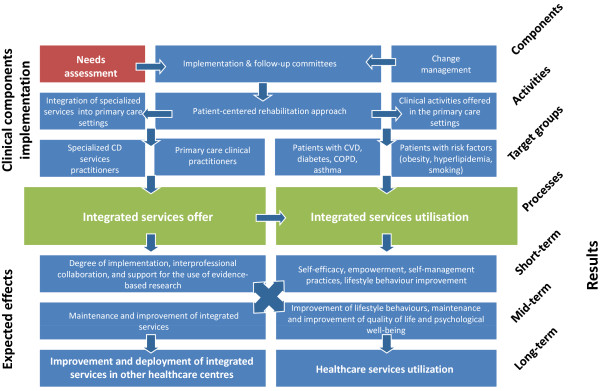
Background: The increasing number of patients with chronic diseases represents a challenge for health care systems. The Chronic Care Model suggests a multi-component remodelling of chronic disease services to improve patient outcomes. To meet the complex and ongoing needs of patients, chronic disease prevention and management (CDPM) has been advocated as a key feature of primary care producing better outcomes, greater effectiveness and improved access to services compared to other sectors. The objective of this study is to evaluate the adaptation and implementation of an intervention involving the integration of chronic disease prevention and management (CDPM) services into primary health care.
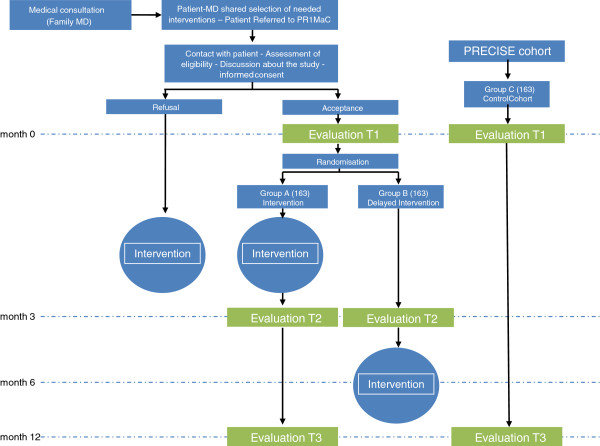
Methods/design: The implementation of the intervention will be evaluated using descriptive qualitative methods to collect data from various stakeholders (decision-makers, primary care professionals, CDPM professionals and patients) before, during and after the implementation. The evaluation of the effects will be based on a combination of experimental designs: a randomized trial using a delayed intervention arm (n = 326), a before-and-after design with repeated measures (n = 163), and a quasi-experimental design using a comparative cohort (n = 326). This evaluation will utilize self-report questionnaires measuring self-efficacy, empowerment, comorbidity, health behaviour, functional health status, quality of life, psychological well-being, patient characteristics and co-interventions. The study will take place in eight primary care practices of the Saguenay region of Quebec (Canada). To be included, patients will have to be referred by their primary care provider and present at least one of the following conditions (or their risk factors): diabetes, cardiovascular diseases, chronic obstructive pulmonary disease, asthma. Patients presenting serious cognitive problems will be excluded.
Discussion: In the short-term, improved patient self-efficacy and empowerment are expected. In the mid-term, we expect to observe an improvement in health behaviour, functional health status, quality of life and psychological well-being. At the organizational level, the project should lead to coordinated service delivery, improved patient follow-up mechanisms and enhanced interprofessional collaboration. Integration of CDPM services at the point of care in primary care practices is a promising innovation in care delivery that needs to be thoroughly evaluated.
Trial registration: ClinicalTrials.gov Identifier: NCT01319656.
Figures
References
-
- World Health Organization. World Health Statistics. 2008. [ http://www.who.int/whosis/whostat/2008/en/index.html]
-
- Mirolla M. The cost of chronic disease in Canada. [ http://www.gpiatlantic.org/pdf/health/chroniccanada.pdf]
-
- Primary Health Services Branch. The Saskatchewan Action Plan for Primary Health Care. Regina, Saskatchewan: Primary Health Services Branch; 2002.
-
- Kirby MJ, LeBreton M. The Health of Canadians - The Federal Role: Recommendations for Reform. Volume 6, Final Report: Recommendations for Reform. Ottawa: The Standing Senate Committee on Social Affairs, Science and Technology, Government of Canada; 2002.
Publication types
MeSH terms
Associated data
Grants and funding
LinkOut - more resources
Full Text Sources
Other Literature Sources
Medical
