


Stentless aortic valve replacement in the young patient: long-term results
- PMID: 23566631
- PMCID: PMC3639088
- DOI: 10.1186/1749-8090-8-68
Stentless aortic valve replacement in the young patient: long-term results
Abstract
Background: Stentless aortic valve replacement (SAVR) became a common surgical procedure to treat aortic valve disease, as it offers larger orifice area and improved hemodynamics. The aim of our single-centre retrospective study was to assess long term results of first generation stentless aortic valves in young patients, where mechanical prostheses are considered first line therapy.
Methods: From 1993 to 2001, 188 (149 male and 39 female) patients (≤60 years) underwent SAVR. Indications were in 63.3% stenosis or mixed lesions and in 36.7% isolated regurgitation. Mean age of patients at surgery was 53.1 ± 7.1 years. Associated procedures were performed in 60 patients (31.9%). Follow-up data were acquired through telephone interviews. Follow-up was 90.4% complete at a mean of 8.8 ± 4.7 years. Total follow-up was 1657.6 patient-years with a maximum of 17 years.
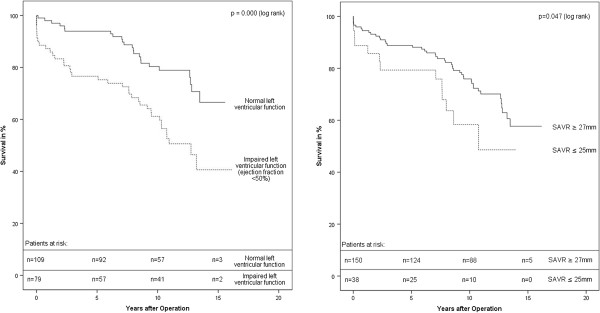
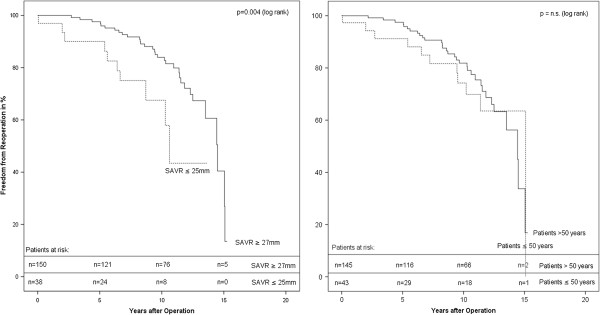
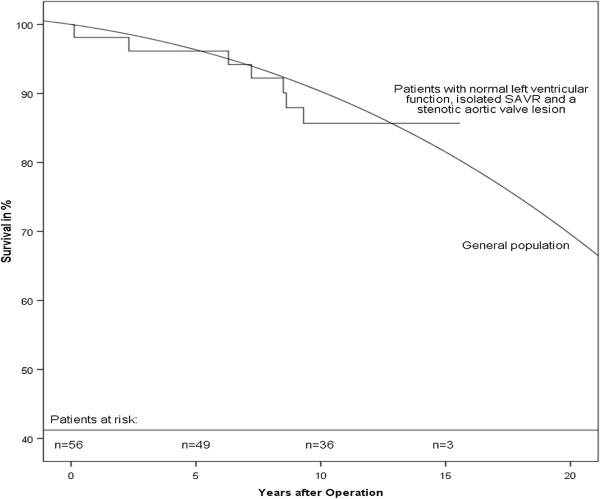
Results: Overall hospital mortality was 3.2% (2.5% for isolated SAVR). Overall actuarial survival-rate at 10/15 years and freedom from reoperation at 10/14 years were 73.0% ± 3.5%/ 55.8% ± 5.4% and 81.0% ± 3.4%/ 58.0% ± 7.5%, respectively. For isolated SAVR, actuarial survival at 10/15 years and freedom from reoperation at 10/14 years were 70.1% ± 4.4%/ 64.1% ± 4.8% and 83.1% ± 4.0%/ 52.9% ± 9.0%, respectively. Reoperation was performed in 42 patients (22.3%) due to structural valve deterioration and endocarditis. Age (≤50 years) and associated procedures did not significantly lower survival and freedom from reoperation, however, small prosthesis sizes (≤25 mm) did.
Conclusion: In patients aged 60 and younger, SAVR provides reliable long-term results especially for larger aortic valves.
Figures
References
Publication types
MeSH terms
LinkOut - more resources
Full Text Sources
Other Literature Sources
