. 2013 May;131(5):e1545-52.
doi: 10.1542/peds.2012-2585. Epub 2013 Apr 8.

Galactose-α-1,3-galactose and delayed anaphylaxis, angioedema, and urticaria in children

Affiliations

Galactose-α-1,3-galactose and delayed anaphylaxis, angioedema, and urticaria in children

Joshua L Kennedy et al. Pediatrics. 2013 May.

Abstract

Background and objective: Despite a thorough history and comprehensive testing, many children who present with recurrent symptoms consistent with allergic reactions elude diagnosis. Recent research has identified a novel cause for "idiopathic" allergic reactions; immunoglobulin E (IgE) antibody specific for the carbohydrate galactose-α-1,3-galactose (α-Gal) has been associated with delayed urticaria and anaphylaxis that occurs 3 to 6 hours after eating beef, pork, or lamb. We sought to determine whether IgE antibody to α-Gal was present in sera of pediatric patients who reported idiopathic anaphylaxis or urticaria.

Methods: Patients aged 4 to 17 were enrolled in an institutional review board-approved protocol at the University of Virginia and private practice allergy offices in Lynchburg, VA. Sera was obtained and analyzed by ImmunoCAP for total IgE and specific IgE to α-Gal, beef, pork, cat epithelium and dander, Fel d 1, dog dander, and milk.

Results: Forty-five pediatric patients were identified who had both clinical histories supporting delayed anaphylaxis or urticaria to mammalian meat and IgE antibody specific for α-Gal. In addition, most of these cases had a history of tick bites within the past year, which itched and persisted.

Conclusions: A novel form of anaphylaxis and urticaria that occurs 3 to 6 hours after eating mammalian meat is not uncommon among children in our area. Identification of these cases may not be straightforward and diagnosis is best confirmed by specific testing, which should certainly be considered for children living in the area where the Lone Star tick is common.

Keywords: delayed anaphylaxis; galactose-α-1,3-galactose; pediatric urticaria; α-Gal.


Figures

FIGURE 1
FIGURE 1
Specific IgE antibody binding to allergens in serum samples from 45 patients with IgE antibodies to α-Gal. The horizontal lines indicate geometric mean values. Numbers below the limit of detection indicate the number of negative values for each allergen. * Complete panel of immunoassays was performed for those sera positive for IgE antibody to α-Gal (n = 45). ** Cat allergen includes epithelium and dander. # The values for chicken, egg, peanut, and fish have significantly lower titers (P < .05) compared with α-Gal, beef, and pork by means of a Mann-Whitney analysis.
FIGURE 2
FIGURE 2
Correlations of IgE to α-Gal and specific allergens. A, Correlation of IgE antibody to pork and IgE antibody to beef (r = 0.99), suggesting that these tests are actually measuring the amount of specific IgE to α-Gal in the serum. B, Correlation of IgE antibody to α-Gal and beef (r = 0.89; P < .001) in patients with IgE antibody to α-Gal. C, Correlation of IgE antibody to α-Gal and pork (r = 0.87; P < .001) in patients with IgE antibody to α-Gal. D, Correlation of IgE antibody to α-Gal and total IgE (r = 0.18; P = not significant) in patients with IgE antibody to α-Gal.
FIGURE 3
FIGURE 3
Component analysis of milk-allergic children with α-Gal. Patients with α-Gal–specific IgE who were positive for specific IgE to milk (n = 34) were tested for milk components, including α-lactalbumin, β-lactoglobulin, and casein-specific IgE. Interestingly, there does not appear to be any reactivity to the milk components (α-lactalbumin, β-lactoglobulin, and casein), suggesting that there is no α-Gal in these immunoassays. Similar results are present for boiled milk and goat’s milk.
FIGURE 4
FIGURE 4
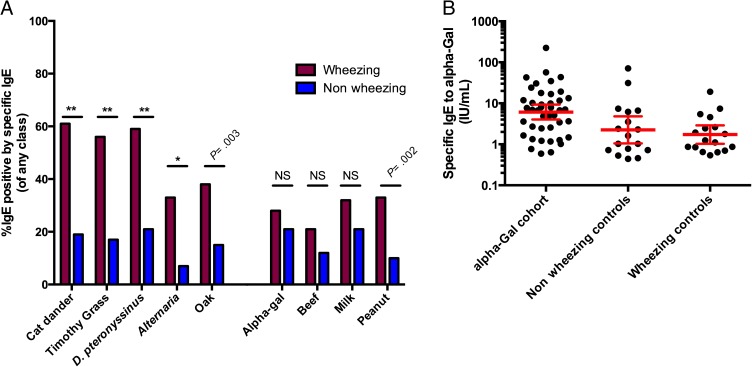
A, Percentage of children (aged 4–18) positive for specific IgE antibodies in wheezing (n = 61; red) and nonwheezing (n = 81; blue) control groups. There were significant differences between the wheezing and control population with regard to aeroallergen sensitization (**P < .001; *P = .001), whereas there were no differences in sensitization patterns to α-Gal, beef, or milk (P = .43, P = .15, and P = .21, respectively). B, Comparison of positive tests for α-Gal among an age-matched pediatric cohort with symptoms of delayed mammalian meat allergy (n = 45) and a cohort of wheezing (n = 17) and nonwheezing (n = 16) control subjects in the hospital. The pediatric cohort with symptoms of delayed mammalian meat allergy has significantly higher levels of specific IgE to α-Gal (P < .001). NS, not significant.

References

    1. Decker WW, Campbell RL, Manivannan V, et al. The etiology and incidence of anaphylaxis in Rochester, Minnesota: a report from the Rochester Epidemiology Project. J Allergy Clin Immunol. 2008;122(6):1161–1165 - PMC - PubMed
    1. May CD. Objective clinical and laboratory studies of immediate hypersensitivity reactions to foods in asthmatic children. J Allergy Clin Immunol. 1976;58(4):500–515 - PubMed
    1. Aalberse RC, Koshte V, Clemens JG. Immunoglobulin E antibodies that crossreact with vegetable foods, pollen, and Hymenoptera venom. J Allergy Clin Immunol. 1981;68(5):356–364 - PubMed
    1. Mari A. IgE to cross-reactive carbohydrate determinants: analysis of the distribution and appraisal of the in vivo and in vitro reactivity. Int Arch Allergy Immunol. 2002;129(4):286–295 - PubMed
    1. Commins SP, Platts-Mills TA. Allergenicity of carbohydrates and their role in anaphylactic events. Curr Allergy Asthma Rep. 2010;10(1):29–33 - PMC - PubMed

Publication types

MeSH terms