. 2013 Aug:61:111-22.
doi: 10.1016/j.yjmcc.2013.03.021. Epub 2013 Apr 6.

Role of late sodium current as a potential arrhythmogenic mechanism in the progression of pressure-induced heart disease

Affiliations

Role of late sodium current as a potential arrhythmogenic mechanism in the progression of pressure-induced heart disease

Karl Toischer et al. J Mol Cell Cardiol. 2013 Aug.

Abstract

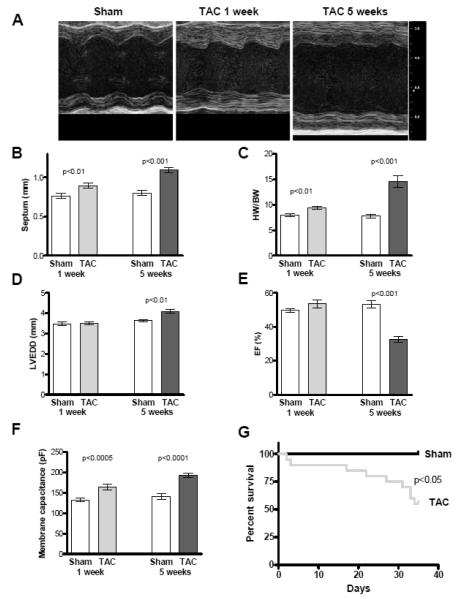
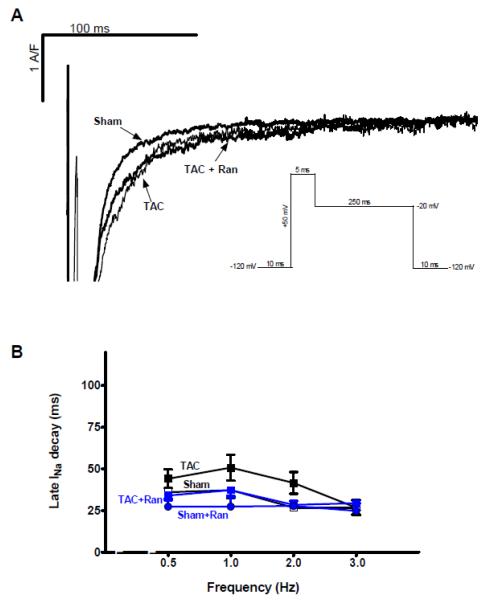
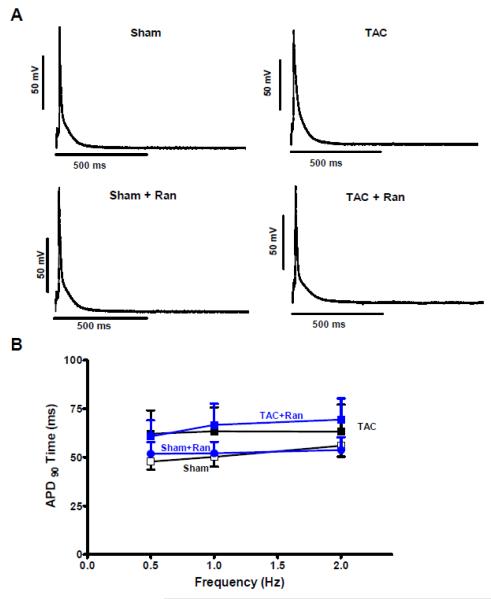
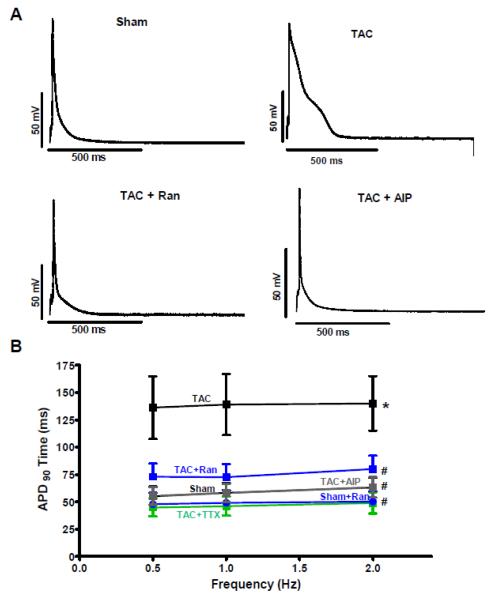
The aim of the study was to determine the characteristics of the late Na current (INaL) and its arrhythmogenic potential in the progression of pressure-induced heart disease. Transverse aortic constriction (TAC) was used to induce pressure overload in mice. After one week the hearts developed isolated hypertrophy with preserved systolic contractility. In patch-clamp experiments both, INaL and the action potential duration (APD90) were unchanged. In contrast, after five weeks animals developed heart failure with prolonged APDs and slowed INaL decay time which could be normalized by addition of the INaL inhibitor ranolazine (Ran) or by the Ca/calmodulin-dependent protein kinase II (CaMKII) inhibitor AIP. Accordingly the APD90 could be significantly abbreviated by Ran, tetrodotoxin and the CaMKII inhibitor AIP. Isoproterenol increased the number of delayed afterdepolarizations (DAD) in myocytes from failing but not sham hearts. Application of either Ran or AIP prevented the occurrence of DADs. Moreover, the incidence of triggered activity was significantly increased in TAC myocytes and was largely prevented by Ran and AIP. Western blot analyses indicate that increased CaMKII activity and a hyperphosphorylation of the Nav1.5 at the CaMKII phosphorylation site (Ser571) paralleled our functional observations five weeks after TAC surgery. In pressure overload-induced heart failure a CaMKII-dependent augmentation of INaL plays a crucial role in the AP prolongation and generation of cellular arrhythmogenic triggers, which cannot be found in early and still compensated hypertrophy. Inhibition of INaL and CaMKII exerts potent antiarrhythmic effects and might therefore be of potential therapeutic interest. This article is part of a Special Issue entitled "Na(+) Regulation in Cardiac Myocytes".

Keywords: Arrhythmias; CaMKII; Heart failure; Hypertrophy; I(NaL); Ranolazine.


Figures

Figure 1
Figure 1. Echocardiographic data
Cardiac phenotype characteristics. A Representative echocardiographic recordings of sham and TAC mice 1 and 5 weeks after intervention (1 week: sham n=6, TAC n=10, 5 weeks: sham n=10, TAC n=15). B Mean values of septum width. C Mean values of heart weight / body weight ratio (HW/BW). D Mean values of ejection fraction (EF). E Mean values of left ventricular end-diastolic diameter (LVEDD). F Mean values of membrane capacitances. G Kaplan-Meier survival curve of sham and TAC animals which does not include mortalility within the first 24 hrs post-TAC surgery.
Figure 2
Figure 2. Effects of TAC on late INa after one week
Measurements of INaL after one week of pressure overload. A Original recordings showing INaL in sham and TAC cells paced at 0.5 Hz in the presence of vehicle or ranolazine. B Mean values of INaL decay time in the corresponding groups (TAC 20, sham 14, TAC+Ran 7, sham+Ran 6 cells, no statistical differences between the groups using 2-way RM ANOVA).
Figure 3
Figure 3. Effects of TAC on late INa after 5 weeks
Measurements of INaL after five weeks of TAC surgery. A Original tracings showing recorded INaL in sham and TAC cells in the presence of either vehicle, Ran, TTX, and AIP (in TAC) paced at 0.5 Hz. B Mean values of INaL decay time in the corresponding groups. There was a statistical difference between INaL decay time of TAC vs. sham (n=26 vs.7), TAC vs. TAC+Ran (n=17), TAC vs. TAC+TTX (n=16), TAC vs. TAC+AIP (n=18) vs. TAC. *=p<0.05 vs. sham #=p<0.05 vs. TAC
Figure 4
Figure 4. Effects of TAC on action potentials after 1 week
Measurements of APs after one week of TAC intervention. A Original tracings showing recorded APs in sham and TAC cells in the presence of vehicle or Ran paced at 0.5 Hz. B Mean values of APD (90%) in the corresponding groups (TAC 7, sham 12, TAC+Ran 19, sham+Ran 15 cells, no statistical differences between the groups using 2-way RM ANOVA).
Figure 5
Figure 5. Effects of TAC on action potentials after 5 week
Measurements of APs in cells isolated from animals five weeks after TAC surgery. A Original tracings showing recorded action potentials in sham and TAC cells in the presence of vehicle, Ran, and AIP paced at 0.5 Hz. B Mean values of (APD90) in the corresponding groups. (TAC 15, sham 8, TAC+Ran 19, TAC+AIP 18, TAC+TTX 10 cells. *=p<0.05 vs. sham #=p<0.05 vs. TAC
Figure 6
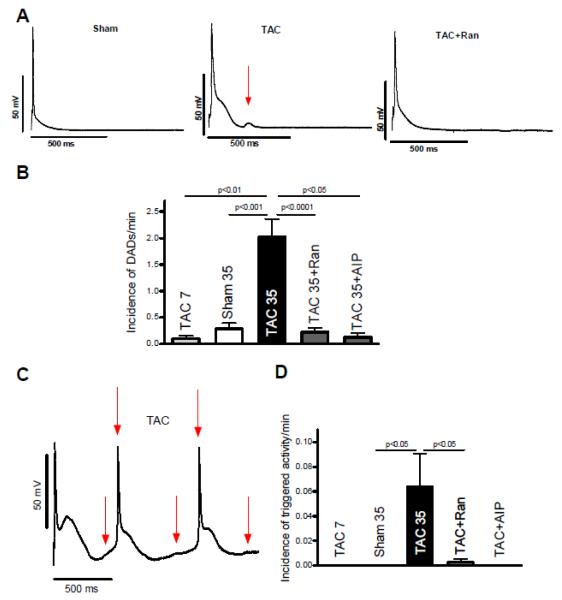
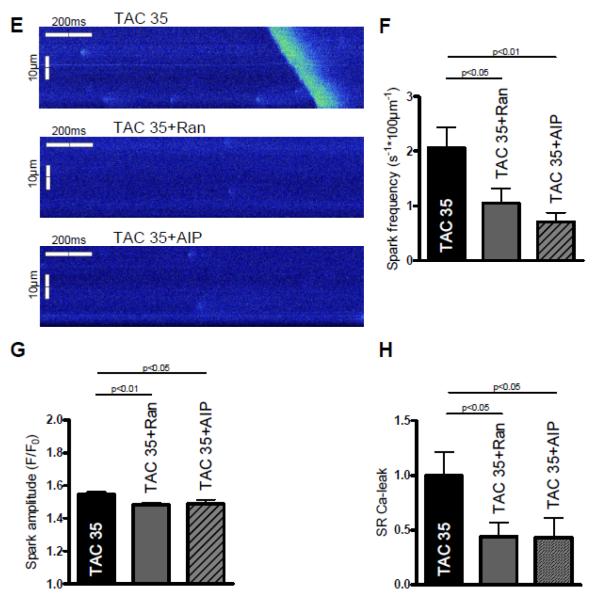
Figure 6. Arrhythmic triggers and SR Ca-leak
Measurements of APs five weeks after TAC surgery in the presence of 10−8 mol/L isoproterenol. A Original tracing of APs in the presence of isoproterenol. Red arrows indicate DADs. B Mean values of DAD-incidence in sham (n=15), TAC (n=20), Ran-treated (n=15) and AIP-treated TAC cells (n=5). C Original tracing of spontaneous APs in the presence of isoproterenol. Red arrows indicate triggered activity (unstimulated APs). D Mean values of triggered activity (meaning unstimulated APs). E Representative confocal line scans of cardiomyocytes under control conditions (above) as well as upon ranolazine (middle) and AIP-treatment (below) showing Ca-sparks and a diastolic Ca-wave (in control group). F Inhibition of INaL by ranolazine as well as CaMKII inhibition by AIP significantly decrease the frequency of diastolic Ca-sparks (n=30-38). G The amplitude of diastolic Ca-sparks is significantly reduced in the presence of ranolazine (n=80 vs. 128, control) as well as after CaMKII-inhibition with AIP (n=41). H The inhibitors yield a significant decrease of the resulting calculated SR Ca-leak (CaSpF − amplitude − duration − width, normalized to control group).
Figure 6
Figure 6. Arrhythmic triggers and SR Ca-leak
Measurements of APs five weeks after TAC surgery in the presence of 10−8 mol/L isoproterenol. A Original tracing of APs in the presence of isoproterenol. Red arrows indicate DADs. B Mean values of DAD-incidence in sham (n=15), TAC (n=20), Ran-treated (n=15) and AIP-treated TAC cells (n=5). C Original tracing of spontaneous APs in the presence of isoproterenol. Red arrows indicate triggered activity (unstimulated APs). D Mean values of triggered activity (meaning unstimulated APs). E Representative confocal line scans of cardiomyocytes under control conditions (above) as well as upon ranolazine (middle) and AIP-treatment (below) showing Ca-sparks and a diastolic Ca-wave (in control group). F Inhibition of INaL by ranolazine as well as CaMKII inhibition by AIP significantly decrease the frequency of diastolic Ca-sparks (n=30-38). G The amplitude of diastolic Ca-sparks is significantly reduced in the presence of ranolazine (n=80 vs. 128, control) as well as after CaMKII-inhibition with AIP (n=41). H The inhibitors yield a significant decrease of the resulting calculated SR Ca-leak (CaSpF − amplitude − duration − width, normalized to control group).
Figure 7
Figure 7
Protein analysis of CaMKIIδ and Na channel isoforms (n=6 per group and time point). A Exemplary western blots. B Mean values of Na channel isoform α1.1 normalised to GAPDH. C Mean values of Na channel isoform α1.5 normalised to GAPDH. D Mean values of Na channel isoform α1.6 normalised to GAPDH. E Mean values of beta1 subunit normalised to GAPDH. F Mean values of phosphorylated CaMKIIδ (at Thr-287) normalised to GAPDH. G Mean values of phosphorylated Nav1.5at Ser571 (CaMKII phosphorylation site) normalized to total Nav1.5.

References

    1. Bers DM. Excitation-Contraction Coupling and Cardiac Contractile Force. 2nd ed Kluwer Academic Publishers; Dordrecht, Netherlands: 2001.
    1. Wagner S, Dybkova N, Rasenack EC, Jacobshagen C, Fabritz L, Kirchhof P, et al. Ca2+/calmodulin-dependent protein kinase II regulates cardiac Na+ channels. J Clin Invest. 2006;116:3127–38. - PMC - PubMed
    1. Undrovinas NA, Maltsev VA, Belardinelli L, Sabbah HN, Undrovinas A. Late sodium current contributes to diastolic cell Ca2+ accumulation in chronic heart failure. J Physiol Sci. 2010;60:245–57. - PMC - PubMed
    1. Undrovinas AI, Maltsev VA, Sabbah HN. Repolarization abnormalities in cardiomyocytes of dogs with chronic heart failure: role of sustained inward current. Cell Mol Life Sci. 1999;55:494–505. - PMC - PubMed
    1. Sossalla S, Maurer U, Schotola H, Hartmann N, Didié M, Zimmermann W, et al. Diastolic dysfunction and arrhythmias caused by overexpression of CaMKIIδC can be reversed by inhibition of late Na+ current. Basic Res Cardiol. 2011;106:263–72. - PMC - PubMed

Publication types

MeSH terms