Review
. 2013 Jun;70(6):703-10.
doi: 10.1001/jamaneurol.2013.1443.

Understanding neurological disease mechanisms in the era of epigenetics

Affiliations
Review

Understanding neurological disease mechanisms in the era of epigenetics

Irfan A Qureshi et al. JAMA Neurol. 2013 Jun.

Abstract

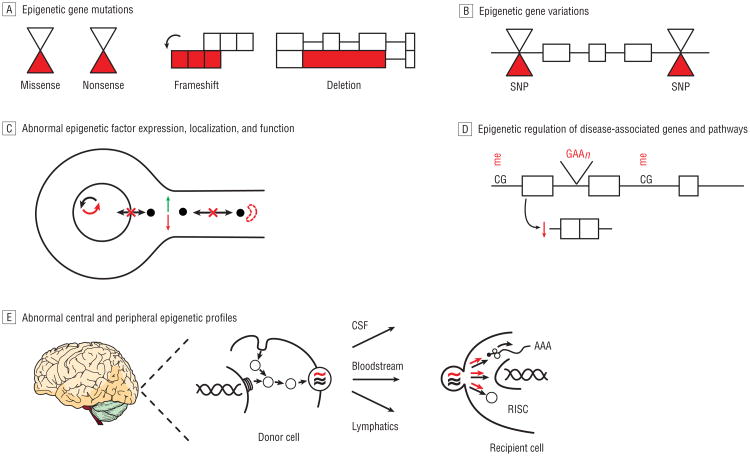
The burgeoning field of epigenetics is making a significant impact on our understanding of brain evolution, development, and function. In fact, it is now clear that epigenetic mechanisms promote seminal neurobiological processes, ranging from neural stem cell maintenance and differentiation to learning and memory. At the molecular level, epigenetic mechanisms regulate the structure and activity of the genome in response to intracellular and environmental cues, including the deployment of cell type-specific gene networks and those underlying synaptic plasticity. Pharmacological and genetic manipulation of epigenetic factors can, in turn, induce remarkable changes in neural cell identity and cognitive and behavioral phenotypes. Not surprisingly, it is also becoming apparent that epigenetics is intimately involved in neurological disease pathogenesis. Herein, we highlight emerging paradigms for linking epigenetic machinery and processes with neurological disease states, including how (1) mutations in genes encoding epigenetic factors cause disease, (2) genetic variation in genes encoding epigenetic factors modify disease risk, (3) abnormalities in epigenetic factor expression, localization, or function are involved in disease pathophysiology, (4) epigenetic mechanisms regulate disease-associated genomic loci, gene products, and cellular pathways, and (5) differential epigenetic profiles are present in patient-derived central and peripheral tissues.


Conflict of interest statement

Conflict of Interest Disclosures: None reported.

Figures

Figure 1
Figure 1
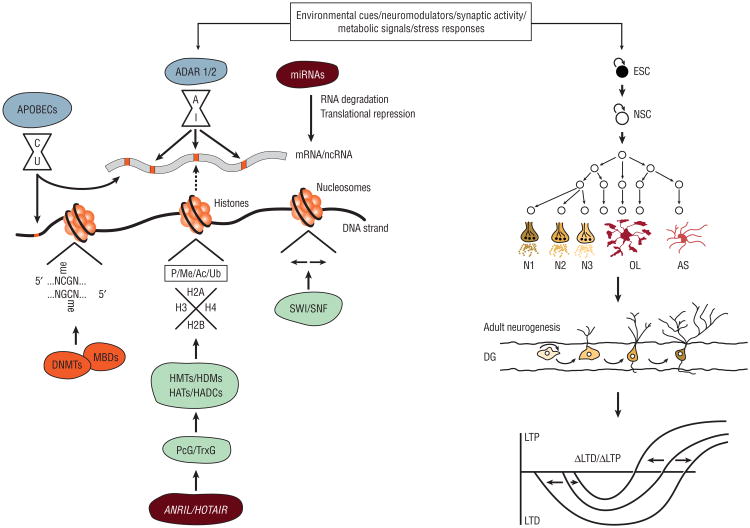
Environmental cues, neuromodulators, synaptic activity, metabolic signals, and stress responses lead to the activation of diverse epigenetic mechanisms, including DNA methylation, histone modifications and chromatin remodeling, noncoding RNA (ncRNA) expression, and RNA editing. In turn, these processes mediate embryonic stem cell (ESC) and neural stem cell (NSC) maintenance and maturation, adult neurogenesis, neural network formation, and synaptic plasticity. Ac indicates acetylation; ADAR, adenosine deaminases that act on RNA enzymes; APOBECs, apolipoprotein B editing catalytic subunit enzymes; AS, astrocyte; C, cytosine; DG, dentate gyrus; DNMTs, DNA methyltransferases; G, guanine; HATs, histone acetylases; HDACs, histone deacetylases; HDMs, histone demethylases; HMTs, histone methyltransferases; LTD, long-term depression; LTP, long-term potentiation; MBDs, methyl-CpG-binding domain proteins; me, methylation; miRNA, microRNA; mRNA, messenger RNA; N, any nucleotide; N1-3, neuronal subtypes 1-3; OL, oligodendrocyte; P, phosphorylation; PcG, Polycomb group proteins; TrxG, Trithorax group proteins; and Ub, ubiquitination.
Figure 2
Figure 2
Emerging paradigms linking epigenetic factors and mechanisms with diverse neurological disease processes. A indicates adenosine; C, cytosine; CSF, cerebrospinal fluid; G, guanine; me, methylation; RISC, RNA-induced silencing complex; and SNP, single-nucleotide polymorphism.

References

    1. Lander ES, Linton LM, Birren B, et al. International Human Genome Sequencing Consortium. Initial sequencing and analysis of the human genome. Nature. 2001;409(6822):860–921. published correction appears in Nature. 2001;411(6838):720. - PubMed
    1. Dunham I, Kundaje A, Aldred SF, et al. ENCODE Project Consortium. An integrated encyclopedia of DNA elements in the human genome. Nature. 2012;489(7414):57–74. - PMC - PubMed
    1. Thurman RE, Rynes E, Humbert R, et al. The accessible chromatin landscape of the human genome. Nature. 2012;489(7414):75–82. - PMC - PubMed
    1. Qureshi IA, Mehler MF. Emerging roles of non-coding RNAs in brain evolution, development, plasticity and disease. Nat Rev Neurosci. 2012;13(8):528–541. - PMC - PubMed
    1. Bond AM, Vangompel MJ, Sametsky EA, et al. Balanced gene regulation by an embryonic brain ncRNA is critical for adult hippocampal GABA circuitry. Nat Neurosci. 2009;12(8):1020–1027. - PMC - PubMed

Publication types