Review
. 2013 Jun;70(6):719-26.
doi: 10.1001/jamaneurol.2013.275.

An inflection point in gene discovery efforts for neurodegenerative diseases: from syndromic diagnoses toward endophenotypes and the epigenome

Affiliations
Review

An inflection point in gene discovery efforts for neurodegenerative diseases: from syndromic diagnoses toward endophenotypes and the epigenome

Philip L De Jager et al. JAMA Neurol. 2013 Jun.

Abstract

We are at an inflection point in our study of the human genome as it relates to neurodegenerative disease. The sequencing of the human genome, and its associated cataloging of human genetic variation and technological as well as methodological development, introduced a period of rapid gene discovery over the past decade. These efforts have yielded many new insights and will continue to uncover the genetic architecture of syndromically defined neurodegenerative diseases in the coming decades. More recently, these successful study designs have been applied to the investigation of intermediate traits that relate to and inform our understanding of clinical syndromes and to exploration of the epigenome, the higher-order structure of DNA that dictates the expression of a given genetic risk factor. While still nascent, given the challenges of accumulating large numbers of subjects with detailed phenotypes and technological hurdles in characterizing the state of chromatin, these efforts represent key investments that will enable the study of the functional consequences of a genetic risk factor and, eventually, its contribution to the clinical manifestations of a given disease. As a community of investigators, we are therefore at an exciting inflection point at which gene discovery efforts are transitioning toward the functional characterization of implicated genetic variation; this transition is crucial for understanding the molecular, cellular, and systemic events that lead to a syndromic diagnosis for a neurodegenerative disease.


Figures
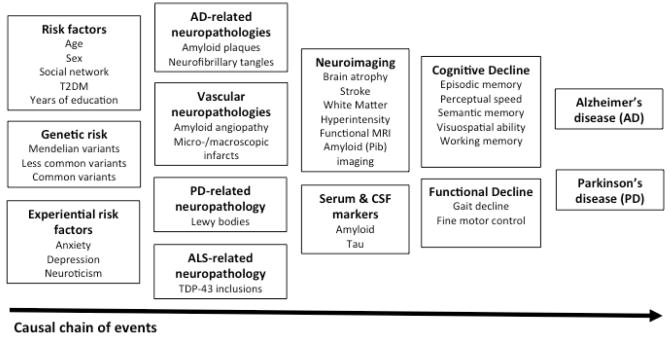
Figure 1
Figure 1. A causal chain linking risk factors to the syndromic phenotypes of AD and PD
Risk factors are presented in the left of the figure, and their functional consequences progress along the horizontal axis, culminating in the clinical expression of symptoms that meet syndromic definitions for these two neurodegenerative diseases. (Adapted from an original model devised by D. Bennett of Rush University, Chicago IL)
Figure 2
Figure 2
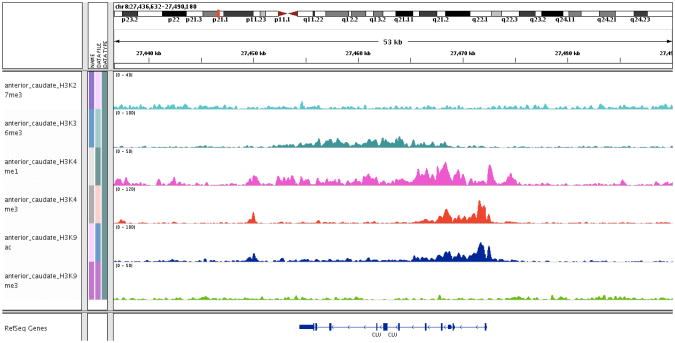
Representative chromatin data generated from frozen, post-mortem anterior caudate using chromatin immunoprecipitation with high-throughput sequencing for 6 chromatin marks (left column). The x-axis is the physical position along chromosome 8, which is detailed at the top of the figure; the clusterin(CLU) locus was selected for visualization. The distribution of the CLU exons is shown at the bottom of the figure. Each chromatin mark is shown in a horizontal track and has its own distribution over the region selected for viewing; some marks, such as H3K9Ac (acetylation of the 9th Lysine of histone H3) and H3K4Me3 (trimethylation of the 4th Lysine of histone H3), have very similar but not identical distributions. Peaks in each track identify positions where the chromatin mark of interest is enriched. Each mark is associated with different functional features, such as a peak of H3K9Ac at the promoter of actively transcribed genes.

References

    1. International HapMap, C. The International HapMap Project. Nature. 2003;426:789–796. doi: 10.1038/nature02168. - DOI - PubMed
    1. Genomes Project, C et al. An integrated map of genetic variation from 1,092 human genomes. Nature. 2012;491:56–65. doi: 10.1038/nature11632. - DOI - PMC - PubMed
    1. Bertram L, Lill CM, Tanzi RE. The genetics of Alzheimer disease: back to the future. Neuron. 2010;68:270–281. doi: 10.1016/j.neuron.2010.10.013. - DOI - PubMed
    1. Lesage S, Brice A. Parkinson's disease: from monogenic forms to genetic susceptibility factors. Human molecular genetics. 2009;18:R48–59. doi: 10.1093/hmg/ddp012. - DOI - PubMed
    1. Pasinelli P, Brown RH. Molecular biology of amyotrophic lateral sclerosis: insights from genetics. Nature reviews Neuroscience. 2006;7:710–723. doi: 10.1038/nrn1971. - DOI - PubMed