


Adverse events of acupuncture: a systematic review of case reports
- PMID: 23573135
- PMCID: PMC3616356
- DOI: 10.1155/2013/581203
Adverse events of acupuncture: a systematic review of case reports
Abstract
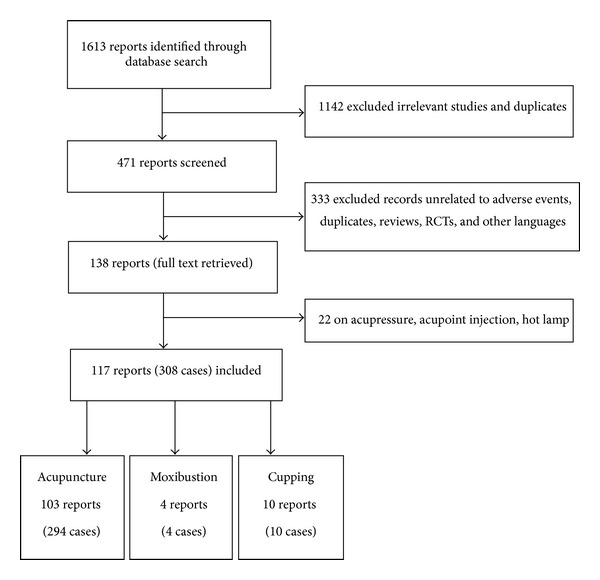
Acupuncture, moxibustion, and cupping, important in traditional Eastern medicine, are increasingly used in the West. Their widening acceptance demands continual safety assessment. This review, a sequel to one our team published 10 years ago, is an evaluation of the frequency and severity of adverse events (AEs) reported for acupuncture, moxibustion, and cupping between 2000 and 2011. Relevant English-language reports in six databases were identified and assessed by two reviewers. During this 12-year period, 117 reports of 308 AEs from 25 countries and regions were associated with acupuncture (294 cases), moxibustion (4 cases), or cupping (10 cases). Country of occurrence, patient's sex and age, and outcome were extracted. Infections, mycobacterial, staphylococcal, and others, were the main complication of acupuncture. In the previous review, we found the main source of infection to be hepatitis, caused by reusable needles. In this review, we found the majority of infections to be bacterial, caused by skin contact at acupoint sites; we found no cases of hepatitis. Although the route of infection had changed, infections were still the major complication of acupuncture. Clearly, guidelines such as Clean Needle Technique must be followed in order to minimize acupuncture AEs.
Figures
References
-
- Cheng X. Chinese Acupuncture and Moxibustion. 3rd edition. Beijing, China: Foreign Languages Press; 2010.
-
- Barnes PM, Bloom B, Nahin RL. Complementary and alternative medicine use among adults and children: United States, 2007. National Health Statistics Reports. 2009;(12):1–23. - PubMed
-
- Melchart D, Weidenhammer W, Streng A, et al. Prospective investigation of adverse effects of acupuncture in 97733 Patients. Archives of Internal Medicine. 2004;164(1):104–105. - PubMed
-
- Lao L, Hamilton GR, Fu J, Berman BM. Is acupuncture safe? A systematic review of case reports. Alternative Therapies in Health and Medicine. 2003;9(1):72–83. - PubMed
Grants and funding
LinkOut - more resources
Full Text Sources
Other Literature Sources
Medical
