


Characterization of SNPs associated with prostate cancer in men of Ashkenazic descent from the set of GWAS identified SNPs: impact of cancer family history and cumulative SNP risk prediction
- PMID: 23573233
- PMCID: PMC3616024
- DOI: 10.1371/journal.pone.0060083
Characterization of SNPs associated with prostate cancer in men of Ashkenazic descent from the set of GWAS identified SNPs: impact of cancer family history and cumulative SNP risk prediction
Abstract
Background: Genome-wide association studies (GWAS) have identified multiple SNPs associated with prostate cancer (PrCa). Population isolates may have different sets of risk alleles for PrCa constituting unique population and individual risk profiles.
Methods: To test this hypothesis, associations between 31 GWAS SNPs of PrCa were examined among 979 PrCa cases and 1,251 controls of Ashkenazic descent using logistic regression. We also investigated risks by age at diagnosis, pathological features of PrCa, and family history of cancer. Moreover, we examined associations between cumulative number of risk alleles and PrCa and assessed the utility of risk alleles in PrCa risk prediction by comparing the area under the curve (AUC) for different logistic models.
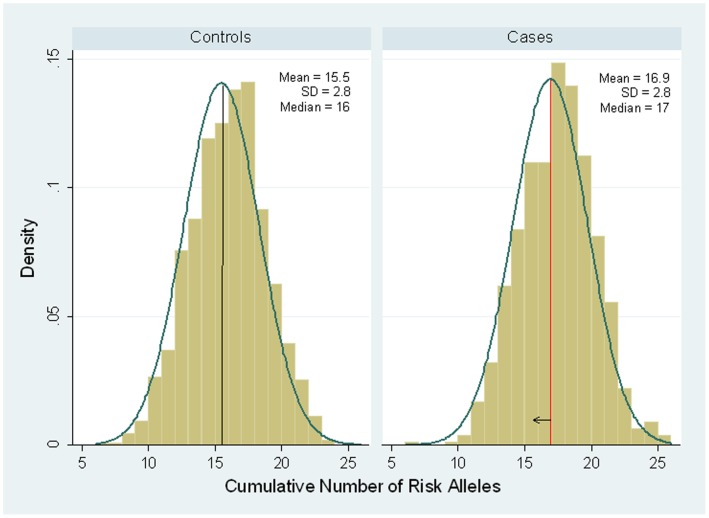
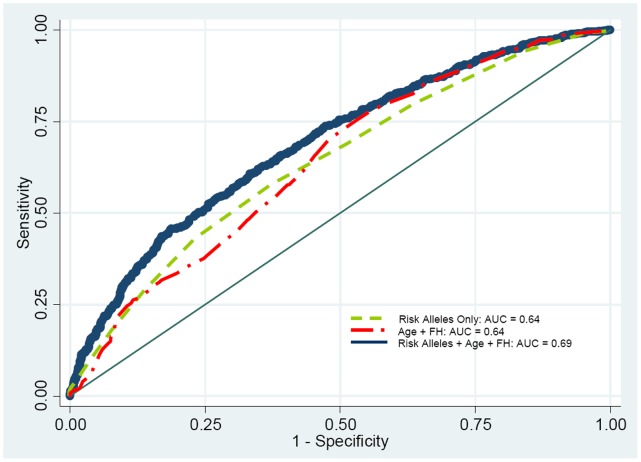
Results: Of the 31 genotyped SNPs, 8 were associated with PrCa at p ≤ 0.002 (corrected p-value threshold) with odds ratios (ORs) ranging from 1.22 to 1.42 per risk allele. Four SNPs were associated with aggressive PrCa, while three other SNPs showed potential interactions for PrCa by family history of PrCa (rs8102476; 19q13), lung cancer (rs17021918; 4q22), and breast cancer (rs10896449; 11q13). Men in the highest vs. lowest quartile of cumulative number of risk alleles had ORs of 3.70 (95% CI 2.76-4.97); 3.76 (95% CI 2.57-5.50), and 5.20 (95% CI 2.94-9.19) for overall PrCa, aggressive cancer and younger age at diagnosis, respectively. The addition of cumulative risk alleles to the model containing age at diagnosis and family history of PrCa yielded a slightly higher AUC (0.69 vs. 0.64).
Conclusion: These data define a set of risk alleles associated with PrCa in men of Ashkenazic descent and indicate possible genetic differences for PrCa between populations of European and Ashkenazic ancestry. Use of genetic markers might provide an opportunity to identify men at highest risk for younger age of onset PrCa; however, their clinical utility in identifying men at highest risk for aggressive cancer remains limited.
Conflict of interest statement
Figures
References
-
- American Cancer Society (2012) Cancer Facts and Figures. Atlanta Georgia.
-
- Jemal A, Bray F (2011) Center MM, Ferlay J, Ward E, et al (2011) Global cancer statistics. CA Cancer J Clin 61: 69–90. - PubMed
-
- Lichtenstein P, Holm NV, Verkasalo PK, Iliadou A, Kaprio J, et al. (2000) Environmental and heritable factors in the causation of cancer–analyses of cohorts of twins from Sweden, Denmark, and Finland. N Engl J Med 343: 78–85. - PubMed
-
- Bruner DW, Moore D, Parlanti A, Dorgan J, Engstrom P (2003) Relative risk of prostate cancer for men with affected relatives: Systematic review and meta-analysis. Int J Cancer 107: 797–803. - PubMed
Publication types
MeSH terms
Grants and funding
LinkOut - more resources
Full Text Sources
Other Literature Sources
Medical
