. 2013 Jun;18(6):450-8.
doi: 10.1111/gtc.12050. Epub 2013 Apr 11.

Efficient identification of TALEN-mediated genome modifications using heteroduplex mobility assays

Affiliations

Efficient identification of TALEN-mediated genome modifications using heteroduplex mobility assays

Satoshi Ota et al. Genes Cells. 2013 Jun.

Abstract

The heteroduplex mobility assay (HMA) is widely used to characterize strain variants of human viruses. To determine whether it can detect small sequence differences in homologous templates, we constructed a series of deletion constructs (1-10 bp deletions) in the multiple cloning site (MCS) of pBluescript II. After PCR amplification of the MCS using a mixture of wild-type and one of the deletion constructs, the resulting PCR amplicons were electrophoresed using 15% polyacrylamide gels. Two types of heteroduplexes exhibited retarded electrophoretic migration compared with individual homoduplexes. Therefore, we applied this HMA to detect transcription activator-like effector nucleases (TALEN)-induced insertion and/or deletion (indel) mutations at an endogenous locus. We found that TALEN in vivo activity was easily estimated by the degree of multiple HMA profiles derived from TALEN-injected F0 embryos. Furthermore, TALEN-injected F0 founder fish produced several unique HMA profiles in F1 embryos. Sequence analysis confirmed that the different HMA profiles contained distinct indel mutations. Thus, HMA is a rapid and sensitive analytical method for the detection of the TALEN-mediated genome modifications.


Figures

Figure 1
Figure 1
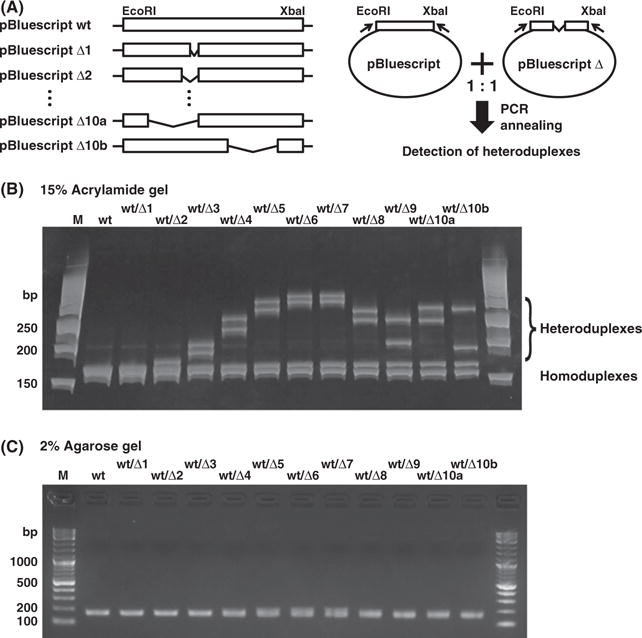
Heteroduplex mobility assay detection of small sequence differences in pBluescript-derived constructs. (A) Schematic representation of the pBluescript-derived constructs (left) and HMA (right). A series of the pBluescript deletion constructs (1–10 bp nucleotide deletions) was generated between EcoRI and XbaI sites. HMA was used to detect heteroduplexes. The MCS was amplified from a mixture of pBluescript wild type (wt) and a pBluescript Δ (delta: Δ1–Δ10b) by PCR. Both pBluescript Δ10a and Δ10b have 10-bp deletion in different region. (B) PCR amplicons for the MCS of the pBluescript-derived constructs were analyzed by electrophoresis on a 15% polyacrylamide gel. PCR amplicons from the mixtures were separated into homoduplexes (lower bands) and heteroduplexes (upper bands). Distinct HMA profiles can be seen for all mixtures except for pBluescript wt and wt/Δ1. (C) A single sharp or broad band was observed in all PCR amplicons in a 2% agarose gel. PCR products were visualized by staining with ethidium bromide. (HMA, heteroduplex mobility assay; M, DNA molecular weight marker; MCS, multiple cloning site).
Figure 2
Figure 2
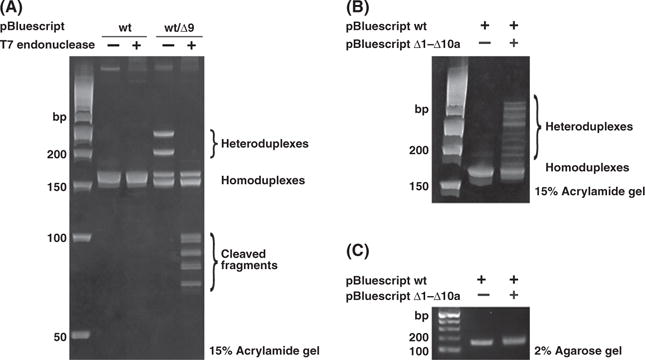
Selective cleavages of heteroduplexes by T7 endonuclease. (A) PCR amplicons from pBluescript wt and pBluescript wt/Δ9 were treated with T7 endonuclease. The two heteroduplex bands (slow mobility) in pBluescript wt/Δ9 sample were selectively cleaved, whereas no homoduplex bands were. (B) HMA of a mixture of pBluescript-derived constructs (wild type and Δ1–Δ10a) in a 15% polyacrylamide gel. PCR products from the mixtures showed multiple HMA profiles. (C) Single broad band was observed in a 2% agarose gel electrophoresis. (HMA, heteroduplex mobility assay).
Figure 3
Figure 3
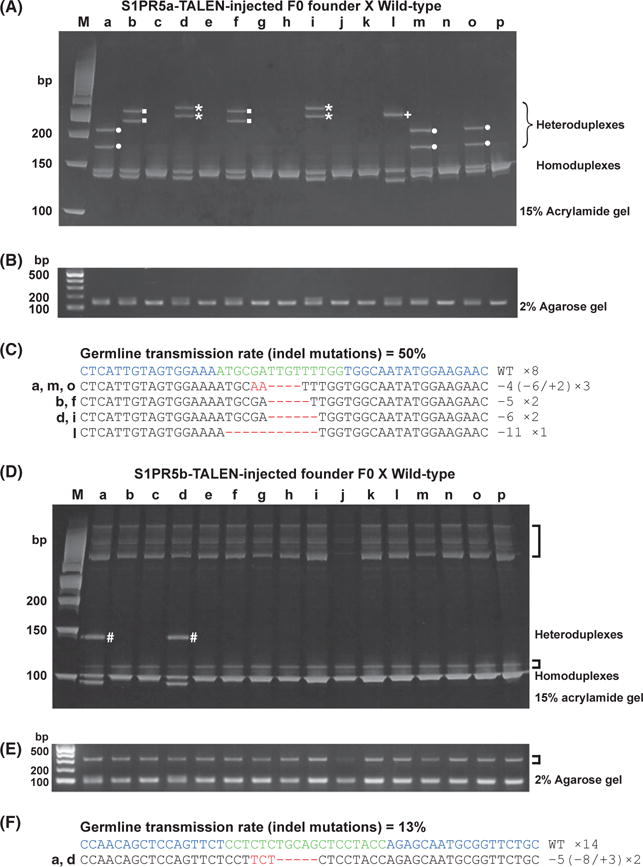
Application of HMA for detecting TALEN-mediated genome modifications in zebrafish. (A) TALENs were injected into zebrafish embryos, and genomic DNA was isolated from TALEN-injected embryos at 1 dpf. TALEN in vivo activity for an endogenous locus was estimated by HMA profiles of the PCR amplicons. Potential founders were mated with wild-type fish (WT). F1 fish with indel mutant alleles was identified by HMA. (B) TALEN target regions were amplified from the genomic DNA of uninjected and the TALEN-injected embryos (S1PR1, S1PR5a and S1PR5b). PCR amplicons derived from the TALEN-injected embryos provided multiple heteroduplex bands. (C) The intensity of PCR amplicons from TALEN-injected embryos was weaker than those of uninjected embryos on a 2% agarose gel. (D) PCR amplicons were subcloned into a pGEM-T Easy vector, and individual inserts were randomly sequenced. Deleted and inserted nucleotides in the DNA sequences are indicated by red dashes and red letters, respectively. The wild-type sequence is shown at the top. The number of nucleotides deleted (−) and inserted (+) is indicated to the right with the detection number. Blue: TALEN target sequences. Green: spacer sequences. (HMA, heteroduplex mobility assay; TALEN, transcription activator-like effector nucleases).
Figure 4
Figure 4
Detection of S1PR5a and S1PR5b mutant alleles by HMA in F1 embryos. (A–C) S1PR5a mutant alleles. (D–F) S1PR5b mutant alleles. (A, D) PCR amplicons from individual F1 genomic DNAs were electrophoresed on a 15% polyacrylamide gel. For S1PR5a, four distinct HMA profiles were detected (●, ■, ⋆, +); for S1PR5b, only one unique HMA profile was detected (#). (B, E) Band patterns of PCR fragments from S1PR5a (B) and S1PR5b (E) target regions were similar in all lanes of a 2% agarose gel. Nonspecific bands amplified by S1PR5b primer sets were observed in all samples (brackets). (C, F) PCR amplicons were subcloned into a pGEM-T Easy vector, and inserts from individual F1 embryos were sequenced. Deleted and inserted nucleotides in the DNA sequences are indicated by red dashes and red letters, respectively. The wild-type sequence is shown at the top. The number of nucleotides deleted (−) and inserted (+) is indicated to the right with the detection number. The germ-line transmission rate is indicated at the top. Blue: TALEN target sequences. Green: spacer sequences. (HMA, heteroduplex mobility assay; TALEN, transcription activator-like effector nucleases).
Figure 5
Figure 5
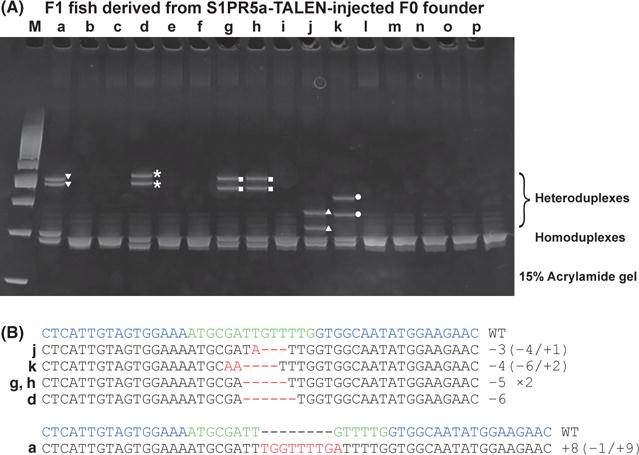
Genotyping of S1PR5a mutant alleles by HMA from fin clips of F1 fish. (A) Genomic DNA was prepared from the fin clips of individual F1 fish. PCR amplicons from individual F1 genomic DNA were electrophoresed on a 15% polyacrylamide gel. Five HMA profiles were detected (▼,⋆, ■, ▲ and ●). (B) Deleted and inserted nucleotides of DNA sequences are indicated by red dashes and red letters, respectively. The wild-type sequence is shown at the top. The number of nucleotides deleted (−) and inserted (+) is indicated to the right with the detection number. Blue: TALEN target sequences. Green: spacer sequences. (HMA, heteroduplex mobility assay; TALEN, transcription activator-like effector nucleases).

References

    1. Bogdanove AJ, Voytas DF. TAL effectors: customizable proteins for DNA targeting. Science. 2011;333:1843–1846. - PubMed
    1. Carroll D. Genome engineering with zinc-finger nucleases. Genetics. 2011;188:773–782. - PMC - PubMed
    1. Cermak T, Doyle EL, Christian M, Wang L, Zhang Y, Schmidt C, Baller JA, Somia NV, Bogdanove AJ, Voytas DF. Efficient design and assembly of custom TALEN and other TAL effector-based constructs for DNA targeting. Nucleic Acids Res. 2011;39:e82. - PMC - PubMed
    1. Chen J, Zhang X, Wang T, Li Z, Guan G, Hong Y. Efficient detection, quantification and enrichment of subtle allelic alterations. DNA Res. 2012;19:423–433. - PMC - PubMed
    1. Dahlem TJ, Hoshijima K, Jurynec MJ, Gunther D, Starker CG, Locke AS, Weis AM, Voytas DF, Grunwald DJ. Simple methods for generating and detecting locus-specific mutations induced with TALENs in the zebrafish genome. PLoS Genet. 2012;8:e1002861. - PMC - PubMed

Publication types

Substances