


Review
doi: 10.4155/fmc.13.17.
Hypoxia inducible factor pathway inhibitors as anticancer therapeutics
Affiliations
- PMID: 23573973
- PMCID: PMC3871878
- DOI: 10.4155/fmc.13.17
Item in Clipboard
Review
Hypoxia inducible factor pathway inhibitors as anticancer therapeutics
Future Med Chem.
2013 Apr.
Abstract
Hypoxia is a significant feature of solid tumor cancers. Hypoxia leads to a more malignant phenotype that is resistant to chemotherapy and radiation, is more invasive and has greater metastatic potential. Hypoxia activates the hypoxia inducible factor (HIF) pathway, which mediates the biological effects of hypoxia in tissues. The HIF complex acts as a transcription factor for many genes that increase tumor survival and proliferation. To date, many HIF pathway inhibitors indirectly affect HIF but there have been no clinically approved direct HIF inhibitors. This can be attributed to the complexity of the HIF pathway, as well as to the challenges of inhibiting protein-protein interactions.
Figures
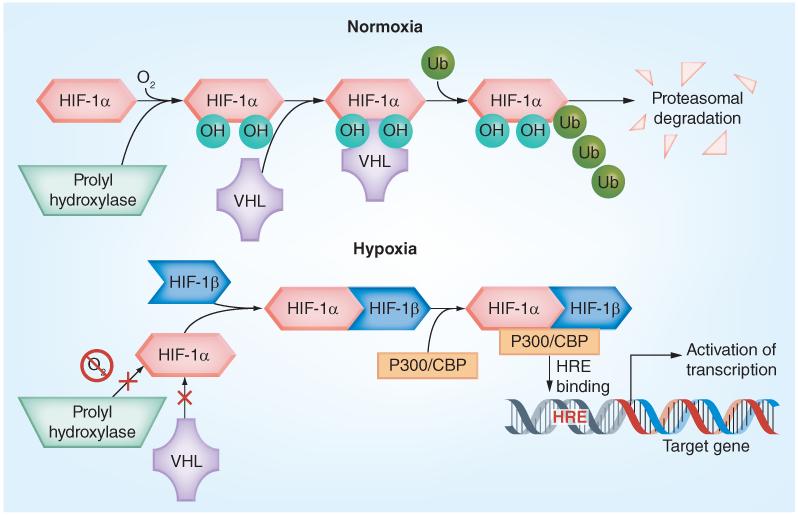
Under normoxic conditions, HIF-1α is rapidly hydroxylated by prolyl hydroxylases, which mediates binding by the VHL ubiquitin ligase complex, addition of poly-Ub which tags it for proteosomal degradation. Under hypoxic conditions, prolyl hydroxylases cannot hydroxylate HIF-1α, preventing VHL binding which leads to HIF-1α stabilization. HIF-1α then heterodimerizes with HIF-1β, recruits the p3oo/CBP co-factors and forms an active HIF transcription complex in the nucleus that binds to HREs on target genes and activates their transcription. HIF: Hypoxia inducible factor; HRE: Hypoxia response element; Ub: Ubiquitin chains; VHL: von Hippel-Lindau tumor suppressor protein.
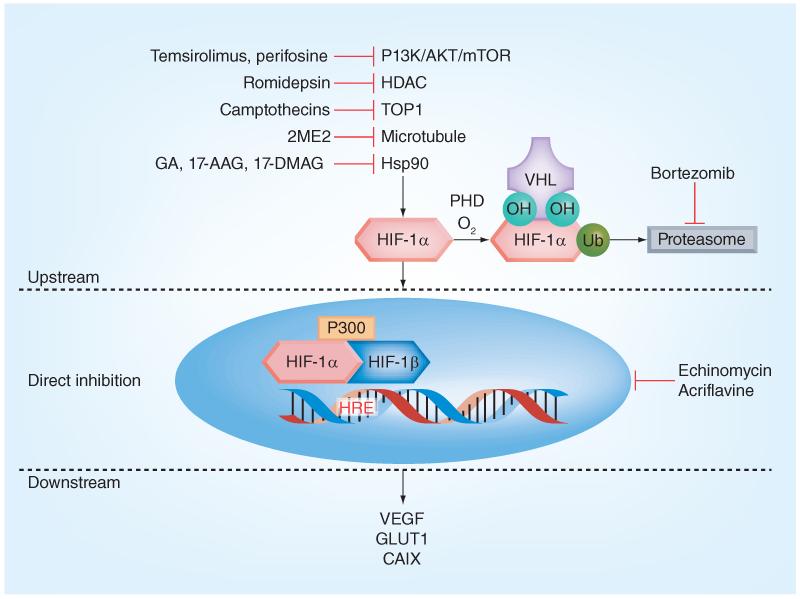
HIF: Hypoxia inducible factor; HRE: Hypoxia response element; PHD: Prolyl hydroxylases; Ub: Ubiquitin chains; VHL: von Hippel-Lindau tumor suppressor protein.
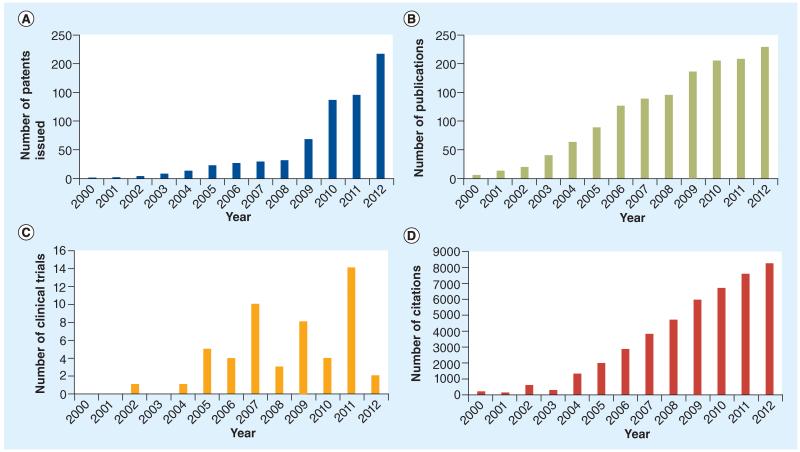
(A) Number of patent issued by year. (B) Number of publications by year. (C) Number of clinical trials by year. (D) Number of citations by year. Data taken from [308-310].
Similar articles
-
Recent advances in hypoxia-inducible factor (HIF)-1 inhibitors.Eur J Med Chem. 2012 Mar;49:24-40. doi: 10.1016/j.ejmech.2012.01.033. Epub 2012 Jan 24. Eur J Med Chem. 2012. PMID: 22305612 Review.
-
Hypoxia-inducible factors: mediators of cancer progression and targets for cancer therapy.Trends Pharmacol Sci. 2012 Apr;33(4):207-14. doi: 10.1016/j.tips.2012.01.005. Epub 2012 Mar 6. Trends Pharmacol Sci. 2012. PMID: 22398146 Free PMC article. Review.
-
Cancer therapy by targeting hypoxia-inducible factor-1.Curr Cancer Drug Targets. 2010 Nov;10(7):782-96. doi: 10.2174/156800910793605857. Curr Cancer Drug Targets. 2010. PMID: 20578983 Review.
-
The transcriptional factors HIF-1 and HIF-2 and their novel inhibitors in cancer therapy.Expert Opin Drug Discov. 2019 Jul;14(7):667-682. doi: 10.1080/17460441.2019.1613370. Epub 2019 May 9. Expert Opin Drug Discov. 2019. PMID: 31070059 Free PMC article. Review.
-
Cancer therapeutic agents targeting hypoxia-inducible factor-1.Curr Med Chem. 2011;18(21):3168-89. doi: 10.2174/092986711796391606. Curr Med Chem. 2011. PMID: 21671859 Review.
Cited by
-
Shooting at Moving and Hidden Targets-Tumour Cell Plasticity and the Notch Signalling Pathway in Head and Neck Squamous Cell Carcinomas.Cancers (Basel). 2021 Dec 10;13(24):6219. doi: 10.3390/cancers13246219. Cancers (Basel). 2021. PMID: 34944837 Free PMC article. Review.
-
Novel cancer treatment paradigm targeting hypoxia-induced factor in conjunction with current therapies to overcome resistance.J Exp Clin Cancer Res. 2023 Jul 18;42(1):171. doi: 10.1186/s13046-023-02724-y. J Exp Clin Cancer Res. 2023. PMID: 37460927 Free PMC article. Review.
-
Anti-growth and pro-apoptotic effects of dasatinib on human oral cancer cells through multi-targeted mechanisms.J Cell Mol Med. 2021 Sep;25(17):8300-8311. doi: 10.1111/jcmm.16782. Epub 2021 Jul 28. J Cell Mol Med. 2021. PMID: 34318593 Free PMC article.
-
Discovery of novel direct small-molecule inhibitors targeting HIF-2α using structure-based virtual screening, molecular dynamics simulation, and MM-GBSA calculations.Mol Divers. 2024 Jun;28(3):1203-1224. doi: 10.1007/s11030-023-10650-6. Epub 2023 Apr 29. Mol Divers. 2024. PMID: 37120484
-
Immunotherapy: Newer Therapeutic Armamentarium against Cancer Stem Cells.J Oncol. 2020 Mar 9;2020:3963561. doi: 10.1155/2020/3963561. eCollection 2020. J Oncol. 2020. PMID: 32211043 Free PMC article. Review.
References
-
- Vaupel P, Mayer A. Hypoxia in cancer: significance and impact on clinical outcome. Cancer Metastasis Rev. 2007;26(2):225–239. - PubMed
-
- Cairns RA, Kalliomaki T, Hill RP. Acute (cyclic) hypoxia enhances spontaneous metastasis of KHT murine tumors. Cancer Res. 2001;61(24):8903–8908. - PubMed
-
- Belozerov VE, Van Meir EG. Inhibition of hypoxia-inducible factor-1 signaling. Curr. Opin. Investig. Drugs. 2006;7(12):1067–1076. - PubMed
-
- Wilson W, Hay M. Targeting hypoxia in cancer therapy. Nat. Rev. Cancer. 2011;11(6):393–410. - PubMed
Websites
-
- American Cancer Society [Accessed 11 April 2012];Cancer facts and figures 2011. www.cancer.org/Research/CancerFactsFigures/CancerFactsFigures/cancer-fac....
-
- World Cancer Research Fund International [Accessed 1 April 2012];General world cancer statistics: GLOBOCAN 2008 database. www.wcrf.org/cancer_statistics/world_cancer_statistics.php.
-
- [Accessed 30 April 2012];US FDA approves topotecan hydrochloride (hycamtin) in combination with cisplatin for the treatment of Stage IVB recurrent or persistent carcinoma of the cervix. www.fda.gov/AboutFDA/CentersOffices/OfficeofMedicalProductsandTobacco/CD....
-
- [Accessed 4 May 2012];GlaxoSmith Kline receives approval for hycamtin (topotecan) capsules for the treatment of relapsed small cell lung cancer. www.drugs.com/newdrugs/gsk-receives-approval-hycamtin-topotecan-capsules....
-
- National Cancer Institute [Accessed 1 June 2011];Romidepsin. www.cancer.gov/cancertopics/druginfo/romidepsin.
Publication types
MeSH terms
Substances
Grants and funding
LinkOut - more resources
Full Text Sources
Other Literature Sources
