


Development of quality of care indicators from systematic reviews: the case of hospital delivery
- PMID: 23574918
- PMCID: PMC3626798
- DOI: 10.1186/1748-5908-8-42
Development of quality of care indicators from systematic reviews: the case of hospital delivery
Abstract
Background: The objective of this research is to generate quality of care indicators from systematic reviews to assess the appropriateness of obstetric care in hospitals.
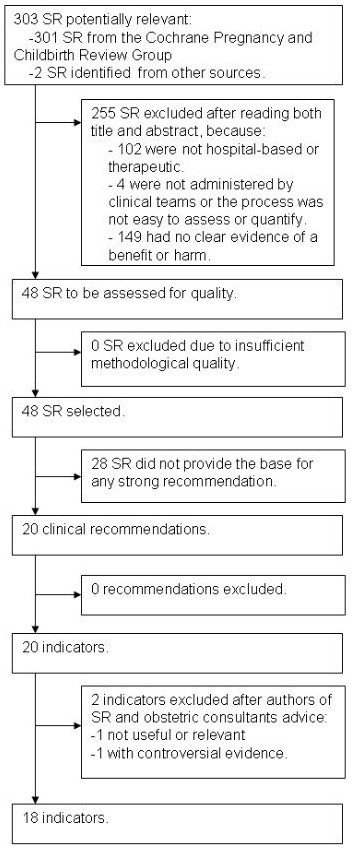
Methods: A search for systematic reviews about hospital obstetric interventions, conducted in The Cochrane Library, clinical evidence and practice guidelines, identified 303 reviews. We selected 48 high-quality evidence reviews, which resulted in strong clinical recommendations using the Grading of Recommendations Assessment, Development and Evaluation (GRADE) system. The 255 remaining reviews were excluded, mainly due to a lack of strong evidence provided by the studies reviewed.
Results: A total of 18 indicators were formulated from these clinical recommendations, on antepartum care (8), care during delivery and postpartum (9), and incomplete miscarriage (1). Authors of the systematic reviews and specialists in obstetrics were consulted to refine the formulation of indicators.
Conclusions: High-quality systematic reviews, whose conclusions clearly claim in favour or against an intervention, can be a source for generating quality indicators of delivery care. To make indicators coherent, the nuances of clinical practice should be considered. Any attempt made to evaluate the extent to which delivery care in hospitals is based on scientific evidence should take the generated indicators into account.
Figures
References
-
- Institute of Medicine (IOM) Medicare: A Strategy for Quality Assurance, Volume I. Washington D.C; 1990.
-
- Buen JM, Peiró S, Caldern SM. Variations in medical practice: importance, causes, and implications. Med Clin (Barc) 1998;110:382–390. - PubMed
Publication types
MeSH terms
LinkOut - more resources
Full Text Sources
Other Literature Sources
Medical
