


doi: 10.1016/0006-8993(90)90581-u.
Changes in pontine unit activity with REM sleep deprivation
Affiliations
- PMID: 2357583
- PMCID: PMC9045851
- DOI: 10.1016/0006-8993(90)90581-u
Item in Clipboard
Changes in pontine unit activity with REM sleep deprivation
Brain Res.
.
Abstract
Short term rapid eye movement (REM) sleep deprivation produced a decrease in walking discharge rates of presumably noradrenergic pontine 'REM sleep-off' cells and an increase in waking discharge rates of pontine 'REM sleep-on' cells. These changes can be viewed as a correlate of increased REM sleep pressure. Slowing of REM sleep-off cells in waking is hypothesized to counteract the functional effects of REM sleep loss on noradrenergic receptor sensitivity. This slowing and the resulting reduction in norepinephrine release may contribute to the loss of vigilance seen with sleep deprivation.
Figures
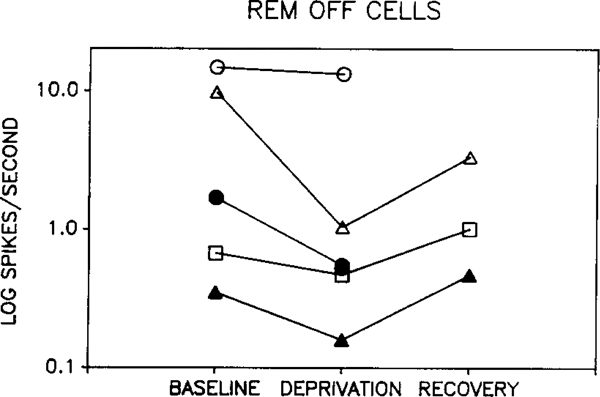
Effect of REM sleep deprivation on waking discharge rates of 'REM sleep-off' cells. Each tracing shows the rate changes seen in a single unit during baseline, REM sleep deprivation and recovery. Deprivation reduced discharge rate in all recorded cells, with return towards baseline levels with recovery sleep.
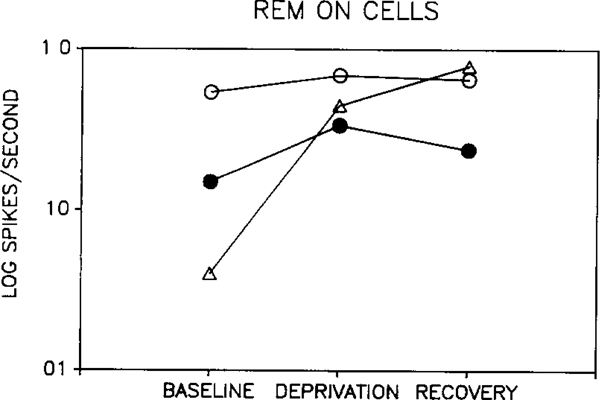
Effect of REM sleep deprivation on waking discharge rates of 'REM sleep-on' cells Deprivation increased discharge rate in all recorded cells. After recovery sleep, waking discharge levels decreased in two cells, but continued to increase in third
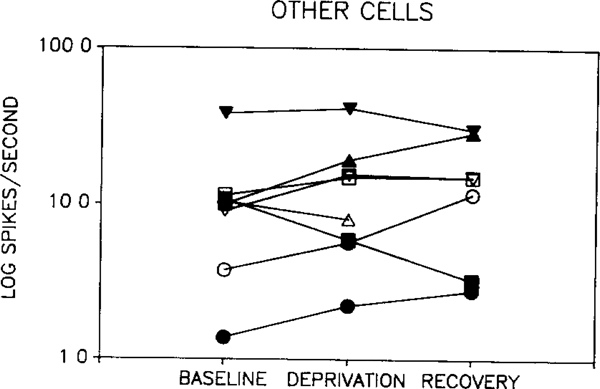
Effect of REM sleep deprivation on waking discharge rates in 'other' cell types. No consistent pattern was seen in this group.
References
-
- Abel MS, Villegas F, Abreu J, Gimino E, Steiner S, Beer B and Meyerson LR, The effect of rapid eye movement sleep deprivation on cortical beta-adrenergic receptors, Brain Res Bull, 11 (1983) 729–734. - PubMed
-
- Amaral DG and Sinnamon HM, The locus coeruleus: neurobiology of a central noradrenergic nucleus, Prog. Neurobiol, 9 (1977) 147–196. - PubMed
Publication types
MeSH terms
Grants and funding
LinkOut - more resources
Full Text Sources
