. 2013 Jun;97(6):1217-27.
doi: 10.3945/ajcn.112.048462. Epub 2013 Apr 10.

DNA methylation potential: dietary intake and blood concentrations of one-carbon metabolites and cofactors in rural African women

Affiliations

DNA methylation potential: dietary intake and blood concentrations of one-carbon metabolites and cofactors in rural African women

Paula Dominguez-Salas et al. Am J Clin Nutr. 2013 Jun.

Abstract

Background: Animal models show that periconceptional supplementation with folic acid, vitamin B-12, choline, and betaine can induce differences in offspring phenotype mediated by epigenetic changes in DNA. In humans, altered DNA methylation patterns have been observed in offspring whose mothers were exposed to famine or who conceived in the Gambian rainy season.

Objective: The objective was to understand the seasonality of DNA methylation patterns in rural Gambian women. We studied natural variations in dietary intake of nutrients involved in methyl-donor pathways and their effect on the respective metabolic biomarkers.

Design: In 30 women of reproductive age (18-45 y), we monitored diets monthly for 1 y by using 48-h weighed records to measure intakes of choline, betaine, folate, methionine, riboflavin, and vitamins B-6 and B-12. Blood biomarkers of these nutrients, S-adenosylhomocysteine (SAH), S-adenosylmethionine (SAM), homocysteine, cysteine, and dimethylglycine were also assessed monthly.

Results: Dietary intakes of riboflavin, folate, choline, and betaine varied significantly by season; the most dramatic variation was seen for betaine. All metabolic biomarkers showed significant seasonality, and vitamin B-6 and folate had the highest fluctuations. Correlations between dietary intakes and blood biomarkers were found for riboflavin, vitamin B-6, active vitamin B-12 (holotranscobalamin), and betaine. We observed a seasonal switch between the betaine and folate pathways and a probable limiting role of riboflavin in these processes and a higher SAM/SAH ratio during the rainy season.

Conclusions: Naturally occurring seasonal variations in food-consumption patterns have a profound effect on methyl-donor biomarker status. The direction of these changes was consistent with previously reported differences in methylation of metastable epialleles. This trial was registered at www.clinicaltrials.gov as NCT01811641.


Figures
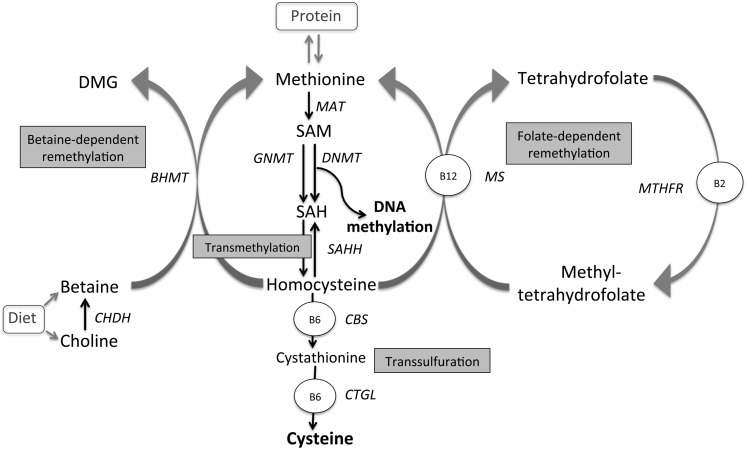
FIGURE 1.
FIGURE 1.
One-carbon metabolism. Adapted from reference . BHMT, betaine-homocysteine methyltransferase; B2, riboflavin; B6, vitamin B-6; B12, vitamin B-12; CBS, cystathionine-β-synthase; CHDH, choline dehydrogenase; CTGL, cystathionine-γ-lyase; DMG, dimethylglycine; DNMT, DNA methyltransferases; GNMT, glycine-N-methyltransferase; MAT, methionine adenosyltrasferase; MTHFR, methylenetetrahydrofolate reductase; MS, methionine synthase; SAH, S-adenosylhomocysteine; SAHH, S-adenosylhomocysteine hydrolase; SAM, S-adenosylmethionine. Methyl groups released from conversion of SAM to SAH are also used for other methylation reactions (eg, proteins).
FIGURE 2.
FIGURE 2.
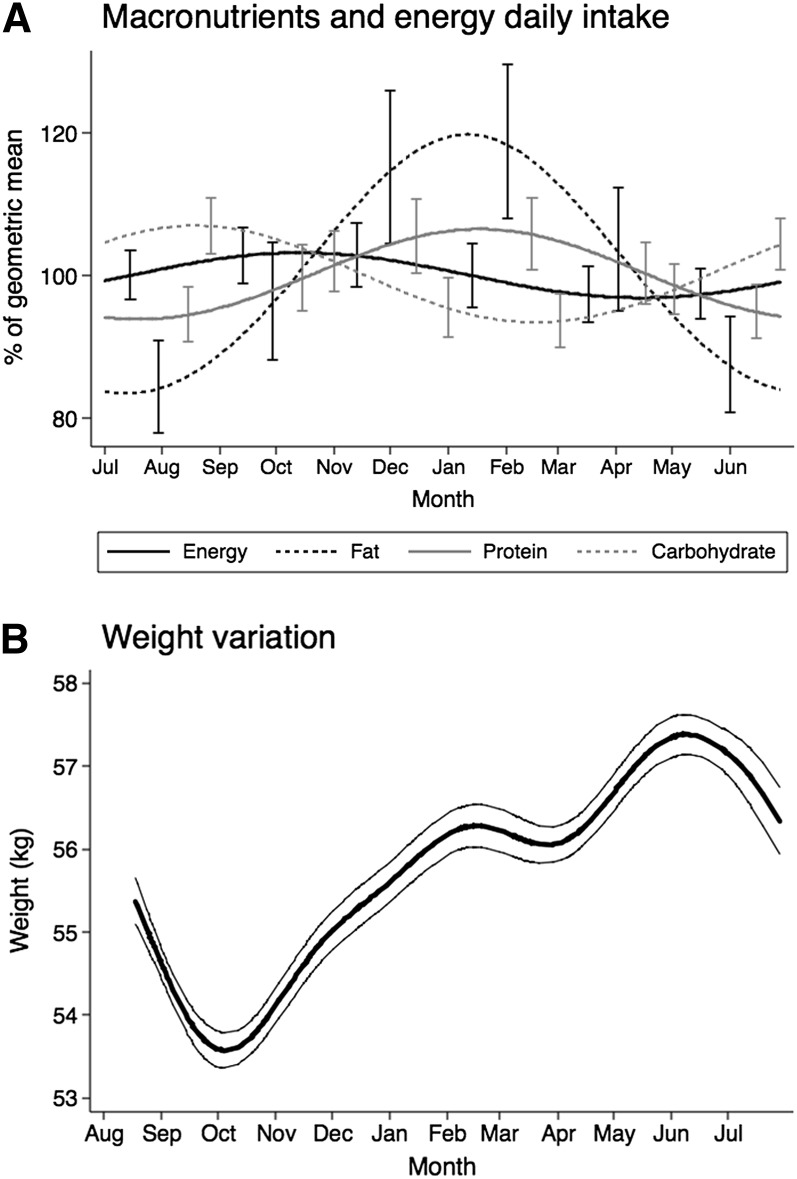
Seasonal trends in energy and macronutrient intakes and weight. A: n dietary intake measurements were made in an average of 29 women × 12 mo × 2 d. 95% CIs are shown with bars, at 2-mo intervals (different by substance to avoid excessive overlap and help visual clarity). Generalized least-squares regression with one pair of Fourier terms was used (P < 0.05 for fat, protein, and carbohydrate only). B: n = 517 subjects × (1–12 mo) = 2747 measure points. Thick line: arithmetic mean. Thin lines: 95% upper and lower CIs. Generalized least-squares regression with 4 pairs of Fourier terms was used.
FIGURE 3.
FIGURE 3.
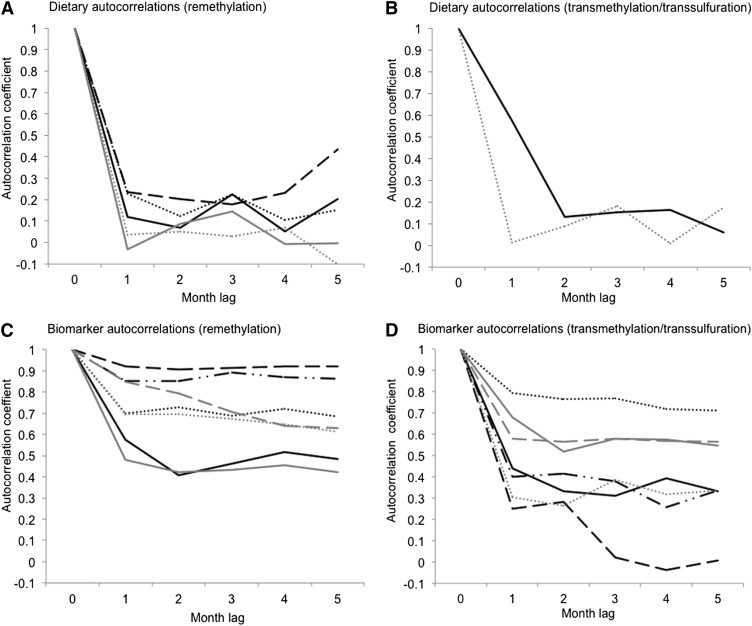
Reliability and stability of dietary intakes and blood biomarker concentrations for substances under study. Black lines: solid (A and C, folate; B and D, methionine), dot (A and C, riboflavin; D, SAM), dash (A and C, vitamin B-12; D, SAH), dash-dot-dot (C, active vitamin B-12; D, SAM/SAH). Gray lines: solid (A and C, choline; D, homocysteine), dot (A and C, betaine; B and C, vitamin B-6), dash (C, DMG; D, cysteine). Autocorrelation (internal correlation) of each variable measurement with measurements for the same woman 1 to 5 months apart (lag: 1–5), adjusted by seasonality. Dietary intake measurements were made in an average of 29 women × 12 mo × 2 d. Number of biomarker measurements = 316 (293 for riboflavin). DMG, dimethylglycine; SAH, S-adenosylhomocysteine; SAM, S-adenosylmethionine.
FIGURE 4.
FIGURE 4.
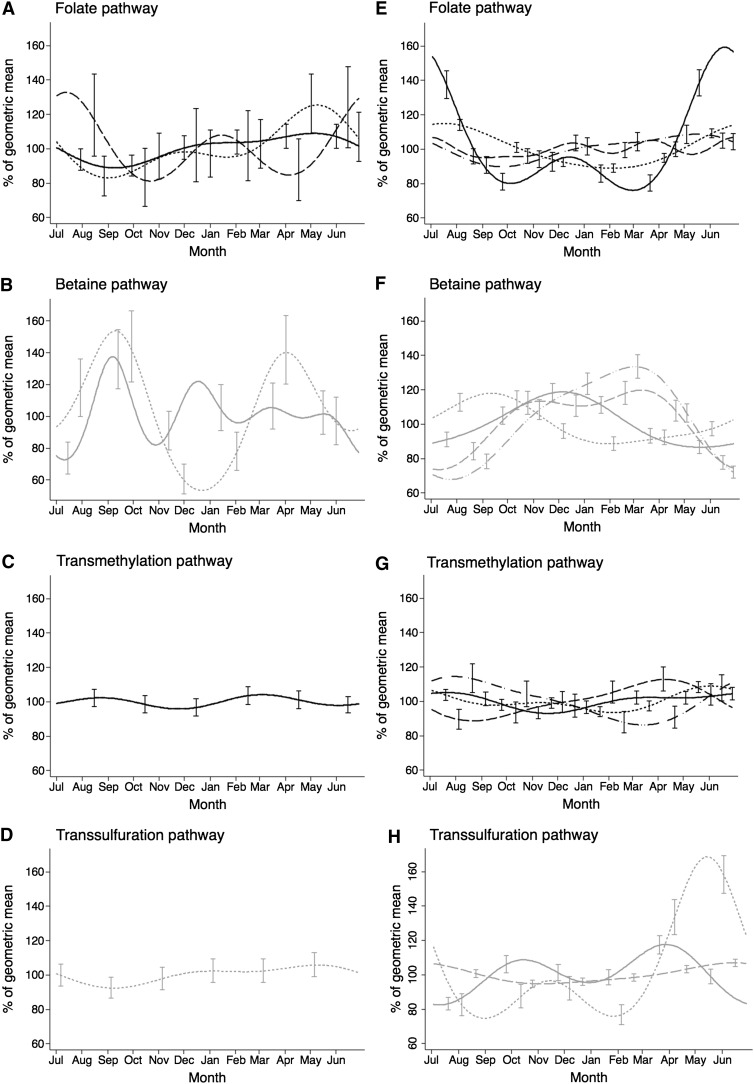
Seasonal trends of methyl donors and cofactors as per dietary intake and blood biomarker concentrations expressed as a percentage of the geometric mean of all measurements (between July 2009 and June 2010). Black lines: solid (A and E, folate; C and G, methionine), dot (A and E, riboflavin; G, SAM), dash (A and E, vitamin B-12; G, SAH), dash-dot-dot (E, active vitamin B-12; G, SAM/SAH). Gray lines: solid (B and F, choline; H, homocysteine), dot (B and F, betaine; D and H, vitamin B-6), dash (F, DMG; H, cysteine), dash-dot-dot (F, DMG/betaine). Dietary intake measurements were made in an average of 29 women × 12 mo × 2 d. Number of biomarker measurements = 316 (293 for riboflavin). Bars indicate 95% CIs at 2-mo intervals (different by substance to avoid excessive overlap and for visual clarity). Generalized least-squares regression with 2 pairs of Fourier terms was used, except for choline dietary intake and plasma vitamin B-12—each of which required 4 pairs of terms. Riboflavin status is shown as the inverse of EGRAC assay results. DMG, dimethylglycine; EGRAC, erythrocyte glutathione reductase activation coefficient; SAH, S-adenosylhomocysteine; SAM, S-adenosylmethionine.
FIGURE 5.
FIGURE 5.
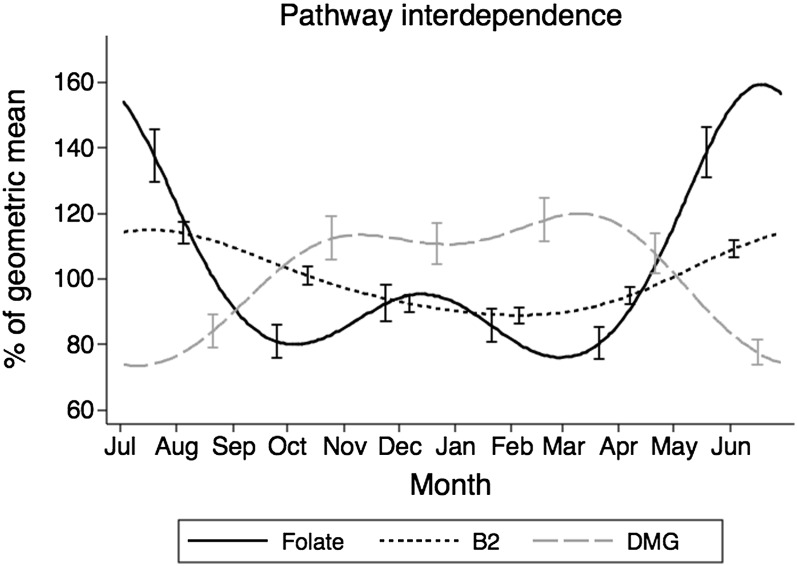
Seasonal trends of folate, B2, and DMG blood concentrations, expressed as a percentage of the geometric mean of all measurements (between July 2009 and June 2010). Interdependence of folate-dependent and betaine-dependent pathways. Number of biomarker measurements = 316 (293 for riboflavin). Bars indicate 95% CIs at 2-mo intervals (different by substance to avoid excessive overlap and for visual clarity). Generalized least-squares regression with 2 pairs of Fourier terms was used. Riboflavin status is shown as the inverse of EGRAC assay results. B2, riboflavin; DMG, dimethylglicine; EGRAC, erythrocyte glutathione reductase activation coefficient.

Comment in

  • You are what your mother ate?
    Kuzawa CW. Kuzawa CW. Am J Clin Nutr. 2013 Jun;97(6):1157-8. doi: 10.3945/ajcn.113.063347. Epub 2013 May 8. Am J Clin Nutr. 2013. PMID: 23656902 No abstract available.

References

    1. Barker DJ, Eriksson JG, Forsen T, Osmond C. Fetal origins of adult disease: strength of effects and biological basis. Int J Epidemiol 2002;31:1235–9 - PubMed
    1. Cedar H, Bergman Y. Linking DNA methylation and histone modification: patterns and paradigms. Nat Rev Genet 2009;10:295–304 - PubMed
    1. Waterland RA, Michels KB. Epigenetic epidemiology of the developmental origins hypothesis. Annu Rev Nutr 2007;27:363–88 - PubMed
    1. Dominguez-Salas P, Cox SE, Prentice AM, Hennig BJ, Moore SE. Maternal nutritional status, C(1) metabolism and offspring DNA methylation: a review of current evidence in human subjects. Proc Nutr Soc 2012;71:154–65 - PMC - PubMed
    1. Brosnan JT, Brosnan ME. The sulfur-containing amino acids: an overview. J Nutr 2006;136(suppl):1636S–40S - PubMed

Publication types

MeSH terms

Associated data