. 2013 Jun;87(12):6542-50.
doi: 10.1128/JVI.00641-13. Epub 2013 Apr 10.

Chimeric hemagglutinin influenza virus vaccine constructs elicit broadly protective stalk-specific antibodies

Affiliations

Chimeric hemagglutinin influenza virus vaccine constructs elicit broadly protective stalk-specific antibodies

Florian Krammer et al. J Virol. 2013 Jun.

Abstract

Current influenza virus vaccine strategies stimulate immune responses toward the globular head domain of the hemagglutinin protein in order to inhibit key steps of the virus life cycle. Because this domain is highly variable across strains, new vaccine formulations are required in most years. Here we demonstrate a novel vaccine strategy that generates immunity to the highly conserved stalk domain by using chimeric hemagglutinin constructs that express unique head and stalk combinations. By repeatedly immunizing mice with constructs that expressed the same stalk but an irrelevant head, we specifically stimulated a stalk-directed response that provided broad-based heterologous and heterosubtypic immunity in mice. Notably, our vaccination scheme provides a universal vaccine approach that protects against challenge with an H5 subtype virus. Furthermore, through in vivo studies using passively transferred antibodies or depletion of CD8(+) T cells, we demonstrated the critical role that humoral mechanisms of immunity play in the protection observed. The present data suggest that a vaccine strategy based on the stalk domain of the hemagglutinin protein could be used in humans to broadly protect against a variety of influenza virus subtypes.


Figures
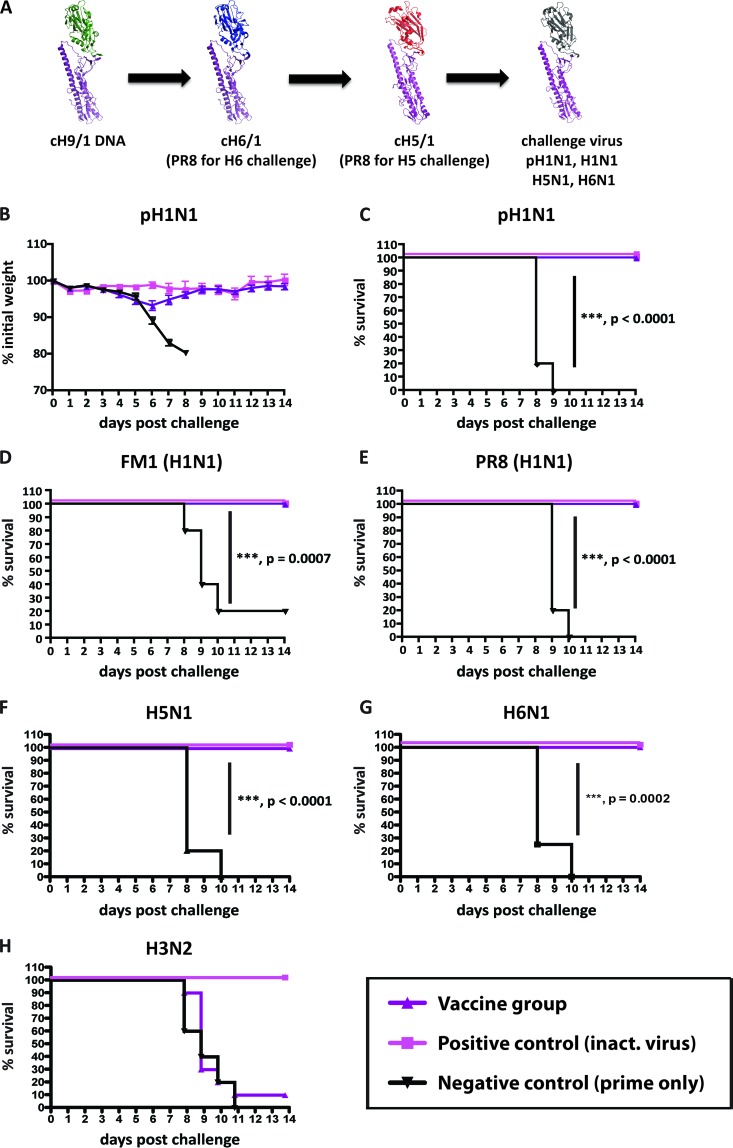
Fig 1
Fig 1
Vaccination with cHA elicits broad-based immunity that mediates protection from heterologous and heterosubtypic virus challenges. Animals were electroporated with DNA encoding cH9/1 and then were vaccinated with cH6/1 (replaced by H1 for panel F) and boosted with cH5/1 (replaced by H1 for E) soluble proteins (purple triangles; n = 10) or BSA (black triangles; n = 5), while positive-control mice received inactivated virus vaccine intramuscularly (pink squares; n = 5). (A) Schematics of vaccination and challenge. Purple, H1 stalk; green, H9 head; blue; H6 head; red, H5 head. The conserved stalk of the challenge viruses is indicated in purple, whereas the generic head domain is shown in gray. (A) Animals were vaccinated and then challenged with pH1N1, H1N1, H5N1, and H6N1 viruses. (B) Mice were challenged with pH1N1 virus and weighed daily. (C) Kaplan-Meier curve depicting survival. (D to G) Kaplan-Meier curves depicting survival upon viral challenge with the FM1 (H1N1) (D), PR8 (H1N1) (E), H5N1 (F), and H6N1 (G) strains. Survival of the chimeric HA vaccine group over that of the cH9/1 DNA-plus-BSA control group was highly significant for all viral challenges (P < 0.0001 for pH1N1, PR8, and H5N1 viruses, P = 0.0007 for FM1, and P = 0.0002 for H6N1 virus). (H) Mice that were vaccinated in a similar manner to that presented in panel A were not protected against challenge with an H3N2 virus strain.
Fig 2
Fig 2
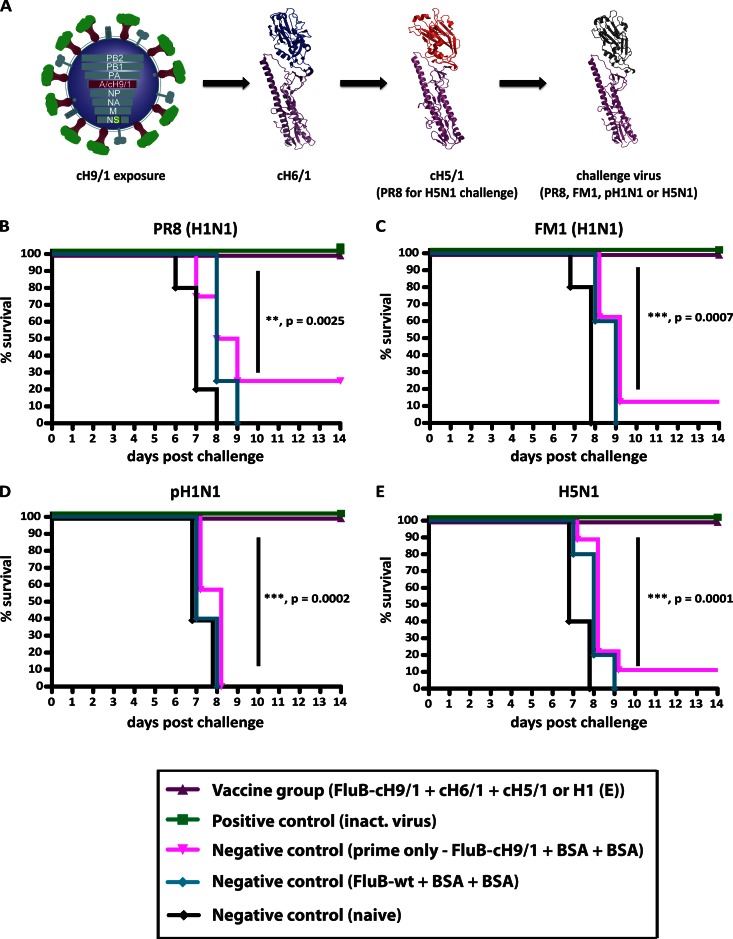
Vaccination with chimeric HA constructs boosts preexisting broad-based immunity and mediates protection from heterologous and heterosubtypic virus challenges. (A to C) Animals were inoculated with fluB-H1 virus and then vaccinated with cH6/1 and boosted with cH5/1 (PR8 for the H5N1 challenge) (purple triangles; n = 10) or BSA protein (pink triangles; n = 5). Controls were inoculated with wt fluB virus and vaccinated with BSA (teal circles; n = 5), given inactivated virus (green squares; n = 5) as a positive control, or kept naive (black circles; n = 5). (A) Schematic of vaccination and challenge. Purple, H1 stalk and head; green, H9 head; blue, H6 head; red, H5 head. The conserved stalk of the challenge viruses is indicated in purple, whereas the generic head domain is shown in gray. Kaplan-Meier curves depict survival upon challenge with PR8 (H1N1) (B), FM1 (H1N1) (C), pH1N1 (D), and H5N1 (E) viruses. Differences in survival of the fluB-cH9/1+cH6/1+cH5/1 or PR8 HA (PR8 HA used for H5 challenge) group versus the fluB-cH9/1+BSA+BSA group were highly significant for all challenge experiments (P = 0.0025, 0.0007, 0.0002, and <0.0001, respectively).
Fig 3
Fig 3
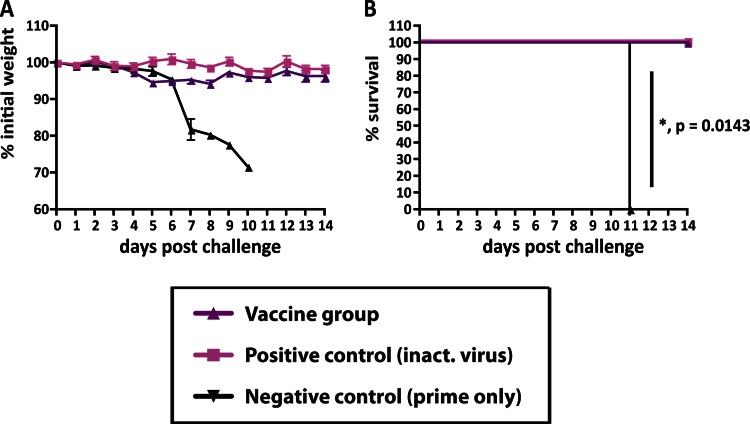
CD8 T cells do not have an essential role in mediating the broad-based protection elicited by vaccination with cHA constructs. (A) Animals were electroporated with DNA encoding cH9/1 and then were vaccinated with cH6/1 and boosted with cH5/1 soluble protein (purple triangles; n = 10) or BSA (black triangles; n = 5), while positive-control mice received inactivated virus intramuscularly (pink squares; n = 5). CD8 T cells were depleted prior to challenge with PR8 (H1N1) virus by treating the animals with an anti-CD8 T-cell antibody (hybridoma line 2.43) (17). Weight loss was monitored for 14 days. (B) Kaplan-Meier curve depicting survival (P = 0.0143).
Fig 4
Fig 4
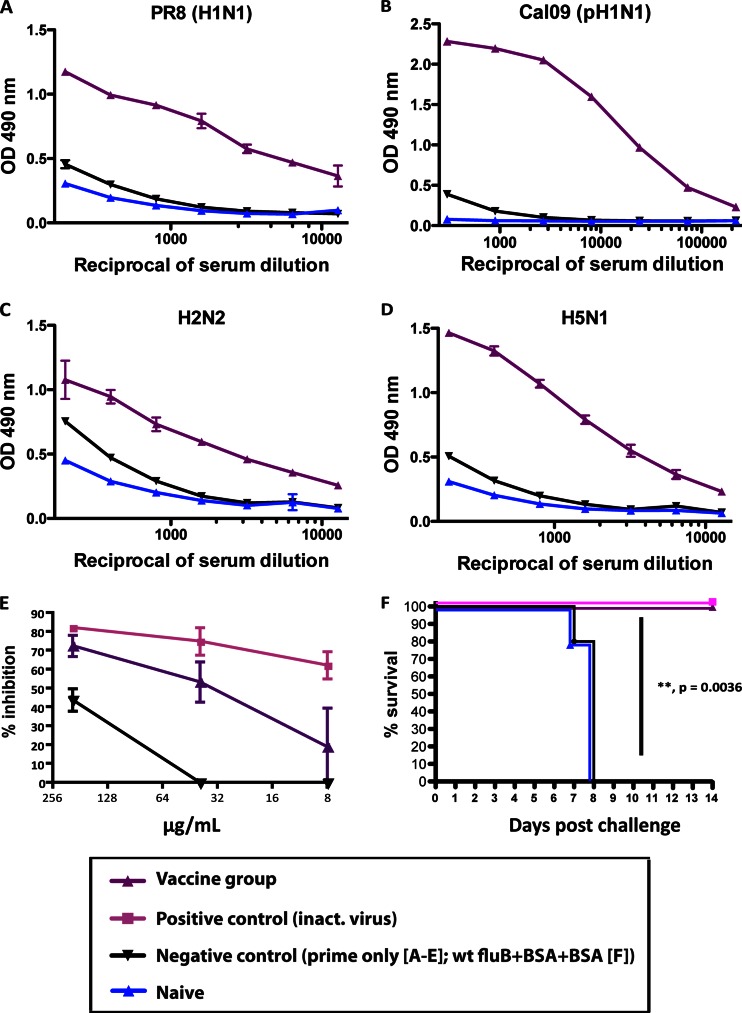
The antibodies elicited by sequential vaccination with chimeric HAs are cross-reactive against group 1 HAs and have neutralizing activity in vitro and in vivo. (A to D) Stalk-specific ELISA reactivities of sera from animals electroporated with cH9/1 DNA and then vaccinated with cH6/1 and cH5/1 (replaced by H1 for mice used for panel C) soluble proteins (purple triangles) or BSA (black triangles) or of sera from naive animals (blue triangles) against H1 HA (purified PR8 [H1N1] virus substrate) (A), pH1 HA [purified Cal09 (pH1N1) protein substrate] (B), H2 HA (purified H2N2 virus substrate) (C), and H5 HA (purified H5N1 virus substrate) (D). (E) Animals were vaccinated as described above. Total IgG was purified for use in an H2-based pseudoparticle entry inhibition assay. Percent inhibition was assessed as the decrease in luciferase expression compared to that of controls. The Fab fragment of CR6261 (pink squares) was used as a positive control. (F) Passive transfer assay. Naive mice received sera from PR8-vaccinated animals (green squares; n = 5), fluB-cH9/1+cH6/1+cH5/1-vaccinated animals (purple triangles; n = 5), wt fluB+BSA+BSA-vaccinated animals (black triangles; n = 5), or naive mice (blue triangles; n = 5) via intraperitoneal injection and were then challenged with PR8 (H1N1) virus. The Kaplan-Meier curve depicts survival (P = 0.0036 between the groups that received sera from fluB-cH9/1+cH6/1+cH5/1-vaccinated animals and the wt fluB+BSA+BSA group).

References

    1. Palese P, Shaw ML. 2006. Orthomyxoviridae: the viruses and their replication, p 1648–1689 In Knipe DM, Howley PM, Griffin DE, Lamb RA, Martin MA, Roizman B, Straus SE. (ed), Fields virology, 5th ed Lippincott Williams & Wilkins, Philadelphia, PA
    1. Ekiert DC, Wilson IA. 2012. Broadly neutralizing antibodies against influenza virus and prospects for universal therapies. Curr. Opin. Virol. 2:134–141 - PMC - PubMed
    1. Ekiert DC, Bhabha G, Elsliger MA, Friesen RH, Jongeneelen M, Throsby M, Goudsmit J, Wilson IA. 2009. Antibody recognition of a highly conserved influenza virus epitope. Science 324:246–251 - PMC - PubMed
    1. Sui J, Hwang WC, Perez S, Wei G, Aird D, Chen LM, Santelli E, Stec B, Cadwell G, Ali M, Wan H, Murakami A, Yammanuru A, Han T, Cox NJ, Bankston LA, Donis RO, Liddington RC, Marasco WA. 2009. Structural and functional bases for broad-spectrum neutralization of avian and human influenza A viruses. Nat. Struct. Mol. Biol. 16:265–273 - PMC - PubMed
    1. Tan GS, Krammer F, Eggink D, Kongchanagul A, Moran TM, Palese P. 2012. A pan-H1 anti-hemagglutinin monoclonal antibody with potent broad-spectrum efficacy in vivo. J. Virol. 86:6179–6188 - PMC - PubMed

Publication types

MeSH terms

Substances