. 2013 Jul;87(13):7265-81.
doi: 10.1128/JVI.03070-12. Epub 2013 Apr 10.

Molecular evolution of the HIV-1 Thai epidemic between the time of RV144 immunogen selection to the execution of the vaccine efficacy trial

Affiliations

Molecular evolution of the HIV-1 Thai epidemic between the time of RV144 immunogen selection to the execution of the vaccine efficacy trial

Gustavo H Kijak et al. J Virol. 2013 Jul.

Erratum in

  • J Virol. 2013 Dec;87(23):13084

Abstract

The RV144 HIV-1 vaccine trial (Thailand, 2003 to 2009), using immunogens genetically matched to the regional epidemic, demonstrated the first evidence of efficacy for an HIV-1 vaccine. Here we studied the molecular evolution of the HIV-1 epidemic from the time of immunogen selection to the execution of the efficacy trial. We studied HIV-1 genetic diversity among 390 volunteers who were deferred from enrollment in RV144 due to preexisting HIV-1 infection using a multiregion hybridization assay, full-genome sequencing, and phylogenetic analyses. The subtype distribution was 91.7% CRF01_AE, 3.5% subtype B, 4.3% B/CRF01_AE recombinants, and 0.5% dual infections. CRF01_AE strains were 31% more diverse than the ones from the 1990s Thai epidemic. Sixty-nine percent of subtype B strains clustered with the cosmopolitan Western B strains. Ninety-three percent of B/CRF01_AE recombinants were unique; recombination breakpoint analysis showed that these strains were highly embedded within the larger network that integrates recombinants from East/Southeast Asia. Compared to Thai sequences from the early 1990s, the distance to the RV144 immunogens increased 52% to 68% for CRF01_AE Env immunogens and 12% to 29% for subtype B immunogens. Forty-three percent to 48% of CRF01_AE sequences differed from the sequence of the vaccine insert in Env variable region 2 positions 169 and 181, which were implicated in vaccine sieve effects in RV144. In conclusion, compared to the molecular picture at the early stages of vaccine development, our results show an overall increase in the genetic complexity of viruses in the Thai epidemic and in the distance to vaccine immunogens, which should be considered at the time of the analysis of the trial results.


Figures
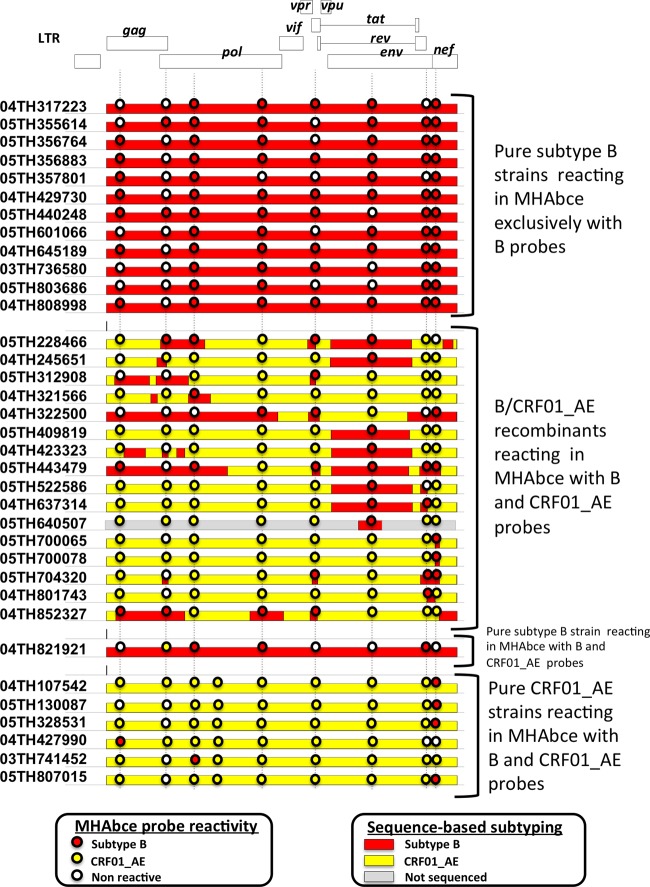
Fig 1
Fig 1
MHAbce reactivity pattern and genomic structure of typed samples showing reactivity with subtype B probes in one or more regions. Color-coded horizontal bars represent the genomic structure based on near-full-genome sequencing, and the circles depict the corresponding MHAbce probe reactivity. Vertical dotted lines indicate the genomic locations of the MHAbce probes. For sample 05TH640507, only a subgenomic sequence was retrieved (HXB2 residues 6991 to 7573). LTR, long terminal repeat.
Fig 2
Fig 2
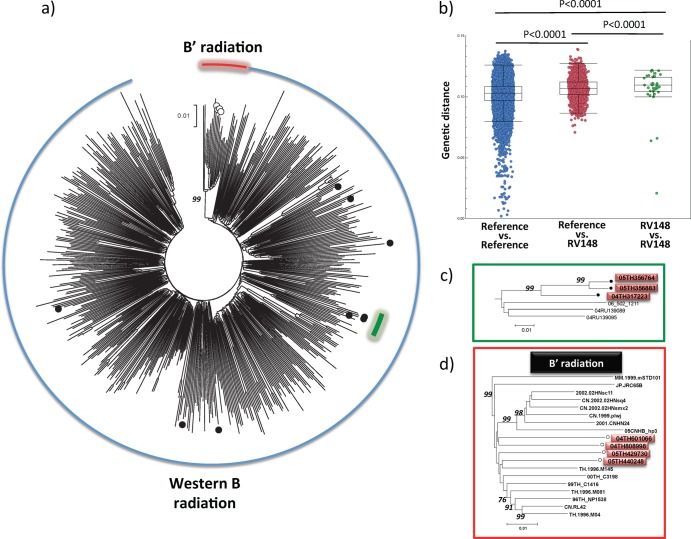
Location of RV148 subtype B strains in the global subtype B phylogeny. (a) Black circles depict RV148 B strains from the Western B radiation, and hollow circles depict RV148 strains from the B′ radiation. (b) Distribution of pairwise genetic distance within the cosmopolitan Western B epidemic (blue circles), among RV148 sequences from the Western B radiation (green circles), and between these two groups (red circles). This analysis was based on near-full-genome sequences from 344 cosmopolitan Western B strains that were sampled between 2000 and 2007. (c) Detail of a trio of RV148 strains with low genetic diversity (red boxes). (d) Subtree of the B′ radiation, where the RV148 strains are highlighted (red boxes). The phylogenetic trees were built using near-full-genome sequences. Numbers on the branches of the phylogenetic trees represent the percentage of bootstrap replicates supporting the relevant clusters.
Fig 3
Fig 3
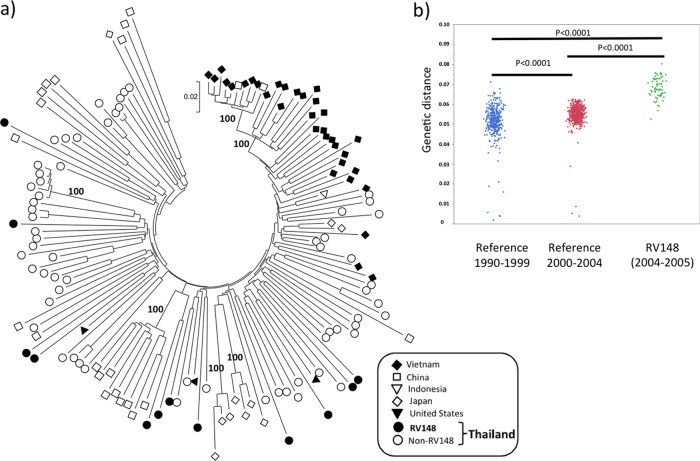
Genetic diversity of near-full-genome CRF01_AE sequences in RV148. (a) Location of CRF01_AE RV148 strains in the context of the Asian CRF01_AE radiation. The different symbols depict the country of sampling of each sequence, as indicated in the box. Sequences sampled in the United States, but likely acquired in Southeast Asia (85), were also included. Numbers on the branches of the phylogenetic tree represent the percentage of bootstrap replicates supporting the relevant clusters. (b) Distribution of pairwise nucleotide genetic distances among CRF01_AE strains in different time periods in the history of the Thai HIV-1 epidemic: 1990 to 1999 (n = 30) and 2000 to 2004 (n = 32).
Fig 4
Fig 4
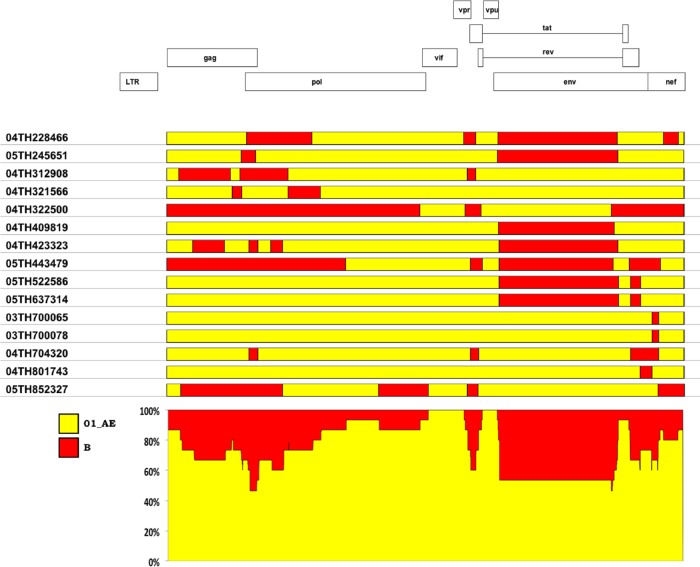
CRF01_AE comprises the majority of the genomic content of B/CRF01_AE recombinants in RV148. On the basis of recombination breakpoint mapping, the subtype composition of all the recombinants was added at each genomic position. Some areas showed equivalent contributions from CRF01_AE and subtype B (e.g., gp120 in env), while other areas were predominantly CRF01_AE (e.g., vif).
Fig 5
Fig 5
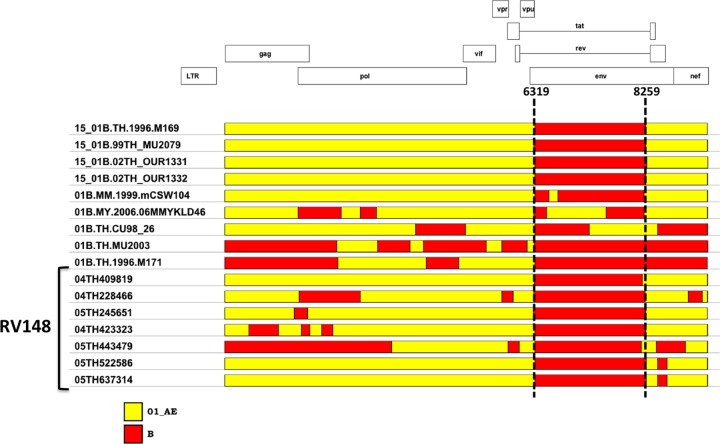
Seven RV148 B/CRF01_AE intersubtype recombinants share common recombination breakpoints with CRF15_01B and with other published Southeast Asian recombinants. The vertical dashed lines indicate the location of CRF15_01B breakpoints in the HXB2 coordinate system. See the text for details.
Fig 6
Fig 6
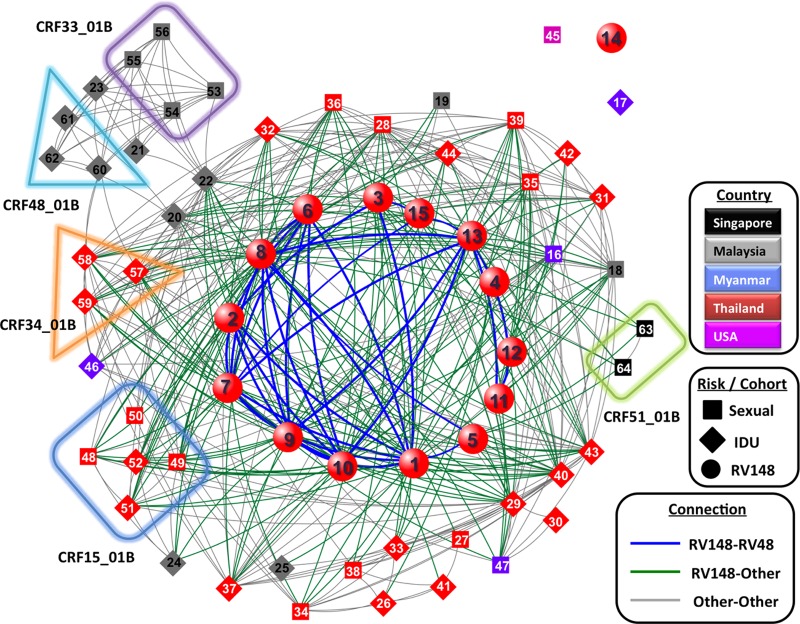
RV148 recombinants are embedded in the larger network of Southeast Asian HIV-1 recombinants. In the network diagram, each node represents a recombinant color coded by country of sampling and shape coded by risk factor for HIV-1 acquisition (risk factors in RV148 were not recorded and thus are depicted as a separate category). Lines connecting nodes link strains that share common recombination breakpoints, and they are color coded to help distinguish relationships within RV148, within published strains, and between these two groups. Boxes group together strains that belong to the same CRF. Numbers within the nodes identify the strains, as follows: 1, 04TH228466; 2, 05TH245651; 3, 04TH312908; 4, 04TH321566; 5, 04TH322500; 6, 04TH409819; 7, 04TH423323; 8, 05TH443479; 9, 05TH522586; 10, 05TH637314; 11, 03TH700065; 12, 03TH700078; 13, 04TH704320; 14, 04TH801743; 15, 05TH852327; 16, 01B.MM.1999.mCSW104; 17, 01B.MM.2000.mIDU502; 18, 01B.MY.2003.03MYKL018_1; 19, 01B.MY.2004.04MYKL016_1; 20, 01B.MY.2004.04MYKL019_1; 21, 01B.MY.2005.05MYKL043_1; 22, 01B.MY.2006.06MMYKLD46; 23, 01B.MY.2007.07MYKLD47; 24, 01B.MY.2007.07MYKLD48; 25, 01B.MY.2007.07MYKLD49; 26, 01B.TH.-0.1269 12_69; 27, 01B.TH.-.CM237; 28, 01B.TH.-.CU98_26; 29, 01B.TH.-.MU2003; 30, 01B.TH.-.NP1623; 31, 01B.TH.-.TH1326; 32, 01B.TH.-.TH283; 33, 01B.TH.-.TH9_95; 34, 01B.TH.1996.M005; 35, 01B.TH.1996.M043; 36, 01B.TH.1996.M171; 37, 01B.TH.1999.OUR2574; 38, 01B.TH.2000.00TH_C2254_BE; 39, 01B.TH.2000.00TH_R1741; 40, 01B.TH.2001.OUR033I; 41, 01B.TH.2002.OUR740I; 42, 01B.TH.2002.OUR840I; 43, 01B.TH.2002.OUR846I; 44, 01B.TH.2002.OUR847I; 45, 01B.US.1998.99US_MSC5043; 46, 01BC.MM.1999.mIDU107; 47, 01BC.MM.2000.mCSW503; 48, 15_01B.TH.1996.M169; 49, 15_01B.TH.1999.99TH_MU2079; 50, 15_01B.TH.1999.99TH_R2399; 51, 15_01B.TH.2002.02TH_OUR1331; 52, 15_01B.TH.2002.02TH_OUR1332; 53, 33_01B.MY.05.05MYKL045_1; 54, 33_01B.MY.2005.05MYKL007_1; 55, 33_01B.MY.2005.05MYKL015_2; 56, 33_01B.MY.2005.05MYKL031_1; 57, 34_01B.TH.1999.OUR1969P; 58, 34_01B.TH.1999.OUR2275P; 59, 34_01B.TH.1999.OUR2478P; 60, 48_01B.MY.2007.07MYKT014; 61, 48_01B.MY.2007.07MYKT016; 62, 48_01B.MY.2007.07MYKT021; 63, 51_01B.SG.2011.11SG_HM021; 64, 51_01B.SG.2011.11SG_HM091. See the text for details.
Fig 7
Fig 7
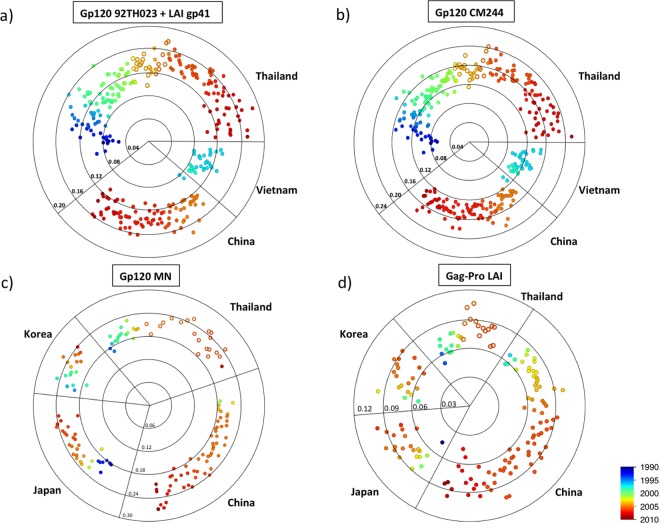
Temporal and geographical differences in the distance of southeast Asian strains to RV144 immunogens. (a) Protein distance of RV148 CRF01_AE and B/CRF01_AE recombinants whose gp120 region is CRF01_AE and published HIV-1 CRF01_AE strains sampled in East and Southeast Asia to the 92TH023 gp120 linked to the LAI gp41 immunogen presented in the ALVAC-HIV. (b) Protein distance of RV148 CRF01_AE and B/CRF01_AE recombinants whose gp120 region is CRF01_AE and published HIV-1 CRF01_AE strains sampled in East and Southeast Asia to the CM244 gp120 immunogen presented in the AIDSVAX B/E. (c) Protein distance of RV148 subtype B and B/CRF01_AE recombinants whose gp120 region is subtype B and published HIV-1 subtype B strains sampled in East and Southeast Asia to the MN gp120 immunogen presented in the AIDSVAX B/E. (d) Protein distance of RV148 strains to subtype B and B/CRF01_AE recombinants whose gag-pro region is subtype B and published HIV-1 subtype B strains sampled in East and Southeast Asia to the LAI Gag immunogen presented in the ALVAC-HIV. Each point in the radar chart depicts an RV148 (hollow circles) or published strain (full circle), and its radial distance to the center represents the protein p-distance to the immunogen. Concentric circles show the distance scale. The country and year of sampling are indicated.
Fig 8
Fig 8
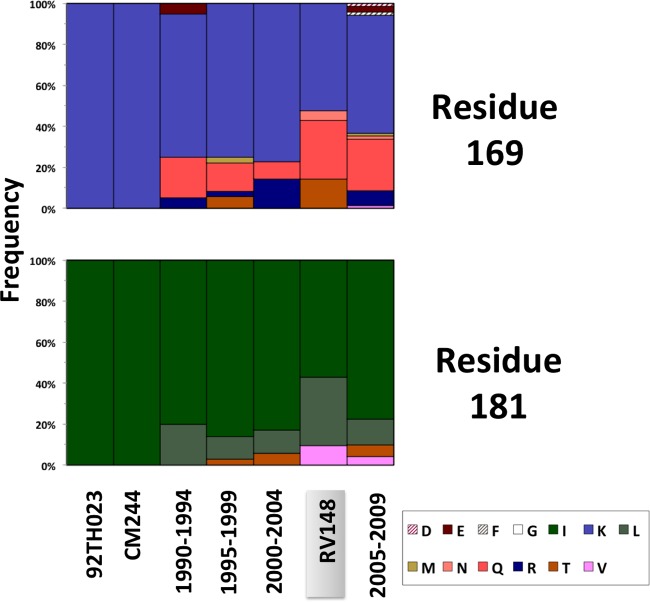
Amino acid variation in V1V2 positions 169 and 181 among CRF01_AE sequences sampled in Thailand between 1990 and 2009 and their relation to the RV144 vaccine immunogens. The frequency of each amino acid residue at the corresponding position is depicted for published Thai CRF01_AE gp120 sequences sampled between 1990 and 1994 (n = 20), 1995 and 1999 (n = 36), 2000 and 2004 (n = 35), and 2005 and 2009 (n = 71), as well as CRF01_AE and B/CRF01_AE recombinants whose gp120 region is CRF01_AE from RV148 (n = 21). The amino acid residues presented in 92TH023 and CM244 RV144 immunogens are depicted for comparison.

References

    1. Kijak GH, McCutchan FE. 2005. HIV diversity, molecular epidemiology, and the role of recombination. Curr. Infect. Dis. Rep. 7:480–488 - PubMed
    1. Tebit DM, Arts EJ. 2011. Tracking a century of global expansion and evolution of HIV to drive understanding and to combat disease. Lancet Infect. Dis. 11:45–56 - PubMed
    1. Kuiken C, Leithner T, Hahn B, Mullins J, Wolinsky S, Foley B, Apetrei C, Mizrahi I, Rambaut A, Korber B. 2012. HIV sequence compendium 2012. Theoretical Biology and Biophysics, Los Alamos National Laboratory, Los Alamos, NM
    1. Taylor BS, Sobieszczyk ME, McCutchan FE, Hammer SM. 2008. The challenge of HIV-1 subtype diversity. N. Engl. J. Med. 358:1590–1602 - PMC - PubMed
    1. Tovanabutra S, Birx D, McCutchan F. 2004. Molecular epidemiology of HIV in Asia and the Pacific. In Lu Y, Essex M. (ed), AIDS in Asia. Kluwer Academic, New York, NY

Publication types