. 2013 Apr 16;110(16):6601-6.
doi: 10.1073/pnas.1302961110. Epub 2013 Apr 1.

Label-free quantitative proteomics of the lysine acetylome in mitochondria identifies substrates of SIRT3 in metabolic pathways

Affiliations

Label-free quantitative proteomics of the lysine acetylome in mitochondria identifies substrates of SIRT3 in metabolic pathways

Matthew J Rardin et al. Proc Natl Acad Sci U S A. .

Abstract

Large-scale proteomic approaches have identified numerous mitochondrial acetylated proteins; however in most cases, their regulation by acetyltransferases and deacetylases remains unclear. Sirtuin 3 (SIRT3) is an NAD(+)-dependent mitochondrial protein deacetylase that has been shown to regulate a limited number of enzymes in key metabolic pathways. Here, we use a rigorous label-free quantitative MS approach (called MS1 Filtering) to analyze changes in lysine acetylation from mouse liver mitochondria in the absence of SIRT3. Among 483 proteins, a total of 2,187 unique sites of lysine acetylation were identified after affinity enrichment. MS1 Filtering revealed that lysine acetylation of 283 sites in 136 proteins was significantly increased in the absence of SIRT3 (at least twofold). A subset of these sites was independently validated using selected reaction monitoring MS. These data show that SIRT3 regulates acetylation on multiple proteins, often at multiple sites, across several metabolic pathways including fatty acid oxidation, ketogenesis, amino acid catabolism, and the urea and tricarboxylic acid cycles, as well as mitochondrial regulatory proteins. The widespread modification of key metabolic pathways greatly expands the number of known substrates and sites that are targeted by SIRT3 and establishes SIRT3 as a global regulator of mitochondrial protein acetylation with the capability of coordinating cellular responses to nutrient status and energy homeostasis.


Conflict of interest statement

The authors declare no conflict of interest.

Figures
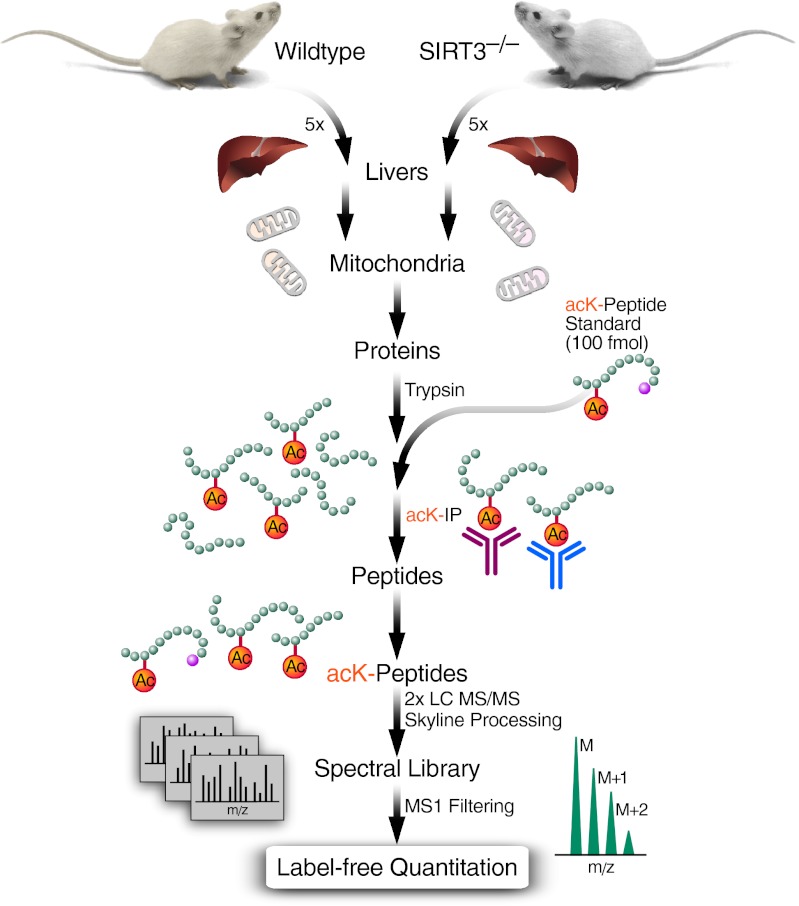
Fig. 1.
Fig. 1.
Strategy for identification and quantitation of the SIRT3-regulated acetylome in mouse liver mitochondria. Liver mitochondria were isolated from five individual WT and SIRT3−/− male mice. Two process replicates from each of 10 mitochondrial protein isolates were digested separately with trypsin, generating 20 samples. The resulting peptide fractions were desalted, and 100 fmol of a heavy isotope-labeled acK-peptide standard (m/z 626.8604++; LVSSVSDLPacKR-13C615N4) was added. acK peptides were immunoprecipitated using two anti-acK antibodies. Enriched peptides were separated and analyzed in duplicate by HPLC-MS/MS. Data were processed using Skyline to generate a MS/MS spectral library of the identified acK peptides. Precursor ion intensity chromatograms for one or more isotopes (M, M+1, M+2) of each peptide were integrated using Skyline MS1 Filtering and used for label-free quantitation across all samples after normalization to the peak area of the peptide standard.
Fig. 2.
Fig. 2.
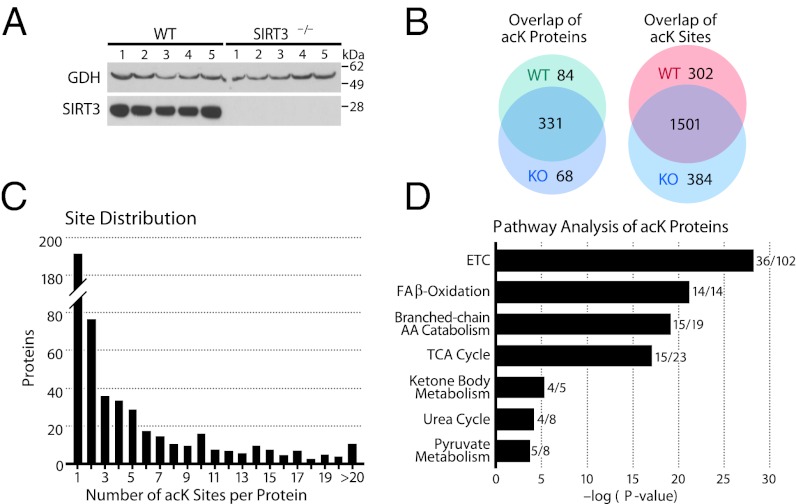
Identification of acetylated peptides and proteins by LC-MS/MS. (A) Western blot analysis of glutamate dehydrogenase (GDH) and SIRT3 in mitochondrial lysates from WT and SIRT3−/− mouse livers. (B) Overlap of identified acetylated proteins and peptides from WT and SIRT3−/− mice. (C) Distribution of acK sites identified per protein. (D) Pathway analysis of the mitochondrial acetylome with the number of proteins identified per pathway indicated.
Fig. 3.
Fig. 3.
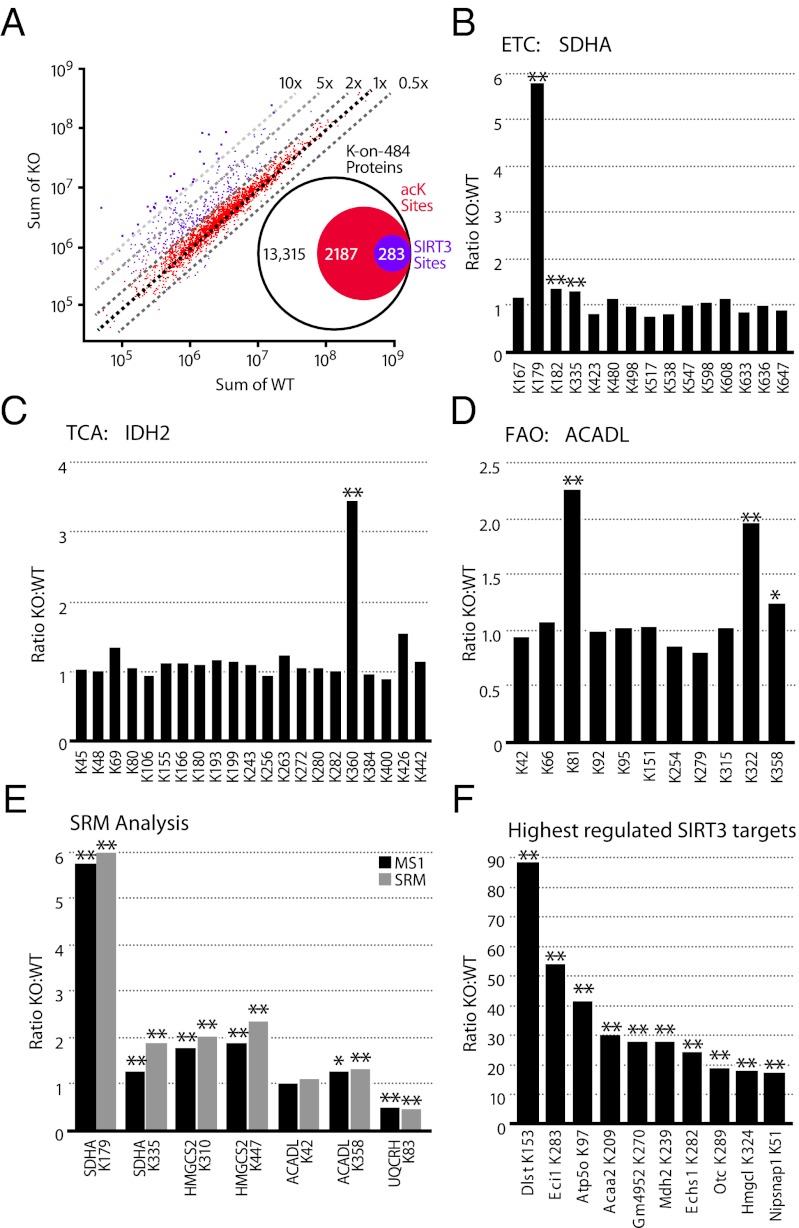
Identification of SIRT3 substrates by label-free quantitation. (A) Scatter plot of the acK peptides quantitated by MS1 Filtering after normalization. Dashed lines indicate the fold change in intensity between WT and KO. Peptides with a significant (P ≤ 0.01) at least twofold change are indicated in purple; all other peptides are in red. Inset summarizes the number of acK sites significantly changed in SIRT3−/− liver mitochondria from the total number of acK sites identified. Acetylation profiles of (B) succinate dehydrogenase subunit A (SDHA) from complex II in the ETC, (C) isocitrate dehydrogenase (IDH2) in the TCA cycle, and (D) long-chain specific acyl-CoA dehydrogenase (ACADL) in the fatty acid oxidation pathway. (E) Relative quantitation measurements resulting from SRM analysis of targeted acK sites using stable isotope dilution with synthetic peptide standards to the indicated proteins/acK sites. The most intense fragment ion was used for analysis and compared with MS1 Filtering results. (F) Largest fold changes (KO:WT) for individual acK sites. From left to right, dihydrolipoyllysine succinyltransferase (DLST), enoyl-CoA isomerase (ECI1), ATP synthase subunit O (ATP5O), 3-ketoacyl-CoA thiolase (ACAA2), Glycine N-acyltransferase-like protein (GM4952), malate dehydrogenase (MDH2), enoyl-CoA hydratase (ECHS1), ornithine carbamoyltransferase (OTC), hydroxymethylglutaryl-CoA lyase (HMGCL), and NipSnap homolog 1 (NIPSNAP1). Two-tailed Student t test (*P ≤ 0.05, **P ≤ 0.01); n = 5 for WT and KO with two injection replicates per sample.
Fig. 4.
Fig. 4.
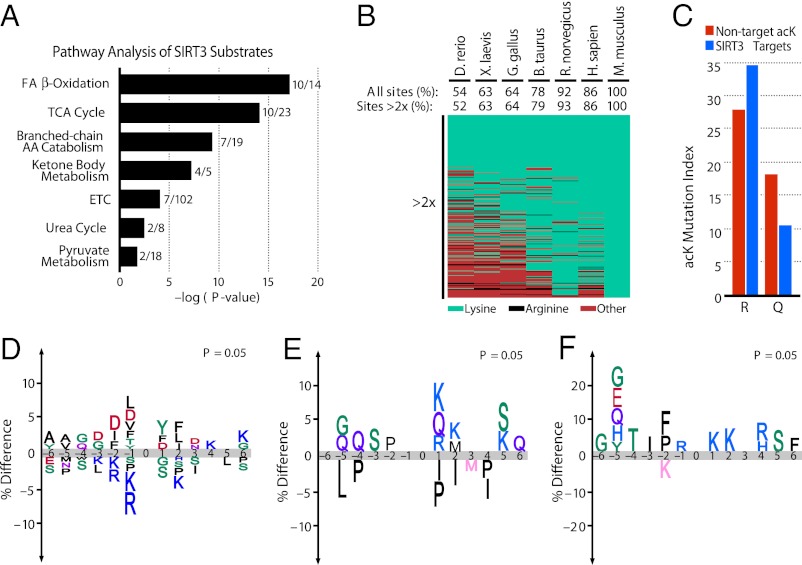
Pathway and evolutionary analysis of acetylation sites and consensus motifs. (A) Pathway analysis of the mitochondrial acetylome altered in SIRT3−/− mice with the number of proteins identified per pathway. (B) Heat map depicting the conservation index of SIRT3 substrates (twofold increase) across seven vertebrate species with percent conservation calculated for all acK sites identified and SIRT3 substrates. Conservation index of all nonregulated sites is available in Fig. S3. (C) Percentage of acK residues identified in mouse mutated to arginine (P = 0.01) or glutamine (P = 0.04) across the seven species in Fig. 3B (P values calculated via χ2 test). (D) Consensus sequence logos plot for acetylation sites ± six amino acids from the lysine of all acK sites identified, (E) from the identified lysine residues significantly increased in SIRT3−/− mice, and (F) for highly conserved acetylation sites significantly increased in SIRT3−/− mice.
Fig. 5.
Fig. 5.
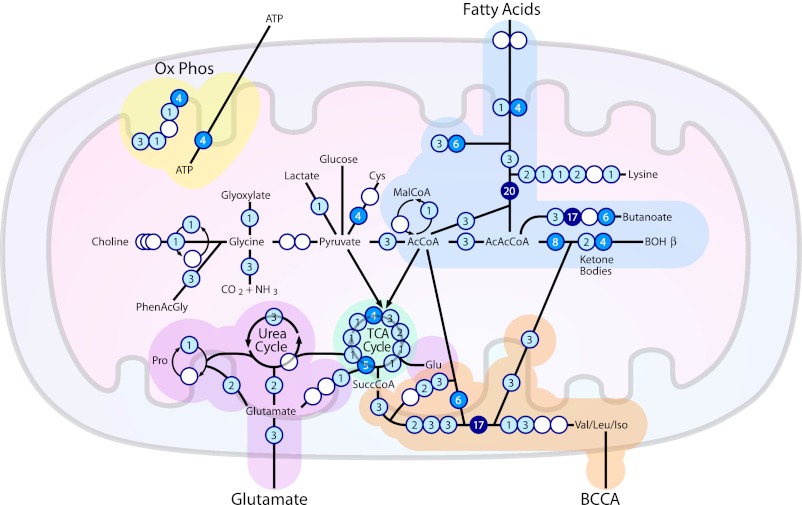
Schematic depicting the primary SIRT3 regulated metabolic pathways within mitochondria including oxidative phosphorylation (Ox Phos), fatty acid oxidation, ketogenesis, branched chain amino acid catabolism (BCCA), the TCA cycle, and the urea cycle. Circles represent constituent proteins or protein complexes within each pathway with the number of SIRT3 regulatory sites indicated. Abbreviations include Acetyl-CoA (AcCoA), acetoacetyl-CoA (AcAcCoA), β-hydroxybutyrate (BOHβ), succinyl-CoA (SuccCoA), malonyl-CoA (MalCoA), ammonia (NH3), carbon dioxide (CO2), glutamate (Glu), proline (Pro), valine (Val), leucine (Leu), isoleucine (Iso), cysteine (Cys), adenosine triphosphate (ATP), and phenylacetylglycine (PhenAcGly).

References

    1. Glozak MA, Sengupta N, Zhang X, Seto E. Acetylation and deacetylation of non-histone proteins. Gene. 2005;363:15–23. - PubMed
    1. Kim SC, et al. Substrate and functional diversity of lysine acetylation revealed by a proteomics survey. Mol Cell. 2006;23(4):607–618. - PubMed
    1. Choudhary C, et al. Lysine acetylation targets protein complexes and co-regulates major cellular functions. Science. 2009;325(5942):834–840. - PubMed
    1. DiMauro S, Schon EA. Mitochondrial respiratory-chain diseases. N Engl J Med. 2003;348(26):2656–2668. - PubMed
    1. Beal MF. Mitochondria take center stage in aging and neurodegeneration. Ann Neurol. 2005;58(4):495–505. - PubMed

Publication types