Fatigue among short- and long-term thyroid cancer survivors: results from the population-based PROFILES registry
- PMID: 23578315
- PMCID: PMC3783928
- DOI: 10.1089/thy.2013.0015
Fatigue among short- and long-term thyroid cancer survivors: results from the population-based PROFILES registry
Abstract
Background: The aims of this study were (i) to obtain insight into the prevalence of fatigue among short- and long-term thyroid cancer (TC) survivors, by comparing a sample of TC survivors with an age- and sex-matched normative population, and (ii) to investigate which demographic, clinical, and TC-specific health-related quality of life (HRQoL) characteristics were associated with fatigue.
Methods: All patients found to have TC between 1990 and 2008, as registered in the Eindhoven Cancer Registry, received a cross-sectional survey on fatigue (Fatigue Assessment Scale), TC-specific HRQoL (THYCA-QoL), and psychological distress (Hospital Anxiety and Depression Scale). The fatigue scores were compared with those of an age- and sex-matched normative population (n=530). Multiple logistic regression analyses were conducted to investigate the independent associations between clinical and demographic characteristics, TC-specific HRQoL, and psychological distress with fatigue.
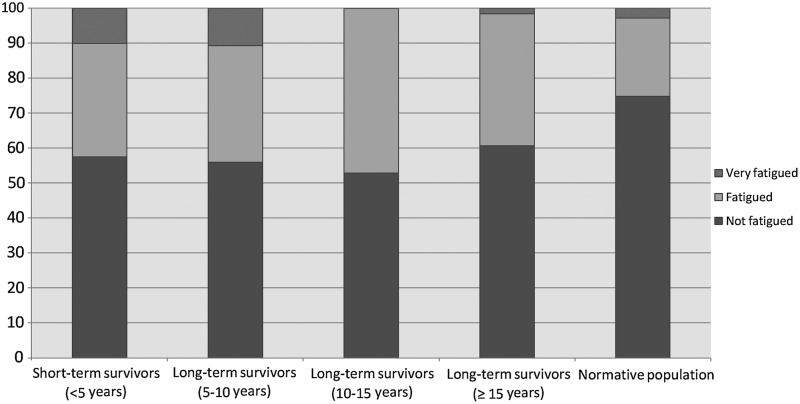
Results: Eighty-six percent (n=306) responded. TC survivors were more often classified as fatigued or very fatigued (short-term <5 years: 43%; long-term 5-10 years: 44%; long-term 10-15 years: 47%; long-term >15 years: 39%) compared to the normative population (25%; p<0.001). Anxiety (odds ratio (OR) 1.15, 95% confidence interval [CI] 1.03-1.28) and depression (OR 1.43 [CI 1.22-1.68]) were associated with fatigue, as was also the case for TC-specific neuromuscular (OR 1.03 [CI 1.01-1.06]), concentration (OR 1.03 [CI 1.01-1.06]), and psychological TC-specific HRQoL (OR 1.06 [CI 1.02-1.10]).
Conclusion: Short- and long-term TC survivors report higher levels of fatigue than an age- and sex-matched normative population do. Both TC-specific HRQoL and psychological distress were associated with fatigue.
Figures
References
-
- Colonna M. Bossard N. Guizard AV. Remontet L. Grosclaude P. Descriptive epidemiology of thyroid cancer in France: incidence, mortality and survival. Ann Endocrinol (Paris) 2010;71:95–101. - PubMed
-
- Howlader N. Noone AM. Krapcho M. Neyman N. Aminou R. Waldron W. Altekruse SF. Kosary CL. Ruhl J. Tatalovich Z. Cho H. Mariotto A. Eisner MP. Lewis DR. Chen HS. Feuer EJ. Cronin KA. Edwards BKe. SEER Cancer Statistics Review. National Cancer Institute; Bethesda, MD: 2010. 1975–2008.
-
- Davies L. Welch HG. Increasing incidence of thyroid cancer in the United States, 1973–2002. JAMA. 2006;295:2164–2167. - PubMed
-
- Pacini F. Castagna MG. Brilli L. Pentheroudakis G. Thyroid cancer: ESMO Clinical Practice Guidelines for diagnosis, treatment and follow-up. Ann Oncol. 2010;21(Suppl 5):v214–v219. - PubMed
-
- Links TP. Huysmans DA. Smit JW. de Heide LJ. Hamming JF. Kievit J. van Leeuwen M. van Pel R. de Klerk JM. van der Wel Y. Guideline “Differentiated thyroid carcinoma,” including diagnosis of thyroid nodules. Ned Tijdschr Geneeskd. 2007;151:1777–1782. - PubMed
Publication types
MeSH terms
LinkOut - more resources
Full Text Sources
Other Literature Sources
Medical