Review
. 2013 Aug;23(8):365-73.
doi: 10.1016/j.tcb.2013.03.006. Epub 2013 Apr 11.

Postage for the messenger: designating routes for nuclear mRNA export

Affiliations
Review

Postage for the messenger: designating routes for nuclear mRNA export

Barbara J Natalizio et al. Trends Cell Biol. 2013 Aug.

Abstract

Transcription of mRNA occurs in the nucleus, making the translocation of mRNA across the nuclear envelope (NE) boundary a critical determinant of proper gene expression and cell survival. A major mRNA export route occurs via the NXF1-dependent pathway through the nuclear pore complexes (NPCs) embedded in the NE. However, recent findings have discovered new evidence supporting the existence of multiple mechanisms for crossing the NE, including both NPC-mediated and NE budding-mediated pathways. An analysis of the trans-acting factors and cis components that define these pathways reveals shared elements as well as mechanistic differences. We review here the current understanding of the mechanisms that characterize each pathway and highlight the determinants that influence mRNA transport fate.

Keywords: exportin; lamin; mRNA export; nuclear envelope; nuclear pore complex; transport.


Figures

Figure 1
Figure 1
NPC-mediated nuclear mRNA export pathways. The major components of the nuclear envelope are the outer nuclear membrane (ONM), inner nuclear membrane (INM), nuclear pore complexes (NPCs), and the nuclear lamina (shaded grey). Of note, lamins are not present in the unicellular organism, S. cerevisiae. The NPC can be divided into three parts: nuclear basket, central channel lined with FG-Nups (brown wavy lines), and cytoplasmic filaments. Export-competent mRNPs assemble in the nucleus. The fate of these mRNAs is dependent on the factors that bind in the nucleus prior to export through the NPC. Major nuclear export receptors are indicated in yellow, whereas adaptor proteins for these receptors are indicated in blue. Higher eukaryotic factors are indicated; however, S. cerevisiae homologues exist for many of these factors. References are cited in the corresponding text. (a) CRM1-mediated mRNA export is RanGTP dependent. LRPPRC binds eIF4E and the RNA element 4E–SE as part of the eIF4E-dependent CRM1-mediated mRNA export pathway. (b) AU-rich element (ARE)-containing mRNAs are bound by the mRNA binding protein HuR that recruits CRM1 via the adaptor proteins, pp32 and APRIL. (c) The tissue-specific factor NXF3 directly interacts with CRM1 and may serve as an adaptor protein for CRM1-mediated mRNA export. (d) The major mRNA export receptor, NXF1 coupled with its heterodimeric partner, NXT1, is required for formation of an export-competent mRNP. REF/Aly serves as an adaptor protein for NXF1. The TREX/THO complex is co-transcriptionally recruited to the mRNP, linking transcription to export. At the cytoplasmic face, NXF1 and NXT1 are remodeled off of the mRNP via the concerted action of DDX19, Gle1, and inositol hexakisphosphate IP6.
Figure 2
Figure 2
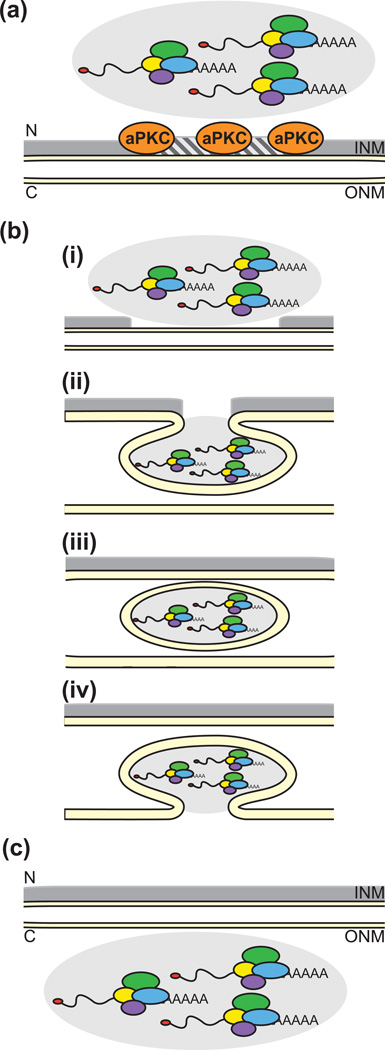
Proposed steps in the NE budding-mediated mRNA export pathway based on [14]. C, cytoplasm; INM, inner nuclear membrane; N, nucleus; ONM, outer nuclear membrane. (a) Formation of intranuclear granules (grey shading) containing endogenous mRNPs is observed, and local disruption of the nuclear lamins is initiated via activity of atypical PKC (aPKC). (b) Changes in the nuclear lamina allow for positioning of the mRNP granule at the INM (i). The INM invaginates to envelope the mRNP granule (ii). Membrane-bound mRNP granule localizes to the perinuclear space between the ONM and INM (iii). The mRNP granule membrane fuses with ONM (iv). (c) The mRNP granule is released into the cytoplasm.

References

    1. Hetzer MW. The nuclear envelope. Cold Spring Harb Perspect Biol. 2010;2 a000539. - PMC - PubMed
    1. Hocine S, et al. RNA processing and export. Cold Spring Harb Perspect Biol. 2010;2 a000752. - PMC - PubMed
    1. Moore MJ, Proudfoot NJ. Pre-mRNA processing reaches back to transcription and ahead to translation. Cell. 2009;136:688–700. - PubMed
    1. Van de Vosse DW, et al. Role of the nuclear envelope in genome organization and gene expression. Wiley Interdiscip Rev Syst Biol Med. 2011;3:147–166. - PMC - PubMed
    1. Antonin W, et al. Traversing the NPC along the pore membrane: targeting of membrane proteins to the INM. Nucleus. 2011;2:87–91. - PMC - PubMed

Publication types