


20-HETE and blood pressure regulation: clinical implications
- PMID: 23584425
- PMCID: PMC4292790
- DOI: 10.1097/CRD.0b013e3182961659
20-HETE and blood pressure regulation: clinical implications
Abstract
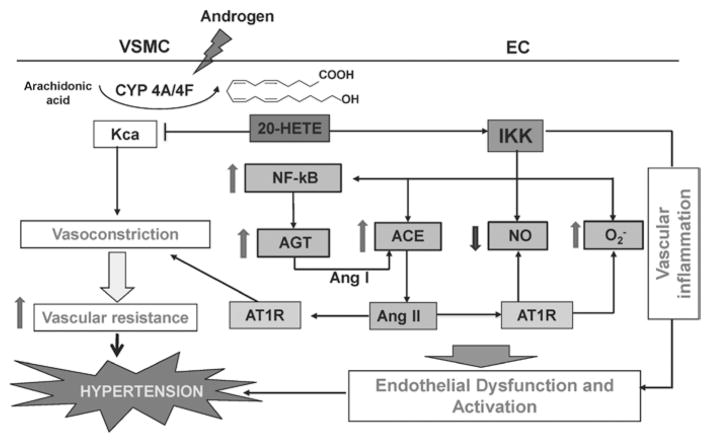
20-Hydroxy-5, 8, 11, 14-eicosatetraenoic acid (20-HETE) is a cytochrome P450 (CYP)-derived omega-hydroxylation metabolite of arachidonic acid. 20-HETE has been shown to play a complex role in blood pressure regulation. In the kidney tubules, 20-HETE inhibits sodium reabsorption and promotes natriuresis, thus, contributing to antihypertensive mechanisms. In contrast, in the microvasculature, 20-HETE has been shown to play a pressor role by sensitizing smooth muscle cells to constrictor stimuli and increasing myogenic tone, and by acting on the endothelium to further promote endothelial dysfunction and endothelial activation. In addition, 20-HETE induces endothelial angiotensin-converting enzyme, thus, setting forth a potential feed forward prohypertensive mechanism by stimulating the renin-angiotensin-aldosterone system. With the advancement of gene sequencing technology, numerous polymorphisms in the regulatory coding and noncoding regions of 20-HETE-producing enzymes, CYP4A11 and CYP4F2, have been associated with hypertension. This in-depth review article discusses the biosynthesis and function of 20-HETE in the cardiovascular system, the pharmacological agents that affect 20-HETE action, and polymorphisms of CYP enzymes that produce 20-HETE and are associated with systemic hypertension in humans.
Conflict of interest statement
The authors have no conflicts of interest to report.
Figures
References
-
- Sacerdoti D, Escalante B, Abraham NG, et al. Treatment with tin prevents the development of hypertension in spontaneously hypertensive rats. Science. 1989;243:388–390. - PubMed
-
- Ito O, Alonso-Galicia M, Hopp KA, et al. Localization of cytochrome P-450 4A isoforms along the rat nephron. Am J Physiol. 1998;274(2 pt 2):F395–F404. - PubMed
-
- Ito O, Roman RJ. Regulation of P-450 4A activity in the glomerulus of the rat. Am J Physiol. 1999;276(6 pt 2):R1749–R1757. - PubMed
-
- Omata K, Abraham NG, Schwartzman ML. Renal cytochrome P-450-arachidonic acid metabolism: localization and hormonal regulation in SHR. Am J Physiol. 1992;262(4 pt 2):F591–F599. - PubMed
Publication types
MeSH terms
Substances
Grants and funding
LinkOut - more resources
Full Text Sources
Other Literature Sources
Medical
