. 2013 Aug;4(4):233-41.
doi: 10.1007/s12672-013-0142-1. Epub 2013 Apr 13.

CREB-regulated transcription co-activator family stimulates promoter II-driven aromatase expression in preadipocytes

Affiliations

CREB-regulated transcription co-activator family stimulates promoter II-driven aromatase expression in preadipocytes

Nirukshi U Samarajeewa et al. Horm Cancer. 2013 Aug.

Abstract

The dramatically increased prevalence of breast cancer after menopause is of great concern and is correlated with elevated local levels of estrogens. This is mainly due to an increase in aromatase expression driven by its proximal promoter II (PII). We have previously demonstrated that the CREB co-activator CRTC2 binds directly to PII and stimulates its activity via mechanisms involving LKB1-AMPK in response to prostaglandin E(2) (PGE(2)). There are three members of the CRTC family (CRTC1-3) and this study aimed to characterize the role of other CRTCs in the activation of aromatase PII. The expression and subcellular localization of CRTCs were examined in preadipocytes using qPCR and immunofluorescence. Under basal conditions, CRTC1 expression was the lowest, whereas CRTC3 transcripts were present at higher levels. Basally, CRTC2 and CRTC3 were mainly cytoplasmic and PGE(2) caused their nuclear translocation. Reporter assays and chromatin immunoprecipitation (ChIP) were performed to assess the effect of CRTCs on PII activity and binding. Basal PII activity was significantly increased with all CRTCs. Forskolin (FSK)/phorbol 12-myristate 13-acetate (PMA), to mimic PGE(2), resulted in a further significant increase in PII activity with all CRTCs, with CRTC2 and CRTC3 having greater effects. This was consistent with ChIP data showing an increased binding of CRTCs to PII with FSK/PMA. Moreover, gene silencing of CRTC2 and CRTC3 significantly reduced the FSK/PMA-mediated stimulation of aromatase activity. Interestingly, CRTCs acted cooperatively with CREB1 to increase PII activity, and both CREs were found to be essential for the maximal induction of PII activity by CRTCs. Phosphorylation of CRTC2 at its AMPK target site, Ser 171, dictated its subcellular localization, and the activation of aromatase PII in preadipocytes. In conclusion, this study demonstrates that aromatase regulation in primary human breast preadipocytes involves more than one CRTC.


Figures
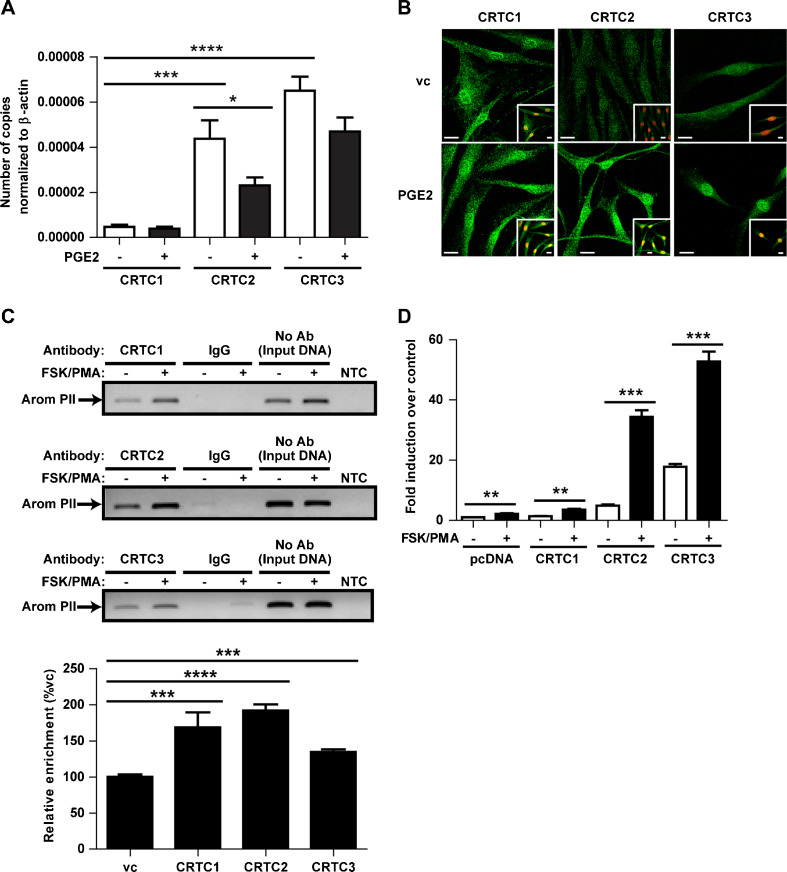
Fig. 1
Fig. 1
Role of CRTCs in aromatase PII activation. a Relative abundance of CRTC transcripts in primary breast preadipocytes with and without PGE2 treatment. b Confocal images of immunofluorescence on endogenous CRTC proteins (green) in primary breast preadipocytes with and without PGE2 treatment, lamin B1 + B2 nuclear stain in red. c Chromatin immunoprecipitation (ChIP) showing endogenous binding of CRTCs to aromatase PII in human breast preadipocytes with and without FSK/PMA treatment. d Reporter assays demonstrating the effect of CRTCs on aromatase PII activity with and without FSK/PMA treatment. vc Vehicle control; mean ± SEM, n = 3 for qPCR and reporter assays; confocal images are representative of the majority of cells examined; scale bar 20.0 μm; all experiments repeated twice
Fig. 2
Fig. 2
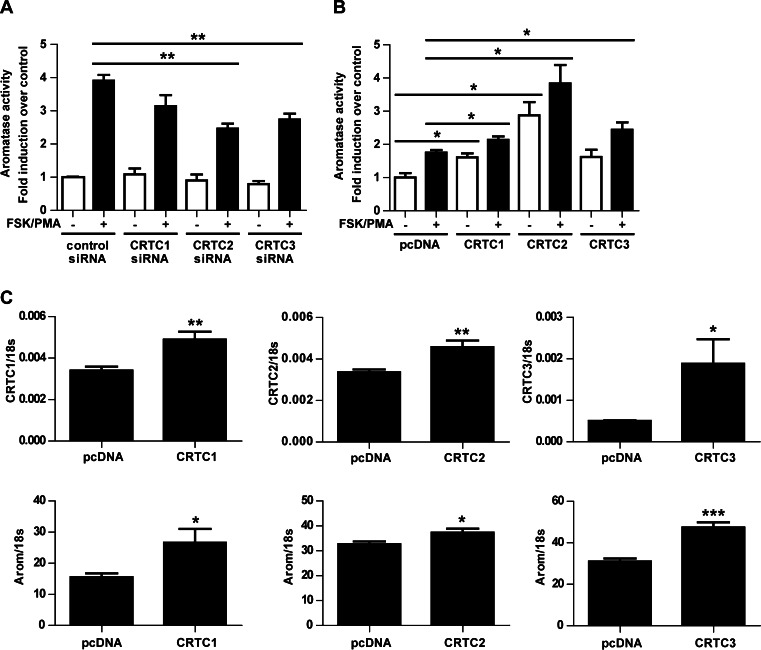
Role of CRTCs in regulating aromatase expression and activity in primary human breast preadipocytes. Aromatase activity assays demonstrating the effect of silencing (a) and overexpressing (b) CRTCs on the FSK/PMA-mediated stimulation of aromatase activity. c Effect of CRTC overexpression on aromatase transcript expression. Mean ± SEM, n = 3, repeated twice
Fig. 3
Fig. 3
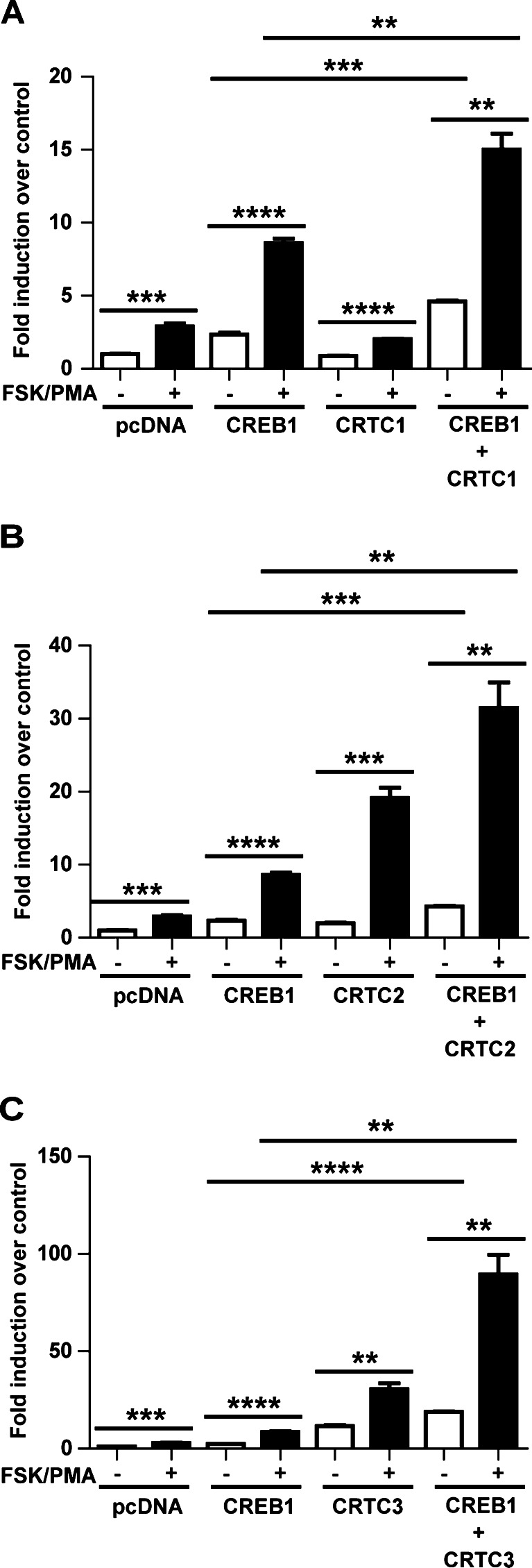
Role of CRTCs and CREB1 in the regulation aromatase PII activity. Reporter assays demonstrating the effect of CREB1 and a CRTC1, b CRTC2, and c CRTC3 on aromatase PII activity with or without FSK/PMA treatment. Mean ± SEM, n = 3, repeated twice
Fig. 4
Fig. 4
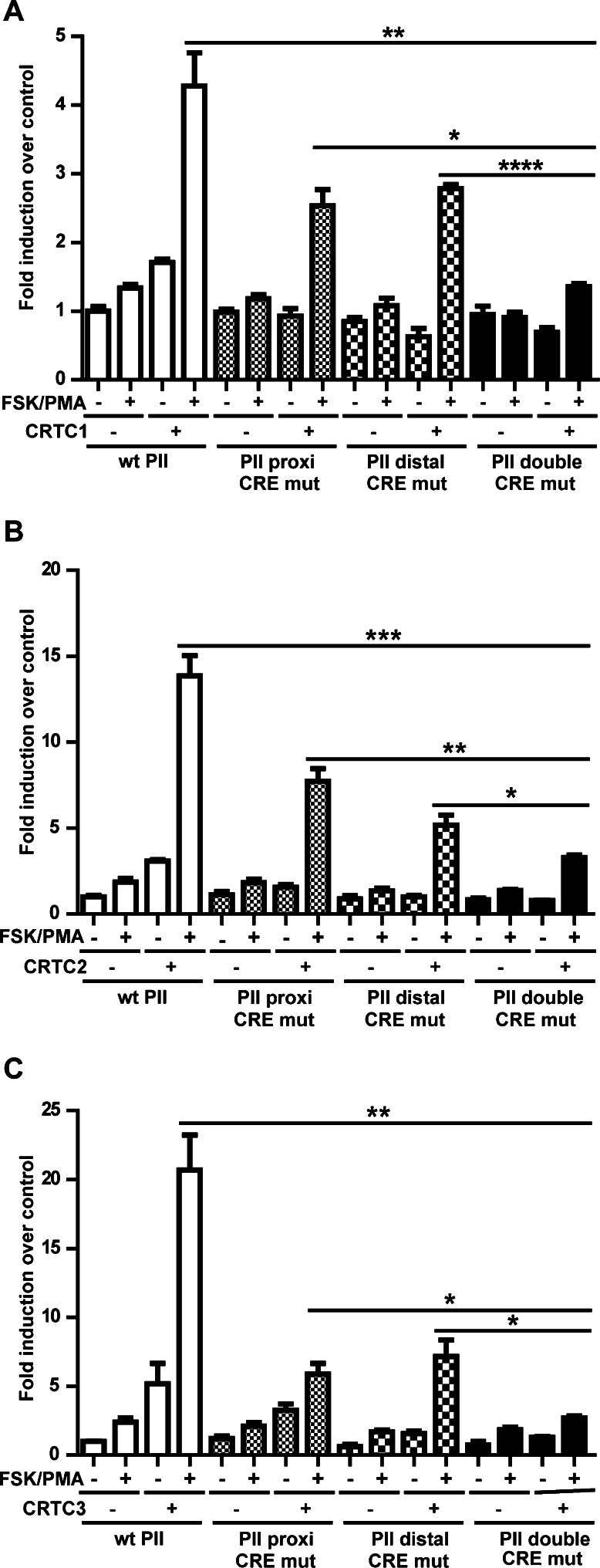
Role of CREs in the activation of aromatase PII. Reporter assays demonstrating the effect of proximal and distal CREs with a CRTC1, b CRTC2, and c CRTC3 on aromatase PII activity with or without FSK/PMA treatment. Mean ± SEM, n = 3, repeated twice
Fig. 5
Fig. 5
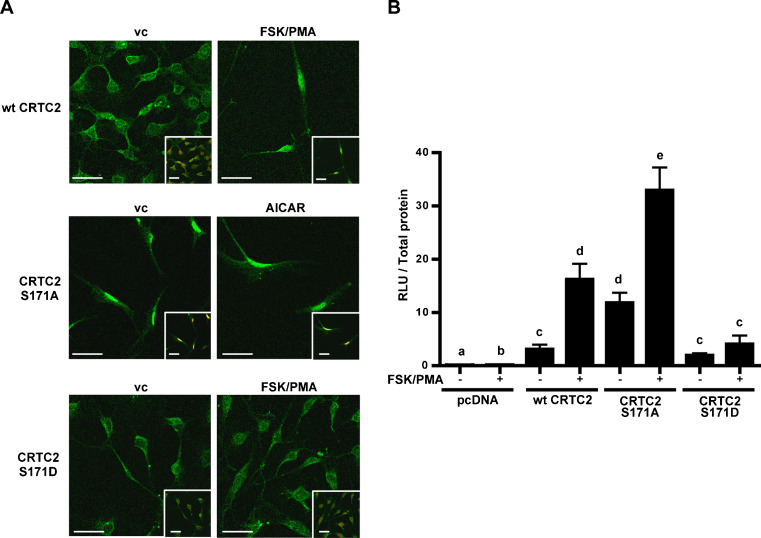
Effect of phosphorylating CRTC2 at Ser171 on its subcellular localization and the activation of aromatase PII in preadipocytes. a Confocal images on overexpressed GFP-tagged wt, S171A and S171D of CRTC2 (green) and immunofluorescence on lamin B1 + B2 nuclear stain in red, with or without FSK/PMA or AICAR treatment. b Reporter assays demonstrating the effect of wt, S171A and S171D of CRTC2 on aromatase PII activity with or without FSK/PMA treatment. vc Vehicle control, RLU relative luciferase units, β-gal β-galactosidase activity. Mean ± SEM, n = 3 for reporter assays, confocal images are representative of the majority of cells examined, scale bar represents 50.0 μm, all experiments repeated twice

References

    1. Simpson ER, Brown KA. Obesity, aromatase and breast cancer. Expert Rev Endocrinol Metab. 2011;6(3):383–395. doi: 10.1586/eem.11.35. - DOI - PubMed
    1. Sofi M, et al. Role of CRE-binding protein (CREB) in aromatase expression in breast adipose. Breast Canc Res Treat. 2003;79(3):399–407. doi: 10.1023/A:1024038632570. - DOI - PubMed
    1. Gonzalez GA, Montminy MR. Cyclic AMP stimulates somatostatin gene transcription by phosphorylation of CREB at serine 133. Cell. 1989;59(4):675–680. doi: 10.1016/0092-8674(89)90013-5. - DOI - PubMed
    1. Roberts DL, Dive C, Renehan AG. Biological mechanisms linking obesity and cancer risk: new perspectives. Annu Rev Med. 2010;61:301–316. doi: 10.1146/annurev.med.080708.082713. - DOI - PubMed
    1. Harvie M, Hooper L, Howell AH. Central obesity and breast cancer risk: a systematic review. Obes Rev. 2003;4(3):157–173. doi: 10.1046/j.1467-789X.2003.00108.x. - DOI - PubMed

Publication types

MeSH terms