. 2006 Feb 1;74(2):123-133.
doi: 10.1119/1.2142789.

Teaching the principles of statistical dynamics

Affiliations

Teaching the principles of statistical dynamics

Kingshuk Ghosh et al. Am J Phys. .

Abstract

We describe a simple framework for teaching the principles that underlie the dynamical laws of transport: Fick's law of diffusion, Fourier's law of heat flow, the Newtonian viscosity law, and the mass-action laws of chemical kinetics. In analogy with the way that the maximization of entropy over microstates leads to the Boltzmann distribution and predictions about equilibria, maximizing a quantity that E. T. Jaynes called "caliber" over all the possible microtrajectories leads to these dynamical laws. The principle of maximum caliber also leads to dynamical distribution functions that characterize the relative probabilities of different microtrajectories. A great source of recent interest in statistical dynamics has resulted from a new generation of single-particle and single-molecule experiments that make it possible to observe dynamics one trajectory at a time.


Figures
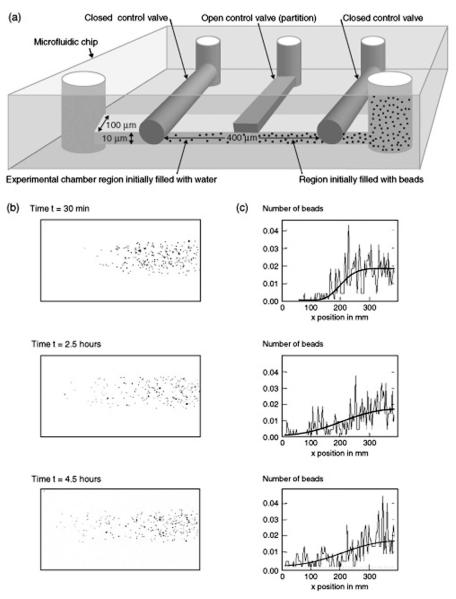
Fig. 1
Fig. 1
Colloidal free expansion setup to illustrate diffusion involving small numbers of particles. (a) Schematic of experimental setup. (b) Several snapshots from the experiment. (c) Normalized histogram of particle positions during the experiment. The solution to the diffusion equation for the microfluidic “free expansion” experiment is superposed for comparison.
Fig. 2
Fig. 2
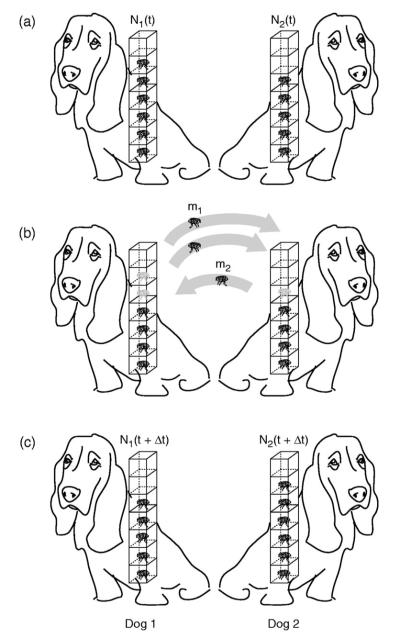
Schematic of the simple dog-flea model. (a) State of the system at time t; (b) a particular microtrajectory in which two fleas jump from the dog on the left and one flea jumps from the dog on the right; (c) occupancies of the dogs at time tt.
Fig. 3
Fig. 3
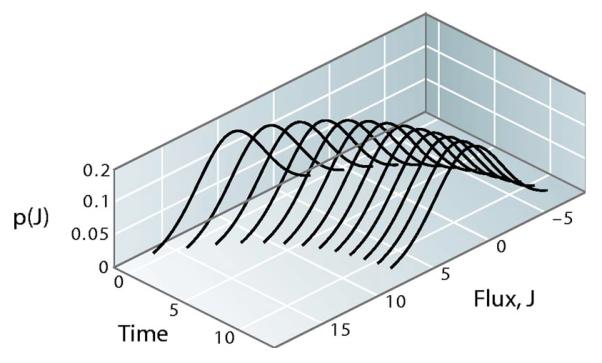
Schematic of the distribution of fluxes for different times as the system approaches equilibrium.
Fig. 4
Fig. 4
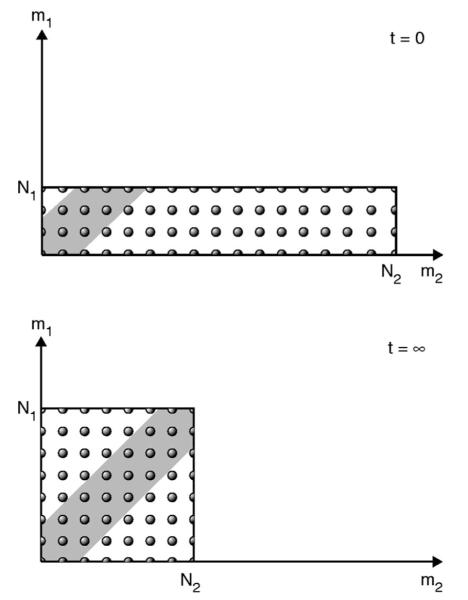
Schematic of which trajectories are potent and which are impotent. The shaded region corresponds to the impotent trajectories for which m1 and m2 are either equal or approximately equal and hence make relatively small change in the macrostate. The unshaded region corresponds to potent trajectories.
Fig. 5
Fig. 5
Illustration of the potency of the microtrajectories associated with different distributions of N particles on the two dogs. The total number of particles N1+N2=N=100.
Fig. 6
Fig. 6
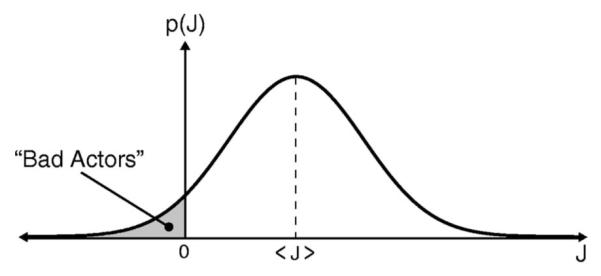
Illustration of the notion of bad actors. Bad actors are the microtrajectories that contribute net particle motion that has the opposite sign from the macroflux.
Fig. 7
Fig. 7
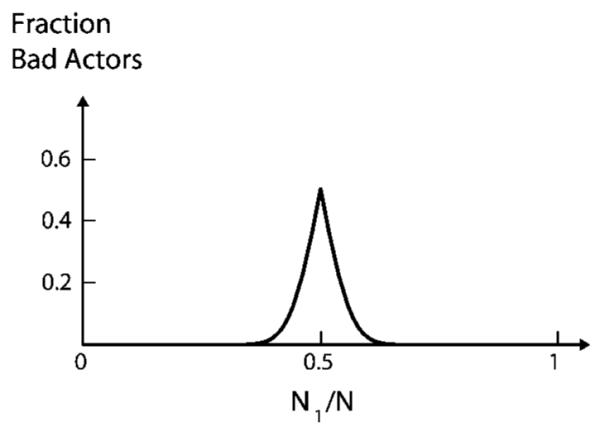
The fraction of all possible trajectories that go against the direction of the macroflux for N=100. The fraction of bad actors is highest at N1=N/2=50.
Fig. 8
Fig. 8
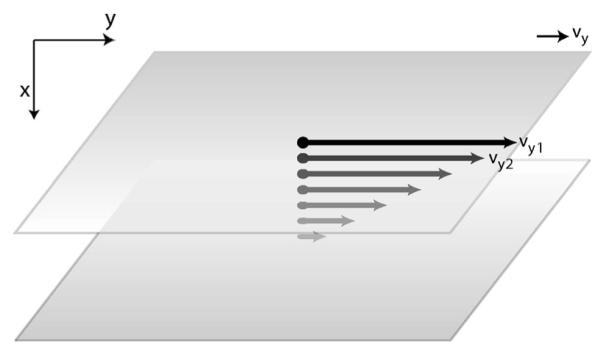
Illustration of Newton’s law of viscosity. The fluid is sheared with a constant stress. The fluid velocity decreases continuously from its maximum value at the top of the fluid to zero at the bottom. There is thus a gradient in the velocity which can be related to the shear stress in the fluid.
Fig. 9
Fig. 9
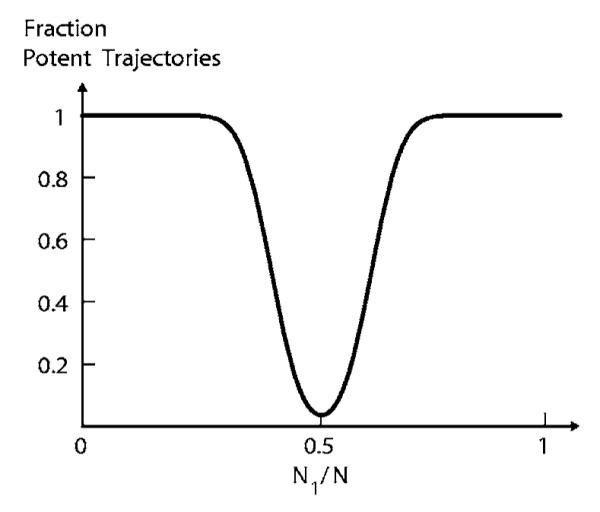
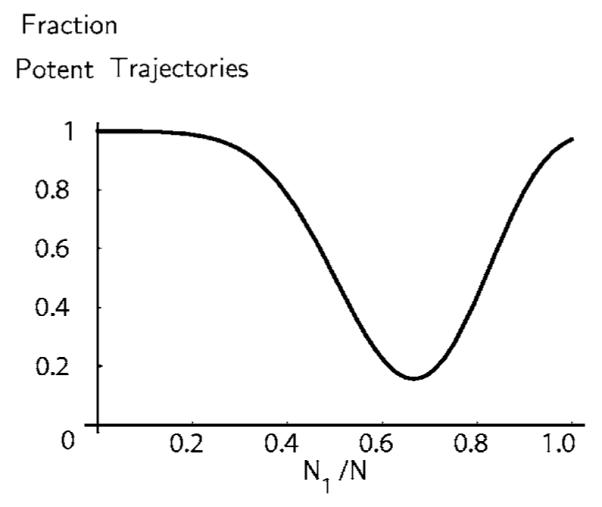
The fraction of potent trajectories Φpotent as a function of N1/N for N1+N2=N=100, and p1=0.1 and p2=0.2. The minimum value of the potency does not occur at N1/N=0.5, but at N1/N=0.66. This value of N1/N also corresponds to its equilibrium value given by p2/(p1+p2).

References

    1. Reif F. Fundamentals of Statistical and Thermal Physics. McGraw-Hill; New York: 1965.
    1. Dill K, Bromberg S. Molecular Driving Forces: Statistical Thermodynamics in Chemistry and Biology. Garland Science; New York: 2003.
    1. Kasianowicz J, Brandin E, Branton D, Deamer D. Characterization of individual polynucleotide molecules using a membrane channel. Proc. Natl. Acad. Sci. U.S.A. 1996;93:13770–13773. - PMC - PubMed
    1. Lu HP, Xun L, Xie XS. Single molecule enzymatic dynamics. Science. 1998;282:1877–1882. - PubMed
    1. Reif M, Rock RS, Mehta AD, Mooseker MS, Cheney RE, Spudich JA. Myosin-V stepping kinetics: A molecular model for processivity. Proc. Natl. Acad. Sci. U.S.A. 2000;97:9482–9486. - PMC - PubMed