. 2013 Jul;169(6):1290-304.
doi: 10.1111/bph.12210.

Functional expression of KCNQ (Kv7) channels in guinea pig bladder smooth muscle and their contribution to spontaneous activity

Affiliations

Functional expression of KCNQ (Kv7) channels in guinea pig bladder smooth muscle and their contribution to spontaneous activity

U A Anderson et al. Br J Pharmacol. 2013 Jul.

Abstract

Background and purpose: The aim of the study was to determine whether KCNQ channels are functionally expressed in bladder smooth muscle cells (SMC) and to investigate their physiological significance in bladder contractility.

Experimental approach: KCNQ channels were examined at the genetic, protein, cellular and tissue level in guinea pig bladder smooth muscle using RT-PCR, immunofluorescence, patch-clamp electrophysiology, calcium imaging, detrusor strip myography, and a panel of KCNQ activators and inhibitors.

Key results: KCNQ subtypes 1-5 are expressed in bladder detrusor smooth muscle. Detrusor strips typically displayed TTX-insensitive myogenic spontaneous contractions that were increased in amplitude by the KCNQ channel inhibitors XE991, linopirdine or chromanol 293B. Contractility was inhibited by the KCNQ channel activators flupirtine or meclofenamic acid (MFA). The frequency of Ca²⁺-oscillations in SMC contained within bladder tissue sheets was increased by XE991. Outward currents in dispersed bladder SMC, recorded under conditions where BK and KATP currents were minimal, were significantly reduced by XE991, linopirdine, or chromanol, and enhanced by flupirtine or MFA. XE991 depolarized the cell membrane and could evoke transient depolarizations in quiescent cells. Flupirtine (20 μM) hyperpolarized the cell membrane with a simultaneous cessation of any spontaneous electrical activity.

Conclusions and implications: These novel findings reveal the role of KCNQ currents in the regulation of the resting membrane potential of detrusor SMC and their important physiological function in the control of spontaneous contractility in the guinea pig bladder.


Figures

Figure 1
Figure 1
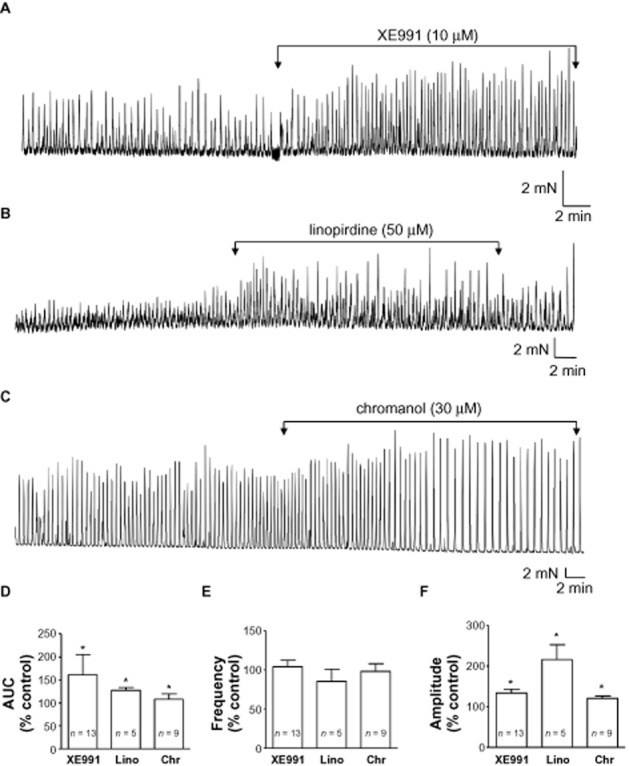
KCNQ channel inhibitors enhance spontaneous contractile activity of bladder strips. (A) An example of the effect of XE991 (10 μM) on myogenic spontaneous activity in a detrusor strip. (B) Linopirdine (Lino; 50 μM) also augmented the amplitude of spontaneous contractions. (C) Example of the increase in contraction amplitude by chromanol 293B (Chr; 30 μM). (D) Summary bar chart of the effect of KCNQ inhibitors on contractility measured as area under curve (AUC) and expressed relative to control (100%). (E) Summary bar chart of the effect of KCNQ inhibitors on frequency. (F) Summary of the effect of KCNQ inhibitors on contraction amplitude. All experiments were carried out in the presence of tetrodotoxin (1 μM). *P < 0.05, significantly different from control.
Figure 2
Figure 2
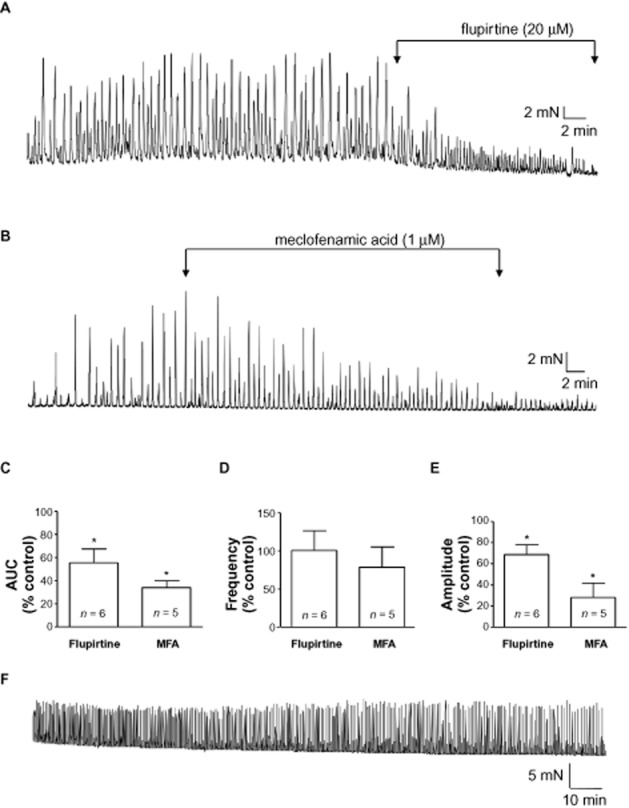
KCNQ channel openers reduce contractility of bladder strips. (A) Example of the reduction in contraction amplitude by the KCNQ opener, flupirtine (20 μM). (B) Meclofenamic acid (MFA; 1 μM) also reduced contraction amplitude. (C, D, E) Summary bar charts for the effects of flupirtine and MFA on contractility measured as area under curve (AUC), frequency and contraction amplitude respectively. All experiments were carried out in the presence of tetrodotoxin (1 μM). *P < 0.05, significantly different from control. (F) Trace from a time-dependent control showing maintenance of spontaneous activity over several hours.
Figure 3
Figure 3
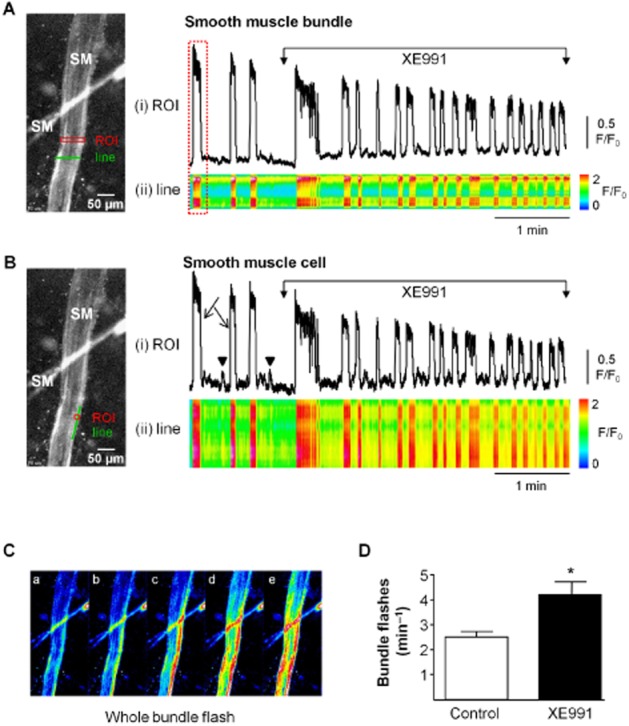
The effect of XE991 on calcium oscillations in SMC within tissue sheets. (A) Bladder tissue preparation loaded with the calcium indicator Fluo-4AM showing 2 smooth muscle bundles (SM). Activity was analysed with a region of interest (ROI) and a line drawn across the bundle. (i) Intensity–time plot of activity in the ROI showing XE991-induced (10 μM) enhancement in the frequency of whole bundle calcium flashes. (ii) Post hoc x-t analysis of fluorescence intensity demonstrates occurrence of the flashes across the width of the bundle. (B) (i) ROI analysis of the smooth muscle cell at the edge of the bundle as indicated on the micrograph showing that activity within a single smooth muscle cell is augmented by XE991. Large Ca2+-transients (arrow) occurred along the length of the cell, as shown in the line analysis below (ii). Smaller, localized Ca2+ events did not propagate along the cell length (arrowhead). Both types of Ca2+ signals were increased by XE991. (C) Consecutive frames from the whole bundle flash highlighted in A show the spread of Ca2+ signal across the bundle from right to left. (D) Summary bar chart of the significant increase in the frequency of smooth muscle bundle flashes by XE991. Control bar refers to pre-drug spontaneous activity. *P < 0.05, significantly different from control: n = 5.
Figure 4
Figure 4
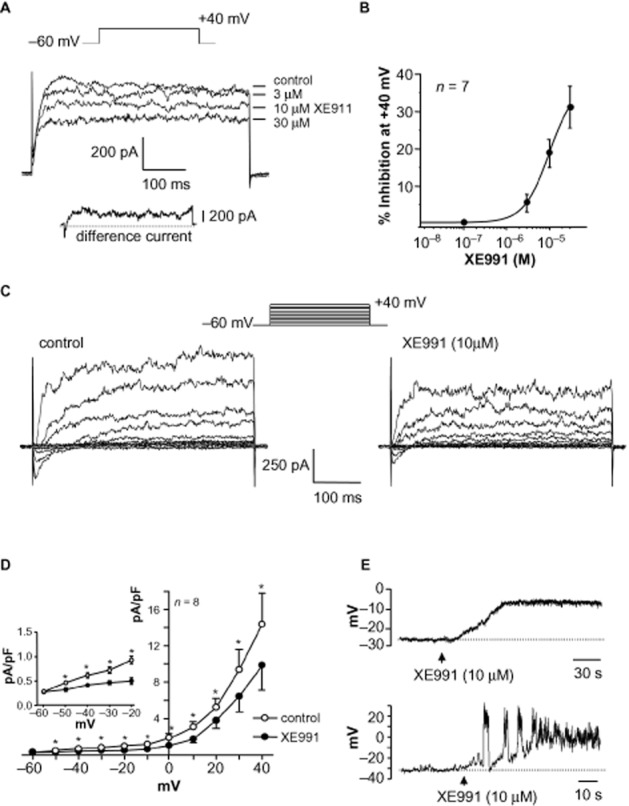
Effect of XE991 on outward current and resting membrane potential in SMC. (A) Currents were evoked by stepping from −60 mV to +40 mV using a pipette solution containing EGTA (5 mM) and ATP (3 mM) to eliminate BK and KATP currents. XE991 reduced the total outward current in a concentration-dependent fashion. The inset trace shows the non-inactivating XE991-sensitive current, obtained by subtracting the trace in 30 μM XE991 from the control trace. (B) Concentration–response curve for the effect of XE991 on peak outward current. Current amplitude in presence of drug was normalized to control and plotted as % inhibition. Mean data for seven cells was fitted with a Hill equation, which calculated the IC50 to be 9.9 ± 0.003 μM. (C) Family of currents evoked by stepping from −60 mV to a range of increasingly positive potentials as denoted in the voltage protocol. XE991 (10 μM) reduced the amplitude of outward currents across the voltage range. (D) Summary current density–voltage graph illustrating the effect of XE991 in eight cells. Inset shows the current density data for −50 mV to −20 mV on an expanded scale. *P < 0.05, significant effect of XE991. (E) An example of the depolarization caused by XE991 (10 μM) in a quiescent SMC (upper trace). The XE991-evoked depolarization was sometimes sufficient to evoke spontaneous transient depolarizations (lower trace).
Figure 5
Figure 5
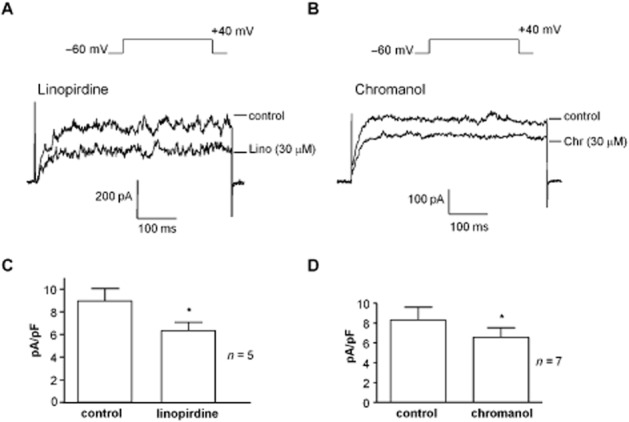
Effect of linopirdine and chromanol on SMC outward current. (A) Currents were evoked by stepping to +40 mV and were reduced by linopirdine (Lino; 30 μM). (B) Outward currents were reduced by chromanol 293B (Chr; 30 μM). (C, D) Summary bar charts of the significant reduction of SMC outward current by linopirdine (n = 5) and chromanol 293B (n = 7). *P < 0.05, significantly different from control.
Figure 6
Figure 6
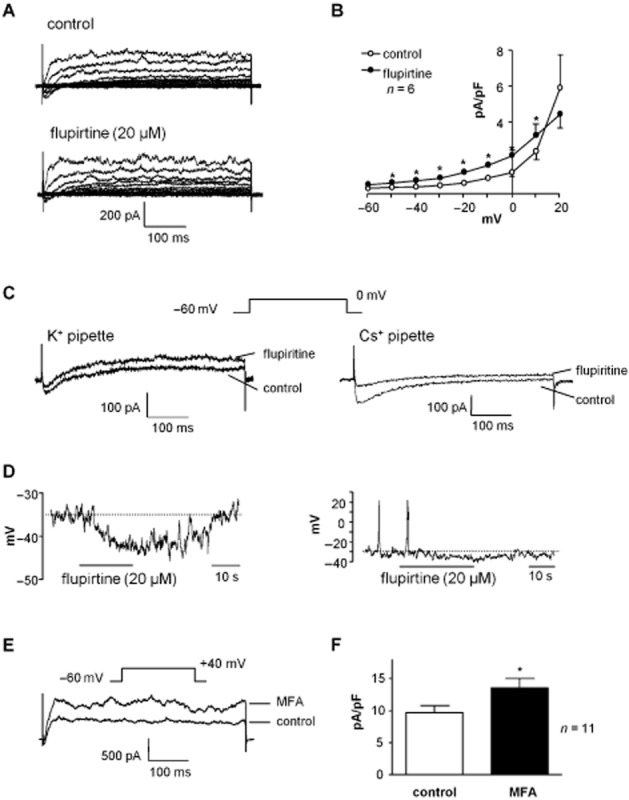
Effect of KCNQ activators on SMC currents and resting membrane potential. (A) Example of a family of outward currents in SMC enhanced by flupirtine (20 μM). (B) Summary of six similar experiments in which flupirtine significantly reduced the outward current at potentials between −50 and +10 mV. (C) The current evoked by stepping to 0 mV had both inward and outward components. Flupirtine reduced the inward component at the beginning of the trace and increased the outward current over the remainder of the sweep. Right panel shows an inward Ca2+ current (at 0 mV), which was recorded using Cs+-filled electrodes in order to eliminate outward K+ currents. Flupirtine reduced the inward current amplitude. (D) Example of a current-clamp recording where flupirtine (20 μM) caused a reversible membrane hyperpolarization in quiescent cells (left panel). Cells which exhibited spontaneous electrical activity in the absence of drugs (right panel) ceased firing on hyperpolarization induced by flupirtine. (E) Meclofenamic acid (MFA, 20 μM) increased amplitude of currents at +40 mV. (F) Summary bar chart showing significant enhancement of current amplitude by MFA in 11 cells. *P < 0.05, significantly different from control.
Figure 7
Figure 7
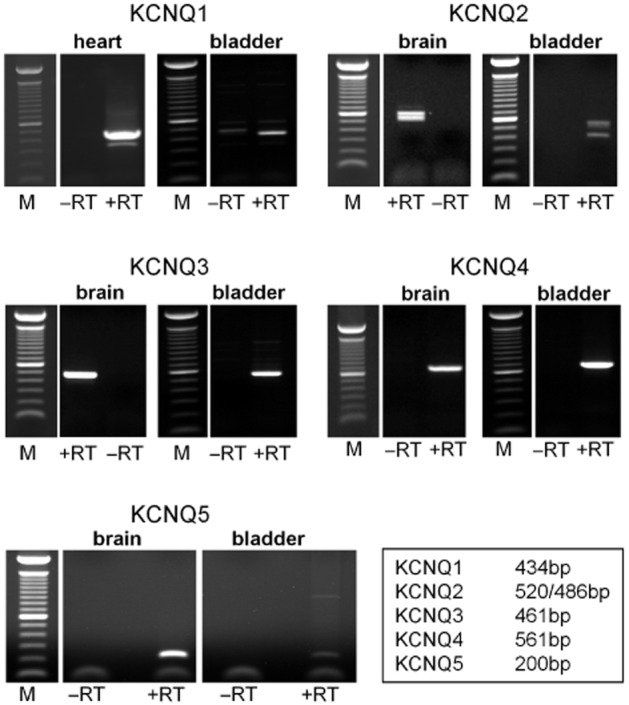
Identification of KCNQ genes in guinea pig bladder cells. RT-PCR analysis of KCNQ1-5 gene family members in RNA extracted from dispersed guinea pig detrusor cells. Guinea pig heart and brain tissues were used as positive controls. ‘+RT’ and ‘−RT’ represent the inclusion or omission of reverse transcriptase respectively in the reverse transcription of mRNA to cDNA process. Bands corresponding to KCNQ1-5, as indicated by the base pair table, were detected in guinea pig detrusor cells.
Figure 8
Figure 8
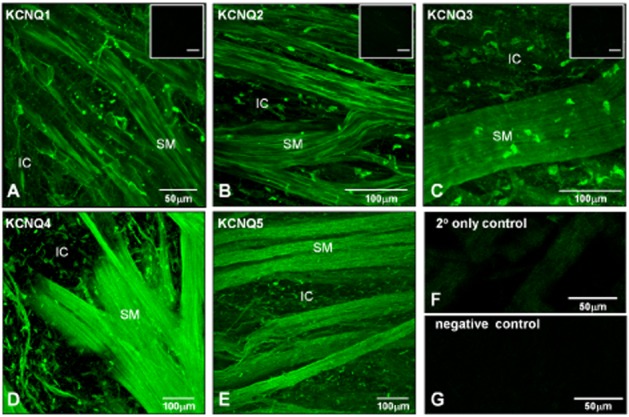
Detection of KCNQ gene expression by immunohistochemistry. (A–E) Whole-mount preparations of guinea pig detrusor were incubated with antibodies to KCNQ1-5 subtypes. Immunoreactivity was detected in both smooth muscle bundles (SM) and in IC adjacent to and between the smooth muscle bundles for the five KCNQ subtypes tested. Inset micrographs in (A–C) show minimal immunofluorescence in pre-absorption controls for KCNQ1-3; the scale bars indicate 50 μm. (F) Micrograph of secondary antibody only control slide, showing minimal immunofluorescence. (G) Micrograph of negative control (no antibodies) demonstrating absence of autofluorescence.

References

    1. Aiken SP, Lampe BJ, Murphy PA, Brown BS. Reduction of spike frequency adaptation and blockade of M-current in rat CA1 pyramidal neurones by linopirdine (DuP 996), a neurotransmitter release enhancer. Br J Pharmacol. 1995;115:1163–1168. - PMC - PubMed
    1. Alexander SP, Mathie A, Peters JA. Guide to Receptors and Channels (GRAC), 5th edition. Br J Pharmacol. 2011;164(Suppl. 1):S1–S324. - PMC - PubMed
    1. Anderson UA, Carson C, McCloskey KD. KCNQ currents and their contribution to resting membrane potential and the excitability of interstitial cells of Cajal from the guinea pig bladder. J Urol. 2009;182:330–336. - PMC - PubMed
    1. Baker SA, Hennig GW, Han J, Britton FC, Smith TK, Koh SD. Methionine and its derivatives increase bladder excitability by inhibiting stretch-dependent K+ channels. Br J Pharmacol. 2008;153:1259–1271. - PMC - PubMed
    1. Beckett EA, Han I, Baker SA, Han J, Britton FC, Koh SD. Functional and molecular identification of pH-sensitive K+ channels in murine urinary bladder smooth muscle. BJU Int. 2008;102:113–124. - PubMed

Publication types

MeSH terms