


Measles, mumps and rubella (MMR) vaccination has no effect on cognitive development in children - the results of the Polish prospective cohort study
- PMID: 23588083
- PMCID: PMC3684783
- DOI: 10.1016/j.vaccine.2013.03.057
Measles, mumps and rubella (MMR) vaccination has no effect on cognitive development in children - the results of the Polish prospective cohort study
Abstract
Objectives: The aim of the study was to examine the hypothesis that MMR exposure has a negative influence on cognitive development in children. Furthermore, MMR was compared to single measles vaccine to determine the potential difference of these vaccines safety regarding children's cognitive development.
Methods: The prospective birth cohort study with sample consisted of 369 infants born in Krakow. Vaccination history against measles (date and the type of the vaccine) was extracted from physicians' records. Child development was assessed using the Bayley Scales of Infant Development (BSID-II) up to 3rd year of life, Raven test in 5th and 8th year and Wechsler (WISC-R) in 6th and 7th year. Data on possible confounders came from mothers' interview, medical records and analyses of lead and mercury level at birth and at the end of 5th year of life. Linear and logistic regression models adjusted for potential confounders were used to assess the association.
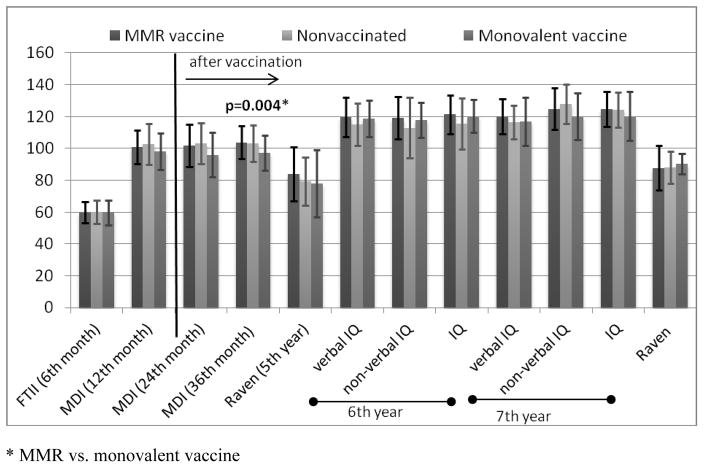
Results: No significant differences in cognitive and intelligence tests results were observed between children vaccinated with MMR and those not vaccinated up to the end of the 2nd year of life. Children vaccinated with MMR had significantly higher Mental BSID-II Index (MDI) in the 36th month than those vaccinated with single measles vaccine (103.8±10.3 vs. 97.2±11.2, p=0.004). Neither results of Raven test nor WISC-R were significantly different between groups of children vaccinated with MMR and with single measles vaccine. After standardization to child's gender, maternal education, family economical status, maternal IQ, birth order and passive smoking all developmental tests were statistically insignificant.
Conclusion: The results suggest that there is no relationship between MMR exposure and children's cognitive development. Furthermore, the safety of triple MMR is the same as the single measles vaccine with respect to cognitive development.
Copyright © 2013 Elsevier Ltd. All rights reserved.
Figures
References
-
- Casiday R, Cresswell T, Wilson D, Panter-Brick C. A survey of UK parental attitudes to the MMR vaccine and trust in medical authority. Vaccine. 2006;24(2):177–84. - PubMed
-
- Guillaume L, Bath PA. A content analysis of mass media sources in relation to the MMR vaccine scare. Health Informatics J. 2008;14(4):323–34. - PubMed
-
- Casiday R. Uncertainty, decision-making and trust: lessons from the MMR controversy. Community Pract. 2006;79(11):354–7. - PubMed
-
- Brown KF, Kroll JS, Hudson MJ, Ramsay M, Green J, Long SJ, Vincent CA, Fraser G, Sevdalis N. Factors underlying parental decisions about combination childhood vaccinations including MMR: a systematic review. Vaccine. 2010;28(26):4235–48. - PubMed
Publication types
MeSH terms
Substances
Grants and funding
LinkOut - more resources
Full Text Sources
Other Literature Sources
