


It takes 2: partner attributes associated with sexually transmitted infections among adolescents
- PMID: 23588126
- PMCID: PMC3894602
- DOI: 10.1097/OLQ.0b013e318283d2c9
It takes 2: partner attributes associated with sexually transmitted infections among adolescents
Abstract
Objectives: The aims of this study were to identify partner attributes associated with sexually transmitted infections (STIs) among adolescents and to summarize implications for research and prevention.
Design: The design of this study was systematic review.
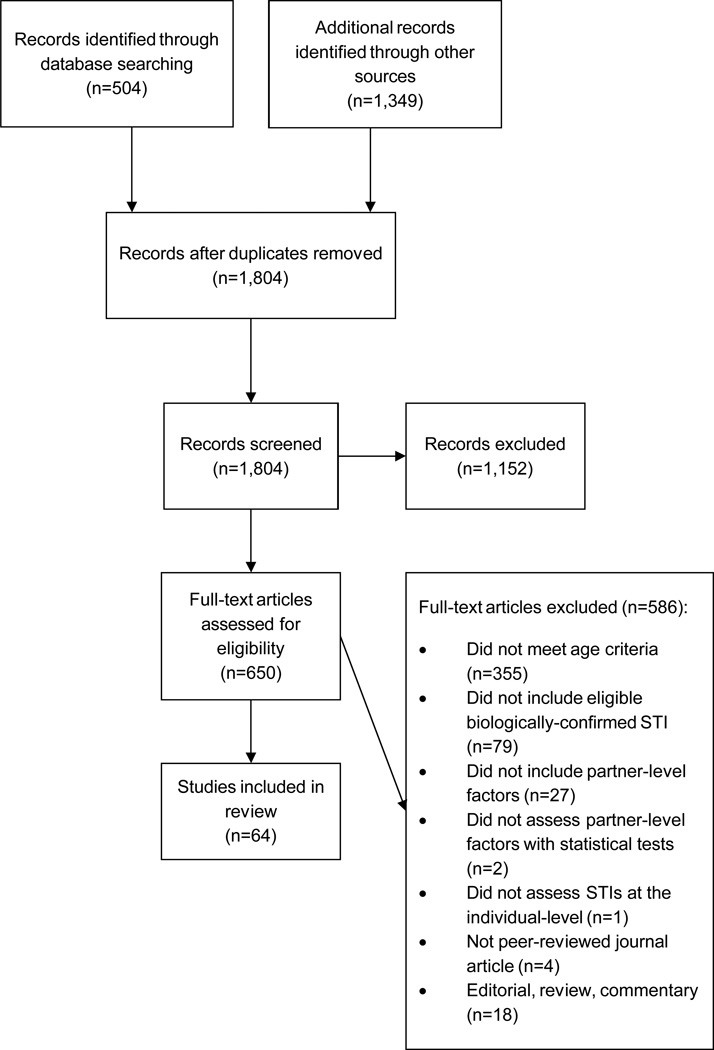
Methods: We identified peer-reviewed studies published in 1990 through 2010 that assessed 1 or more partner attributes in relation to a biologically confirmed STI among adolescents (15-24 years) by searching MEDLINE and included articles. Studies that included adolescents but more than 50% of the sample or with mean or median age of 25 years or greater were excluded.
Results: Sixty-four studies met the eligibility criteria; 61% were conducted in high-income countries; 80% were cross sectional; and 91% enrolled females and 42% enrolled males. There was no standard "partner" definition. Partner attributes assessed most frequently included the following: age, race/ethnicity, multiple sex partners, and STI symptoms. Older partners were associated with prevalent STIs but largely unrelated to incidence. Black race was associated with STIs but not uniformly. Partners with multiple partners and STI symptoms seem to be associated with STIs predominantly among females. Although significant associations were reported, weaker evidence exists for the following: other partner sociodemographics, sexual and other behaviors (sexual concurrency, intimate partner violence, substance use, travel), and STI history. There were no apparent differences by STI.
Conclusions: Partner attributes are independently associated with STIs among male and female adolescents worldwide. These findings reinforce the importance of assessing partner attributes when determining STI risk. Prevention efforts should continue to promote and address barriers to condom use. Increased efforts are needed to screen and treat STIs and reduce risky behavior among men. A standard partner definition would facilitate the interpretation of findings in future studies.
Conflict of interest statement
Figures
References
-
- Dehne KL. Sexually transmitted infections among adolescents: The need for adequate health services. Geneva, Switzerland: World Health Organization and Deutsche Gesellschaft fuer Technische Zusammenarbeit; 2005.
-
- DiClemente RJ, Salazar LF, Crosby RA. A review of STD/HIV preventive interventions for adolescents: Sustaining effects using an ecological approach. J Pediatr Psychol. 2007;32(8):888–906. - PubMed
-
- Wilson SR, Lavori PW, Brown NL, et al. Correlates of sexual risk for HIV infection in female members of heterosexual California Latino couples: An application of a Bernoulli process model. AIDS Behav. 2003;7(3):273–290. - PubMed
-
- Sawyer SM, Afifi RA, Bearinger LH, et al. Adolescence: A foundation for future health. Lancet. 2012;379(9826):1630–1640. - PubMed
-
- Drumright LN, Gorbach PM, Holmes KK. Do people really know their sex partners? concurrency, knowledge of partner behavior, and sexually transmitted infections within partnerships. Sex Transm Dis. 2004;31(7):437–442. - PubMed
Publication types
MeSH terms
Grants and funding
LinkOut - more resources
Full Text Sources
Other Literature Sources
Medical
Miscellaneous
