Can serum surfactant protein D or CC-chemokine ligand 18 predict outcome of interstitial lung disease in patients with early systemic sclerosis?
- PMID: 23588945
- PMCID: PMC3728890
- DOI: 10.3899/jrheum.120997
Can serum surfactant protein D or CC-chemokine ligand 18 predict outcome of interstitial lung disease in patients with early systemic sclerosis?
Abstract
Objective: To examine the predictive significance of 2 pneumoproteins, surfactant protein D (SP-D) and CC-chemokine ligand 18 (CCL18), for the course of systemic sclerosis (SSc)-related interstitial lung disease.
Methods: The pneumoproteins were determined in the baseline plasma samples of 266 patients with early SSc enrolled in the GENISOS observational cohort. They also were measured in 83 followup patient samples. Pulmonary function tests were obtained annually. The primary outcome was decline in forced vital capacity (FVC percentage predicted) over time. The predictive significance for longterm change in FVC was investigated by a joint analysis of longitudinal measurements (sequentially obtained FVC percentage predicted) and survival data.
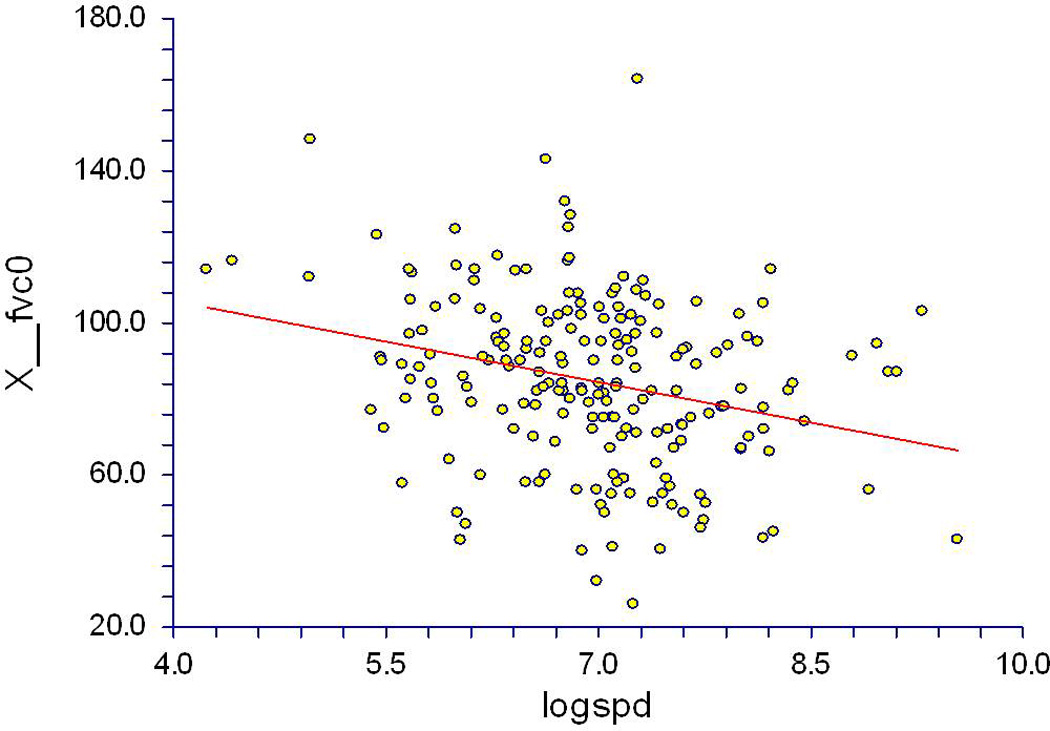
Results: SP-D and CCL18 levels were both higher in patients with SSc than in matched controls (p < 0.001 and p = 0.015, respectively). Baseline SP-D levels correlated with lower concomitantly obtained FVC (r = -0.27, p < 0.001), but did not predict the short-term decline in FVC at 1 year followup visit or its longterm decline rate. CCL18 showed a significant correlation with steeper short-term decline in FVC (p = 0.049), but was not a predictor of its longterm decline rate. Similarly, a composite score of SP-D and CCL18 was a significant predictor of short-term decline in FVC but did not predict its longterm decline rate. Further, the longitudinal change in these 2 pneumoproteins did not correlate with the concomitant percentage change in FVC.
Conclusion: SP-D correlated with concomitantly obtained FVC, while CCL18 was a predictor of short-term decline in FVC. However, neither SP-D nor CCL18 was a longterm predictor of FVC course in patients with early SSc.
Keywords: CC-CHEMOKINE LIGAND 18; INTERSTITIAL LUNG DISEASE; SURFACTANT D; SYSTEMIC SCLEROSIS.
Figures
Comment in
-
The ambitious goal of validating prognostic biomarkers for systemic sclerosis-related interstitial lung disease.J Rheumatol. 2013 Jul;40(7):1034-6. doi: 10.3899/jrheum.130549. J Rheumatol. 2013. PMID: 23818721 No abstract available.
References
-
- Elhai M, Meune C, Avouac J, Kahan A, Allanore Y. Trends in mortality in patients with systemic sclerosis over 40 years: A systematic review and meta-analysis of cohort studies. Rheumatology. 2012;51:1017–1026. - PubMed
-
- Thomas E, Symmons DP, Brewster DH, Black RJ, Macfarlane GJ. National study of cause-specific mortality in rheumatoid arthritis, juvenile chronic arthritis, and other rheumatic conditions: A 20 year followup study. J Rheumatol. 2003;30:958–965. - PubMed
-
- Tyndall AJ, Bannert B, Vonk M, Airo P, Cozzi F, Carreira PE, et al. Causes and risk factors for death in systemic sclerosis: A study from the EULAR Scleroderma Trials and Research (EUSTAR) database. Ann Rheum Dis. 2010;69:1809–1815. - PubMed
Publication types
MeSH terms
Substances
Grants and funding
- T32 AR052283/AR/NIAMS NIH HHS/United States
- P50 AR054144/AR/NIAMS NIH HHS/United States
- N01 AR002251/AR/NIAMS NIH HHS/United States
- K23 AR061436/AR/NIAMS NIH HHS/United States
- 1U01AI09090-01/AI/NIAID NIH HHS/United States
- UL1 RR024148/RR/NCRR NIH HHS/United States
- R01 AR055258/AR/NIAMS NIH HHS/United States
- U01 AI090909/AI/NIAID NIH HHS/United States
- M01 RR00073/RR/NCRR NIH HHS/United States
- M01 RR000073/RR/NCRR NIH HHS/United States
- TL1 RR024147/RR/NCRR NIH HHS/United States
- M01 RR001346/RR/NCRR NIH HHS/United States
- M01 RR01346/RR/NCRR NIH HHS/United States
LinkOut - more resources
Full Text Sources
Other Literature Sources
Medical