. 2013 May;88(5):817-827.
doi: 10.4269/ajtmh.12-0007. Epub 2013 Apr 15.

Mathematical models of within-host and transmission dynamics to determine effects of malaria interventions in a variety of transmission settings

Mathematical models of within-host and transmission dynamics to determine effects of malaria interventions in a variety of transmission settings

Philip Eckhoff. Am J Trop Med Hyg. 2013 May.

Abstract

A model for Anopheles population dynamics and malaria transmission is combined with a within-host dynamics microsolver to study baseline transmission, the effects of seasonality, and the impact of interventions. The Garki Project is recreated in simulation of the pre-intervention baseline and the different combinations of interventions deployed. Modifications are introduced, and longer project duration, extension of dry-season spraying, and transmission-blocking vaccines together achieve local elimination in some conditions. A variety of interventions are simulated in transmission settings that vary in transmission intensity and underlying seasonality. Adding vaccines to existing vector control efforts extends the ability to achieve elimination to higher baseline transmission and less favorable vector behavior. If one species of the Anopheles gambiae species complex feeds disproportionately outdoors for a given complex average behavior, vector control impacts are less than for a single species. Non-zero dry-season transmission limits seasonal oscillation in parasite dynamics and impact of wet-season interventions.


Conflict of interest statement

Disclosure: The author is employed by the Global Good Fund at Intellectual Ventures, LLC on a malaria modeling project. The models, software, and results will be freely available, so no financial or other conflict of interest exists. This statement is made in the interest of full disclosure and not because the author believes there is a conflict of interest.

Figures

Figure 1.
Figure 1.
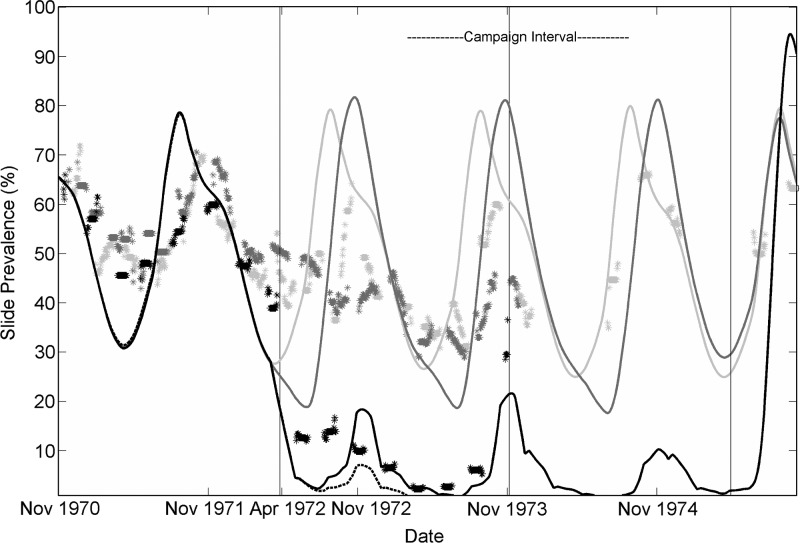
Reconstruction of the Garki Project outcomes with the detailed mechanistic within-host model and vector dynamics modeled after Garki. Light gray is baseline, then indoor residual spraying (IRS) in dark gray, then IRS plus mass drug administration in black. The dotted black line shows the potential impact of overlaying the IRS plus mass drug administration campaign with mass distribution of a sexual-stage transmission-blocking vaccine with 50% efficacy at reducing transmission from humans to mosquitoes.
Figure 2.
Figure 2.
Modification of the Garki Project campaign, extending the overall campaign duration to 36 months and with spray campaigns scheduled to maintain indoor residual spraying (IRS) efficacy over a window from one month before the rainy season until one month into the dry season. For the propoxur campaign used in Garki, this would require an additional spray round in the dry season leading into the rainy season. Light gray is baseline, then IRS in dark gray, then IRS plus mass drug administration in black. The dotted black line shows the potential impact of adding mass distribution of a sexual-stage vaccine with 50% efficacy to the IRS plus mass drug administration campaign.
Figure 3.
Figure 3.
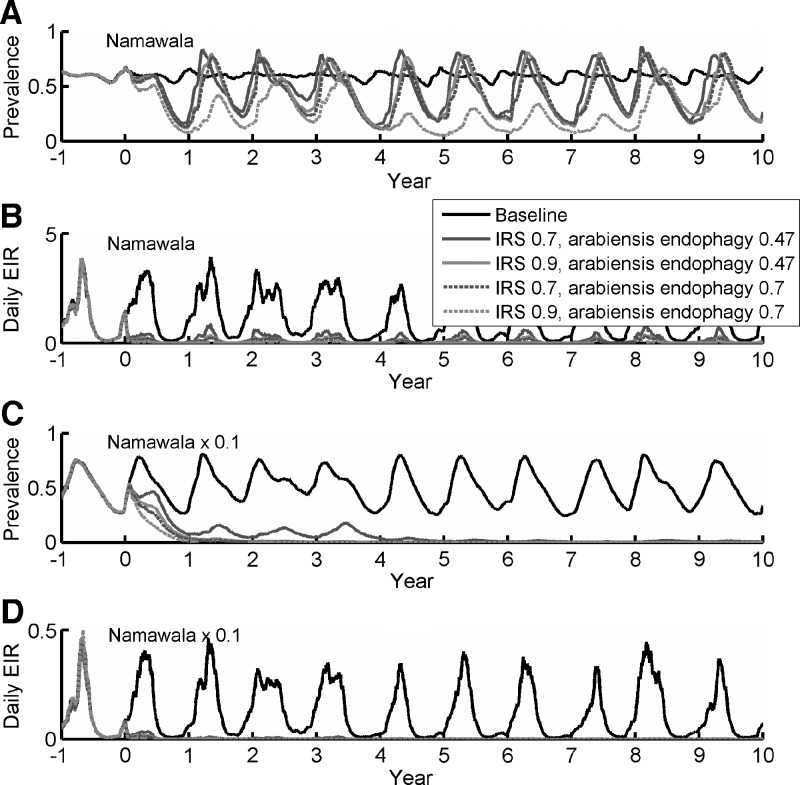
Effect of indoor residual spraying (IRS) campaigns on detected prevalence (A and C) and daily entomologic inoculation rate (EIR) (B and D). Simulations use Namawala, Tanzania weather and mixture of vector species, with (A and B) based on actual Namawala EIR and with the vector populations in (C and D) reduced to 0.1 of original values. Results are shown for two separate values of Anopheles arabiensis endophagy. Disease persists for all simulations in (A and B), but disease fades out in (C and D) with the exception of the 70% IRS coverage for An. arabiensis feeding indoors only 47% of the time.
Figure 4.
Figure 4.
Effect of partitioning Anopheles gambiae sensu lato into An. gambiae sensu stricto and An. arabiensis. A and B, Effect of 70% coverage of indoor residual spraying (IRS) on detected prevalence and daily entomolgic inoculation rate (EIR) for even partition of the complex into its components (solid line) and 90% dominance by An. arabiensis (dashed line). C and D, Simulation of campaign and the impact of An. gambiae complex partition are repeated for IRS with 90% coverage.
Figure 5.
Figure 5.
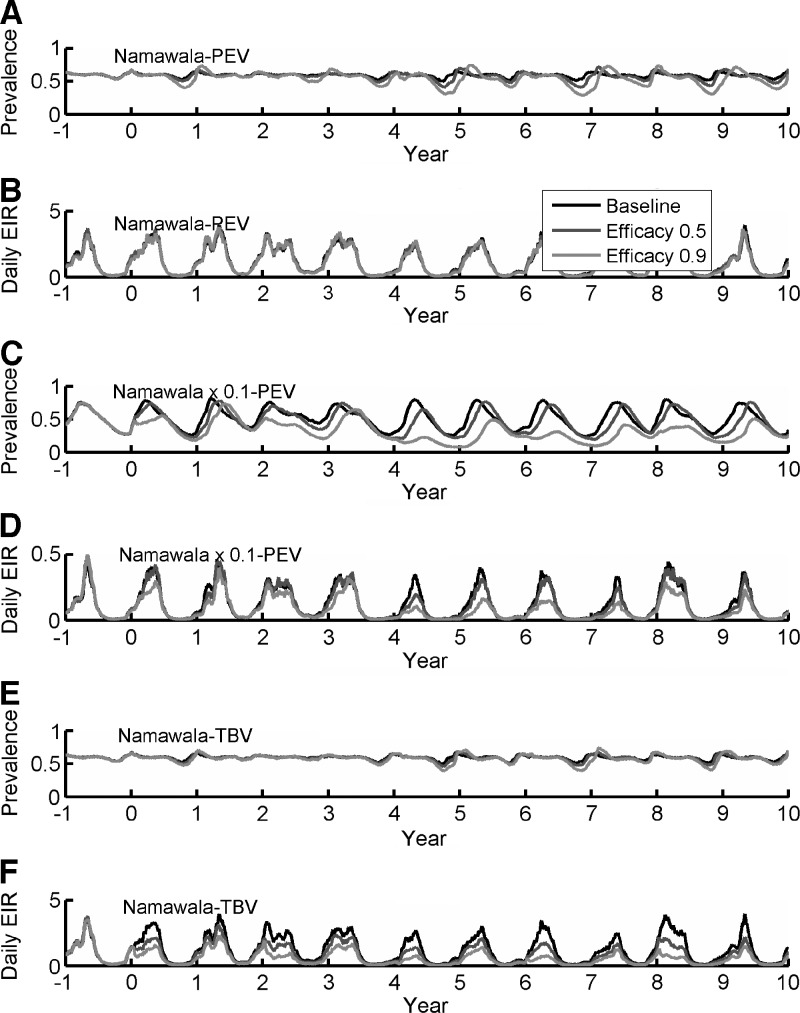
Effects on detected prevalence and daily entomologic inoculation rate induced by pre-erythrocytic (A–D) and sexual-stage transmission-blocking (E and F) vaccines introduced in Namawala, Tanzania (A, B, E, and F) and 0.1 Namawala intensity (C and D). PEV = pre-erythrocytic vaccine; TBV = transmission-blocking vaccine.
Figure 6.
Figure 6.
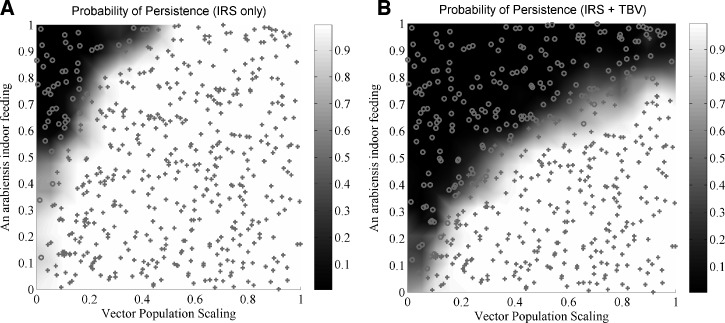
Plots of the probability of disease persistence for (A) indoor residual spraying (IRS) and (B) IRS plus a sexual-stage transmission-blocking vaccine (TBV), as a function of the indoor feeding propensity of Anopheles arabiensis and the scaling of the vector population. Simulations based on Namawala, Tanzania seasonality and vector composition with a simple infection model.
Figure 7.
Figure 7.
Effects of combining mass vaccination with vector control for pre-erythrocytic vaccine (PEV) (A and B) and sexual-stage transmission-blocking vaccine (TBV) (C and D) in Namawala, Tanzania. Baseline dynamics are presented with the vaccine by itself and the vaccine combined with 70% coverage with indoor residual spraying (IRS) for Anopheles arabiensis indoor feeding values of 0.47 and 0.7. EIR = entomologic inoculation rate.
Figure 8.
Figure 8.
Efficacy decay profiles for insecticide-treated nets (ITNs) and effect on dynamics for Namawala, Tanzania dynamics and simple infection model. A, Baseline, no bed nets. B, ITNs distributed every five years with a four-year box efficacy. C, ITNs distributed every five years with an exponentially decaying efficacy with a four-year time constant. D, ITNs distributed every five years, with efficacy constant for two years, followed by exponential decay with a four-year time constant. EIR = entomologic inoculation rate.

Comment in

References

    1. Snow RW, Guerra CA, Noor AM, Myint HY, Hay SI. The global distribution of clinical episodes of Plasmodium falciparum malaria. Nature. 2005;434:214–217. - PMC - PubMed
    1. World Health Organization . World Malaria Report: 2011. Geneva: World Health Organization; 2011.
    1. Hay SI, Guerra CA, Gething PW, Patil AP, Tatem AJ, Noor AM, Kabaria CW, Manh BH, Elyazar IR, Brooker S, Smith DL, Moyeed RA, Snow RW. A world malaria map: Plasmodium falciparum endemicity in 2007. PLoS Med. 2009;6:e1000048. - PMC - PubMed
    1. Hay SI, Sinka ME, Okara RM, Kabaria CW, Mbithi PM, Tago CC, Benz D, Gething PW, Howes RE, Patil AP, Temperley WH, Bangs MJ, Chareonviriyaphap T, Elyazar IR, Harbach RE, Hemingway J, Manguin S, Mbogo CM, Rubio-Palis Y, Godfray HC. Developing global maps of the dominant Anopheles vectors of human malaria. PLoS Med. 2010;7:e1000209. - PMC - PubMed
    1. Gimnig JE, Kolczak MS, Hightower AW, Vulule JM, Schoute E, Kamau L, Phillips-Howard PA, Ter Kuile FO, Nahlen BL, Hawley WA. Effect of permethrin-treated bed nets on the spatial distribution of malaria vectors in western Kenya. Am J Trop Med Hyg. 2003;68:115–120. - PubMed

Publication types

MeSH terms

Substances

LinkOut - more resources