Review
. 2013 May 20;31(15):1825-33.
doi: 10.1200/JCO.2013.48.7215. Epub 2013 Apr 15.

Clinical analysis and interpretation of cancer genome data

Affiliations
Review

Clinical analysis and interpretation of cancer genome data

Eliezer M Van Allen et al. J Clin Oncol. .

Abstract

The scale of tumor genomic profiling is rapidly outpacing human cognitive capacity to make clinical decisions without the aid of tools. New frameworks are needed to help researchers and clinicians process the information emerging from the explosive growth in both the number of tumor genetic variants routinely tested and the respective knowledge to interpret their clinical significance. We review the current state, limitations, and future trends in methods to support the clinical analysis and interpretation of cancer genomes. This includes the processes of genome-scale variant identification, including tools for sequence alignment, tumor-germline comparison, and molecular annotation of variants. The process of clinical interpretation of tumor variants includes classification of the effect of the variant, reporting the results to clinicians, and enabling the clinician to make a clinical decision based on the genomic information integrated with other clinical features. We describe existing knowledge bases, databases, algorithms, and tools for identification and visualization of tumor variants and their actionable subsets. With the decreasing cost of tumor gene mutation testing and the increasing number of actionable therapeutics, we expect the methods for analysis and interpretation of cancer genomes to continue to evolve to meet the needs of patient-centered clinical decision making. The science of computational cancer medicine is still in its infancy; however, there is a clear need to continue the development of knowledge bases, best practices, tools, and validation experiments for successful clinical implementation in oncology.


Figures
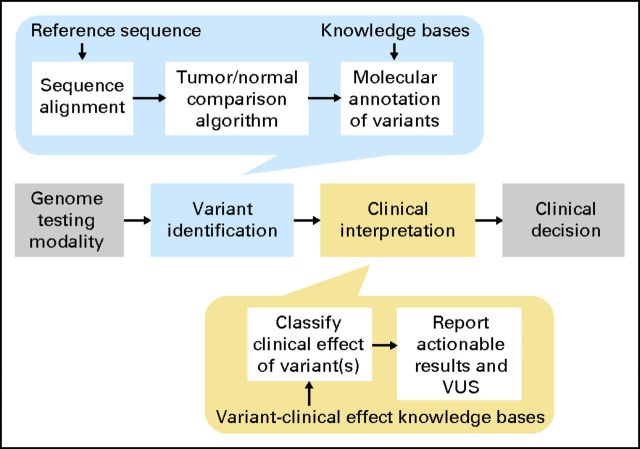
Fig 1.
Fig 1.
Clinical workflow for tumor genome analysis and interpretation. The workflow begins with the genome-testing modality that may or may not have digital output. Variant identification may be done manually or with the assistance of automated algorithms, depending on the modality. Automated methods for variant identification include several processes shown at the top, including algorithms for sequence alignment that take as input a reference sequence, algorithms for comparison of the tumor and normal genome, and variant annotation. Clinical interpretation of the variant is a process that includes a determination of the size of variant effect and its interaction with other variants as well as an analysis of the strength of the evidence of the effect. These processes require the use of knowledge bases of variant–drug–disease relationships. Actionable results are reported as well as variants of unknown significance (VUS). The process culminates with a clinician using the information to make a clinical decision.
Fig 2.
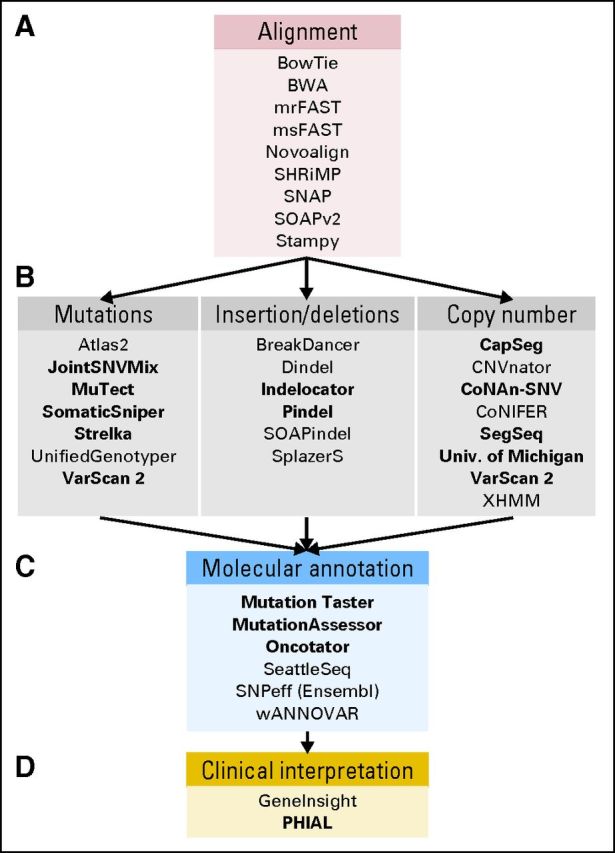
Fig 2.
A representative set of tools for the analysis and interpretation of genome sequencing data. These include (A) a listing of representative algorithms for sequencing alignment, (B) variant identification, (C) variant annotation, and (D) clinical interpretation. Boldfaced entries are those specifically geared toward tumor versus normal analysis.
Fig 3.
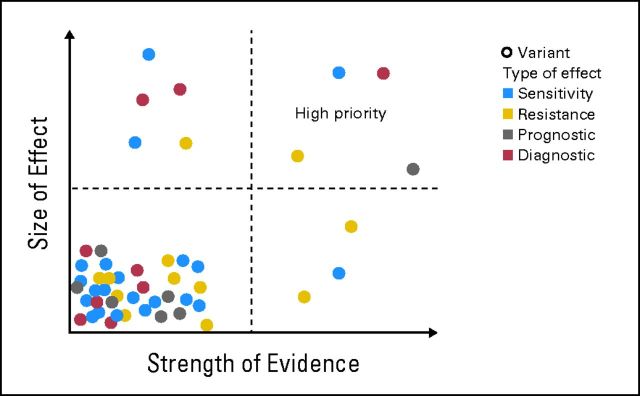
Fig 3.
Classification of the clinical effect of the variant taking into account the type of effect, strength of the evidence, and the size of the effect. Variants in the top right quadrant should have the highest priority with respect to actionable clinical decisions.

References

    1. Su Z, Dias-Santagata D, Duke M, et al. A platform for rapid detection of multiple oncogenic mutations with relevance to targeted therapy in non-small-cell lung cancer. J Mol Diagn. 2011;13:74–84. - PMC - PubMed
    1. MacConaill LE, Campbell CD, Kehoe SM, et al. Profiling critical cancer gene mutations in clinical tumor samples. PloS One. 2009;4:e7887. - PMC - PubMed
    1. Roychowdhury S, Iyer MK, Robinson DR, et al. Personalized oncology through integrative high-throughput sequencing: A pilot study. Sci Transl Med. 2011;3:111ra21. - PMC - PubMed
    1. Macconaill LE, Garraway LA. Clinical implications of the cancer genome. J Clin Oncol. 2010;28:5219–5228. - PMC - PubMed
    1. Mino-Kenudson M, Chirieac LR, Law K, et al. A novel, highly sensitive antibody allows for the routine detection of ALK-rearranged lung adenocarcinomas by standard immunohistochemistry. Clin Cancer Res. 2010;16:1561–1571. - PMC - PubMed

Publication types