


Association of age and macular pigment optical density using dual-wavelength autofluorescence imaging
- PMID: 23589675
- PMCID: PMC3622437
- DOI: 10.2147/OPTH.S42549
Association of age and macular pigment optical density using dual-wavelength autofluorescence imaging
Abstract
Background: Several lines of evidence suggest that macular pigment may play a protective role against age-related macular degeneration, but the influence of age on macular pigment density levels remains unclear. This study was designed to investigate the relationship between age and the normal distribution of macular pigment optical density (MPOD) values surrounding the fovea.
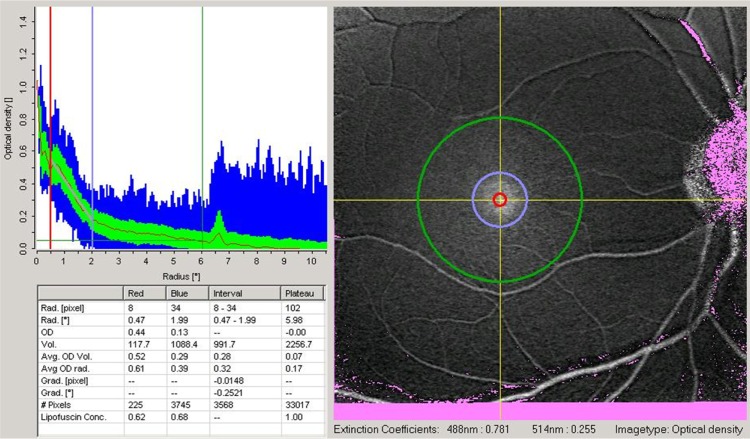
Methods: Consecutive healthy subjects with no evidence of ocular disease were enrolled in this study. After inclusion, MPOD values were measured at specific eccentricities (0.5, 1, and 2 degrees) from the foveal center using a dual-wavelength autofluorescence method employing a modified confocal scanning laser ophthalmoscope. Whenever both eyes were eligible, one was randomly selected for analysis. The correlation between age and MPOD values was investigated using regression analysis.
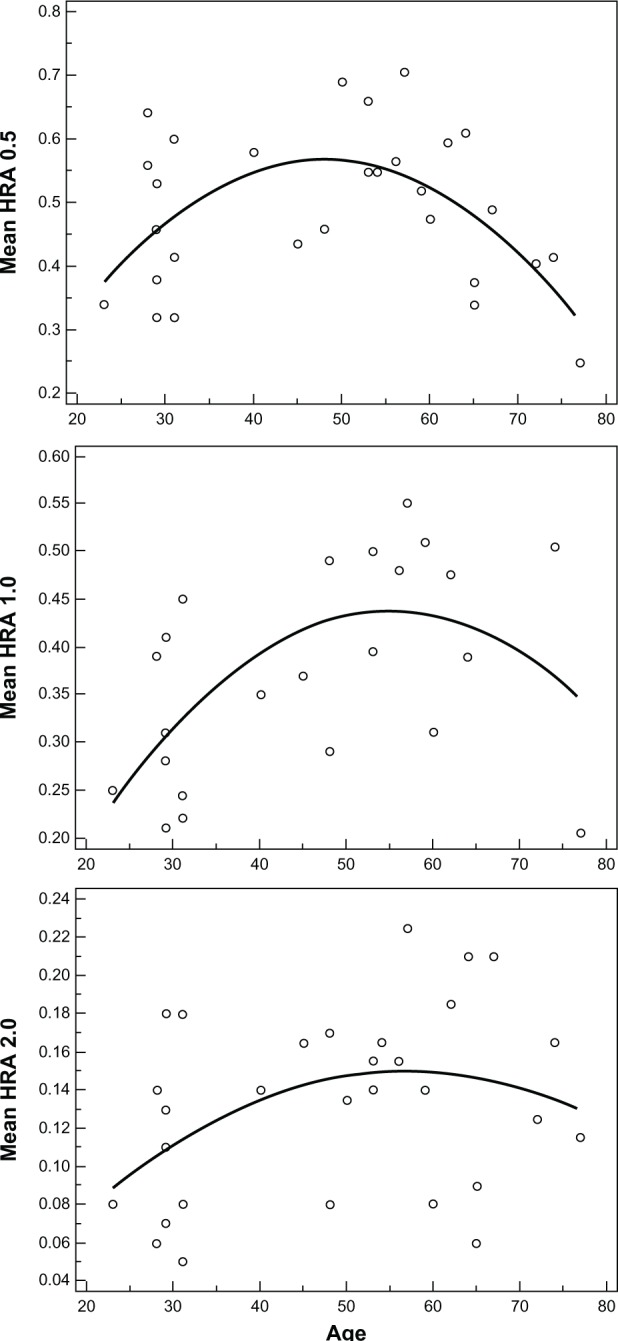
Results: Thirty subjects (30 eyes) were included (mean age 48.6 ± 16.4 [range 23-77] years). Significant differences were found between MPOD values measured at 0.5, 1, and 2 degrees from the center of the fovea (0.49 ± 0.12 density units, 0.37 ± 0.11 density units, and 0.13 ± 0.05 density units, respectively, P < 0.05). Significant correlations between age and MPOD values at 0.5 and 1 degree were found (P ≤ 0.02). Values measured at 2 degrees did not correlate significantly with age (P = 0.06).
Conclusion: In healthy subjects, MPOD values were highest near the foveal center. These values appeared to increase during adulthood (peak at 45-50 years), followed by a gradual reduction after 60 years of age.
Keywords: age; association; dual-wavelength autofluorescence imaging; macular pigment optical density.
Figures
References
-
- Sommerburg OG, Siems WG, Hurst JS, Lewis JW, Kliger DS, van Kuijk FJ. Lutein and zeaxanthin are associated with photoreceptors in the human retina. Curr Eye Res. 1999;19:491–495. - PubMed
-
- Nolan JM, Stack J, O’Connell E, Beatty S. The relationship between macular pigment optical density and its constituent carotenoids in diet and serum. Invest Ophthalmol Vis Sci. 2007;48:571–582. - PubMed
-
- Beatty S, Koh H, Phil M, Henson D, Boulton M. The role of oxidative stress in the pathogenesis of age-related macular degeneration. Surv Ophthalmol. 2000;45:115–134. - PubMed
-
- Bone RA, Landrum JT. Distribution of macular pigments components, zeaxanthin and lutein, in human retina. Methods Enzymol. 1992;213:360–366. - PubMed
-
- Rapp LM, Maple SS, Choi JH. Lutein and zeaxanthin concentrations in rod outer segment membranes from perifoveal and peripheral human retina. Invest Ophthalmol Vis Sci. 2000;41:1200–1209. - PubMed
LinkOut - more resources
Full Text Sources
Other Literature Sources
