


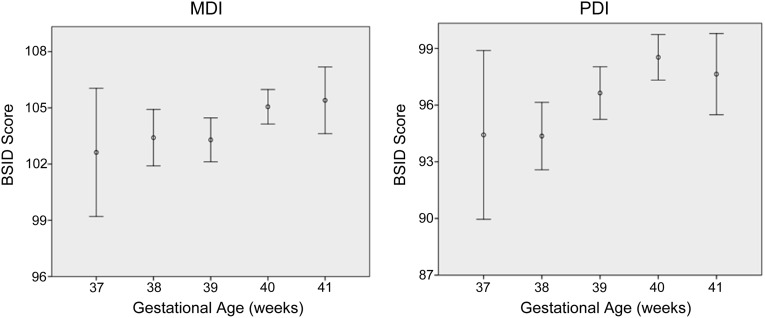
Developmental scores at 1 year with increasing gestational age, 37-41 weeks
- PMID: 23589812
- PMCID: PMC3639464
- DOI: 10.1542/peds.2012-3215
Developmental scores at 1 year with increasing gestational age, 37-41 weeks
Abstract
Objective: To examine the relationship between gestational age and mental and psychomotor development scores in healthy infants born between 37 and 41 weeks.
Methods: The cohort included 1562 participants enrolled during infancy in an iron deficiency anemia preventive trial in Santiago, Chile. All participants were healthy, full-term (37-41 weeks) infants who weighed 3 kg or more at birth. Development at 12 months was assessed using the Bayley Scales of Infant Development. Using generalized linear modeling, we analyzed the association between gestational age and 1-year-old developmental status, taking into account potential confounders including birth weight percentile, gender, socioeconomic status, the home environment, iron status, and iron supplementation.
Results: For each additional week of gestation, the Mental Development Index increased by 0.8 points (95% confidence interval = 0.2-1.4), and the Psychomotor Development Index increased by 1.4 points (95% confidence interval = 0.6-2.1) controlling for birth weight percentile, gender, socioeconomic status, and home environment.
Conclusions: In a large sample of healthy full-term infants, developmental scores obtained using the Bayley Scales of Infant Development at 12 months increased with gestational age (37-41 weeks). There is increasing evidence that birth at 39 to 41 weeks provides developmental advantages compared with birth at 37 to 38 weeks. Because cesarean deliveries and early-term inductions have increased to 40% of all births, consideration of ongoing brain development during the full-term period is an important medical and policy issue.
Keywords: Bayley Scales of Infant Development; cognition; development; gestational age; term infants.
Figures
References
-
- Bhutta AT, Cleves MA, Casey PH, Cradock MM, Anand KJ. Cognitive and behavioral outcomes of school-aged children who were born preterm: a meta-analysis. JAMA. 2002;288(6):728–737 - PubMed
-
- Hunt JV, Rhodes L. Mental development of preterm infants during the first year. Child Dev. 1977;48(1):204–210 - PubMed
-
- Petrini JR, Dias T, McCormick MC, Massolo ML, Green NS, Escobar GJ. Increased risk of adverse neurological development for late preterm infants. J Pediatr. 2009;154(2):169–176 - PubMed
-
- Talge NM, Holzman C, Wang J, Lucia V, Gardiner J, Breslau N. Late-preterm birth and its association with cognitive and socioemotional outcomes at 6 years of age. Pediatrics. 2010;126(6):1124–1131 - PubMed
-
- Eide MG, Oyen N, Skjaerven R, Bjerkedal T. Associations of birth size, gestational age, and adult size with intellectual performance: evidence from a cohort of Norwegian men. Pediatr Res. 2007;62(5):636–642 - PubMed
Publication types
MeSH terms
Grants and funding
LinkOut - more resources
Full Text Sources
Other Literature Sources
Medical
