


Diversity of the 47-kD HtrA nucleic acid and translated amino acid sequences from 17 recent human isolates of Orientia
- PMID: 23590326
- PMCID: PMC3669598
- DOI: 10.1089/vbz.2012.1112
Diversity of the 47-kD HtrA nucleic acid and translated amino acid sequences from 17 recent human isolates of Orientia
Abstract
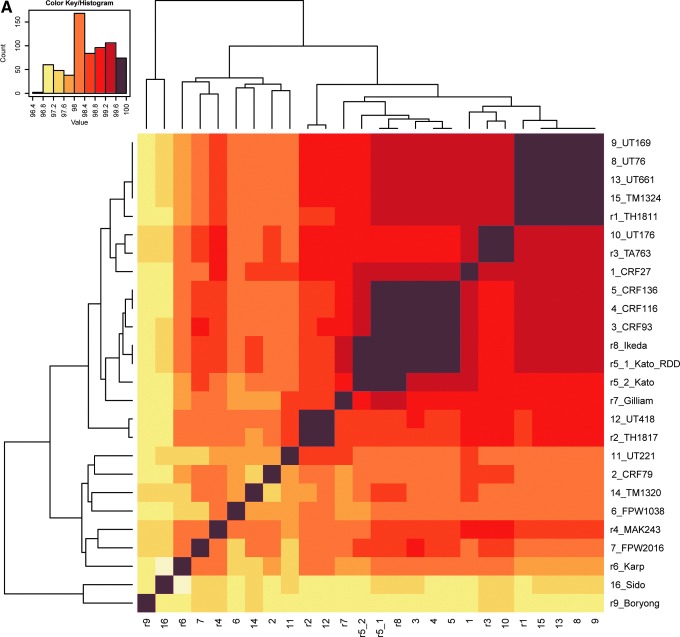
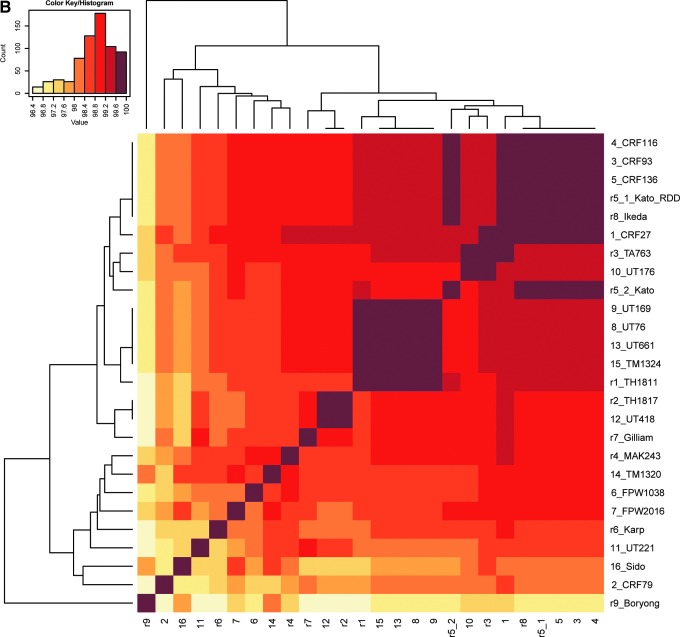
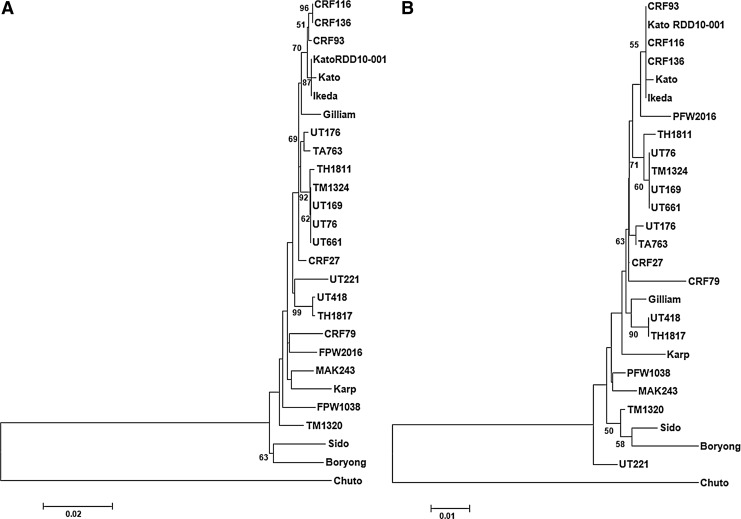
Orientia tsutsugamushi, the etiologic agent of potentially fatal scrub typhus, is characterized by a high antigenic diversity, which complicates the development of a broadly protective vaccine. Efficacy studies in murine and nonhuman primate models demonstrated the DNA vaccine candidate pKarp47, based upon the O. tsutsugamushi Karp 47-kD HtrA protein gene, to be a successful immunoprophylactic against scrub typhus. To characterize 47-kD HtrA protein diversity among human isolates of Orientia, we sequenced the full open reading frame (ORF) of the 47-kD HtrA gene and analyzed the translated amino acid sequences of 17 patient isolates from Thailand (n=13), Laos (n=2), Australia (n=1), and the United Arab Emirates (UAE) (n=1) and 9 reference strains: Karp (New Guinea), Kato (Japan), Ikeda (Japan), Gilliam (Burma), Boryong (Korea), TA763, TH1811 and TH1817 (Thailand), and MAK243 (China). The percentage identity (similarity) of translated amino acid sequences between 16 new isolates and 9 reference strains of O. tsutsugamushi ranged from 96.4% to 100% (97.4% to 100%). However, inclusion of the recently identified Orientia chuto sp. nov. reduced identity (similarity) values to 82.2% to 83.3% (90.4% to 91.4%). These results demonstrate the diversity of Orientia 47-kD HtrA among isolates encountered by humans and therefore provide support for the necessity of developing a broadly protective scrub typhus vaccine that takes this diversity into account.
Figures
References
-
- Blacksell SD. Luksameetanasan R. Kalambaheti T. Aukkanit N, et al. Genetic typing of the 56-kDa type-specific antigen gene of contemporary Orientia tsutsugamushi isolates causing human scrub typhus at two sites in north-eastern and western Thailand. FEMS Immunol Med Microbiol. 2008;52:335–342. - PubMed
-
- Brown GW. Robinson DM. Huxsoll DL. Ng TS, et al. Scrub typhus: A common cause of illness in indigenous populations. Trans Royal Soc Trop Med Hyg. 1976;70:444–448. - PubMed
-
- Chattopadhyay S. Richards AL. Scrub typhus vaccines: Past history and recent developments. Hum Vaccines. 2007;3:73–80. - PubMed
-
- Ge H. Tong M. Li A. Mehta R. Ching WM. Cloning and sequence analysis of the 22-kDa antigen genes of Orientia tsutsugamushi strains Kato, TA763, AFSC 7, 18-032460, TH1814, and MAK 119. Ann NY Acad Sci. 2005;1063:231–238. - PubMed
Publication types
MeSH terms
Substances
Associated data
- Actions
- Actions
- Actions
- Actions
- Actions
- Actions
- Actions
- Actions
- Actions
- Actions
- Actions
- Actions
- Actions
- Actions
- Actions
- Actions
- Actions
- Actions
- Actions
- Actions
- Actions
- Actions
Grants and funding
LinkOut - more resources
Full Text Sources
Other Literature Sources
