Comment
. 2013 Apr 16;4(2):e00224.
doi: 10.1128/mBio.00224-13.

Assembly and annotation of Pneumocystis jirovecii from the human lung microbiome

Affiliations
Comment

Assembly and annotation of Pneumocystis jirovecii from the human lung microbiome

Melanie T Cushion et al. mBio. .

Abstract

Pneumocystis jirovecii is a fungus that causes Pneumocystis pneumonia in immunosuppressed patients and has been closely associated with AIDS since the beginning of the AIDS epidemic. Because in vitro cultivation of P. jirovecii is not possible, progress has been hindered in our understanding of its life cycle, mode of transmission, metabolic function, and genome. Limited amounts of P. jirovecii can be obtained from infected patients, but the occurrence of bacteria, other fungi, and human cells in clinical samples presents new challenges for whole-genome sequencing and downstream bioinformatic analysis. In a recent article, Cissé et al. used cell immunoprecipitation enrichment together with whole-genome amplification to generate sufficient quantities of DNA for Roche 454 and Illumina sequencing [O. H. Cissé, M. Pagni, and P. M. Hauser, mBio 4(1):e00428-12, 2012, doi:10.1128/mBio.00428-12]. In addition, a bioinformatic pipeline was devised to sort and assemble lung microbiome reads, thereby generating an 8.1-Mb P. jirovecii genome comprised of 356 contigs with an N50 (median length of all contigs) of 41.6 kb. Knowledge of this genome will open new avenues of research, including the identification of nutritional requirements for in vitro cultivation as well as the identification of new and novel drug and vaccine targets.


Figures
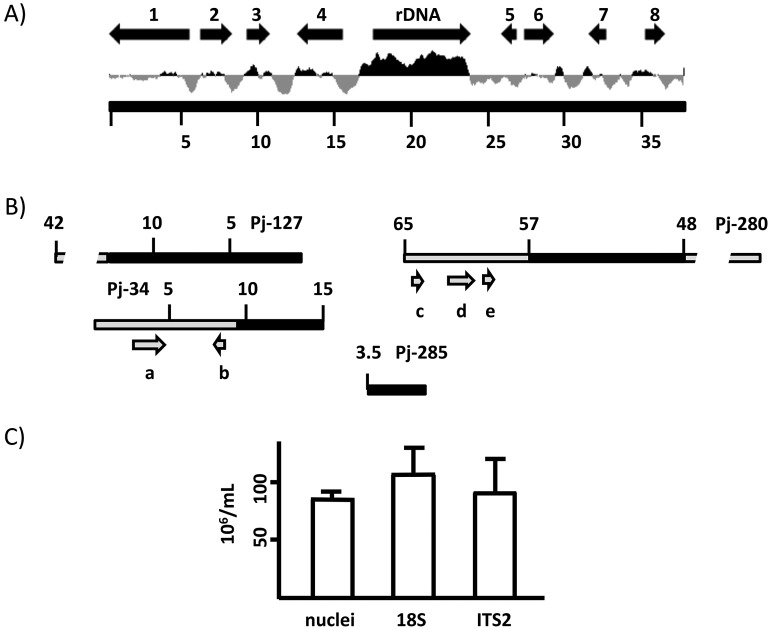
FIG 1
FIG 1
Pneumocystis contains one copy of rDNA. (A) Genetic map of the 38-kb cosmid 3C5 containing P. carinii rDNA. The black arrows represent approximate nucleotide locations and sizes of rDNA and BLASTx (16) genes in the flanking regions of 3C5. The number above each black arrow indicates a BLASTx hit, as follows: arrow 1, a cell morphogenesis protein (PAG1); arrow 2, NADPH cytochrome P450 reductase (CprA); arrow 3, sporulation-specific protein 5 (Spo5); arrow 4, a 26S proteasome subunit (Rpn1); arrow 5, U3 small nucleolar RNA-associated protein 6; arrow 6, a developmental regulator (FlbA); arrow 7, a hypothetical zinc finger protein; and arrow 8, damage-inducible protein 1. The black arrow for rDNA contains the entire 37S ribosomal DNA locus, which includes the 18S, internal transcribed spacer 1 (ITS1), 5.8S, ITS2, and 26S genes. Below the black arrows is the GC content of 3C5; black and gray plots represent above- and below-average GC contents, respectively. The numbers indicate nucleotide positions of 3C5. (B) P. jirovecii contigs similar to 3C5. Five P. jirovecii contigs had significant alignments with 3C5. They were Pj-127 (length, 42 kb), Pj-34 (15 kb), Pj-285 (3.5 kb), Pj-280 (65 kb), and Pj-200 (22 kb, not shown). Black-filled rectangles represent regions of similarity between P. jirovecii contigs and 3C5 (cf. panel A), whereas gray-filled rectangles represent dissimilarity. The overall percentages of nucleotide identity from the BLAST alignments between corresponding matching regions of 3C5 and each P. jirovecii contig were 87.2% ± 4.5% (Pj-127), 86.2% ± 4.2% (Pj-280), 87.6% ± 4.1% (Pj-34), 83.2% ± 3% (Pj-200), and 95.7% ± 2.1% (Pj-285). The gray arrows indicate the approximate locations and sizes of BLASTx hits in regions of P. jirovecii contigs that do not match 3C5, as follows: arrow a, an unknown protein product; arrow b, a DNA repair protein (Rad13) (b); arrow c, an unknown protein product; arrow d, origin recognition complex subunit 4 (Orc4); and arrow e, DNA-directed RNA polymerase subunit 4 (Rpb4). Contig Pj-200 matched only arrow 5 of 3C5 (i.e., the U3 small nucleolar RNA-associated protein 6 gene [comparison not shown]). (C) There is one copy of rDNA in P. murina. Microscope slides containing P. murina organisms were stained with Diff-Quik (Baxter Scientific, McGraw Park, IL), and nuclei were counted as described previously (17) and are expressed as numbers of nuclei per ml. Genomic DNA was extracted from P. murina as previously described (17). A 5′ region of the P. murina 18S rDNA locus (GenBank accession no. AY532651) was amplified with primers Pm-18sFor (5′ ATGCATGTCTAAGTATAAGCAAG 3′) and Pm-18Srev (5′ CTAATAAATACATCCCTTCCATAA 3′). The second transcribed spacer locus in AY532651 was amplified with primers ITS2For (5′ AGGTTCGTGTTGGGCTATGC 3′) and ITS2Rev (5′ ATTCAAAAAATCAGCTTAACATTTC 3′). Forty cycles of PCR were performed in the presence of SYBR green under the following conditions: 95°C for 15 s, 50°C for 15 s, and 72°C for 15 s. DNA plasmids containing these 18S rDNA and ITS2 targets were used as standards to establish a linear relationship between log-transformed numbers of copies of the target and PCR threshold cycles as previously described (17).

Comment on

References

    1. Cissé OH, Pagni M, Hauser PM. 2012. De novo assembly of the Pneumocystis jirovecii genome from a single bronchoalveolar lavage fluid specimen from a patient. mBio 4(1):e00428-12 http://dx.doi.org/10.1128/mBio.00428-12 - PMC - PubMed
    1. Smulian AG, Sesterhenn T, Tanaka R, Cushion MT. 2001. The ste3 pheromone receptor gene of Pneumocystis carinii is surrounded by a cluster of signal transduction genes. Genetics 157:991–1002 - PMC - PubMed
    1. Cushion MT. 2005. Pneumocystis pneumonia, p 763–806 In Merz WG, Hay RJ, Topley and Wilson’s microbiology and microbial infections, 10th ed. ASM Press, Washington, DC
    1. Ma L, Huang DW, Cuomo CA, Sykes S, Fantoni G, Das B, Sherman BT, Yang J, Huber C, Xia Y, Davey E, Kutty G, Bishop L, Sassi M, Lempicki RA, Kovacs JA. 7 February 2013. Sequencing and characterization of the complete mitochondrial genomes of three Pneumocystis species provide new insights into divergence between human and rodent Pneumocystis. FASEB J. [Epub ahead of print.] http://dx.doi.org/10.1096/fj.12-224444 - PMC - PubMed
    1. Sesterhenn TM, Slaven BE, Keely SP, Smulian AG, Lang BF, Cushion MT. 2010. Sequence and structure of the linear mitochondrial genome of Pneumocystis carinii. Mol. Genet. Genomics 283:63–72 - PubMed