


The role of treatment fidelity on outcomes during a randomized field trial of an autism intervention
- PMID: 23592849
- PMCID: PMC3738205
- DOI: 10.1177/1362361312473666
The role of treatment fidelity on outcomes during a randomized field trial of an autism intervention
Abstract
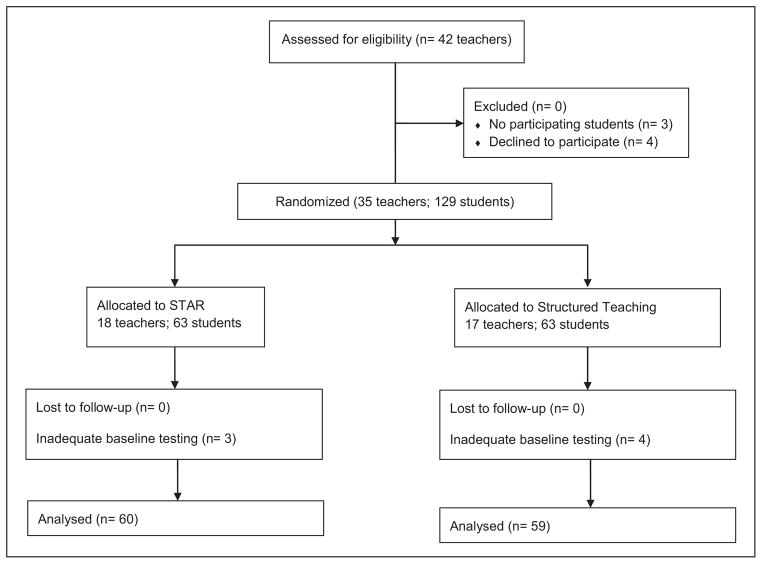
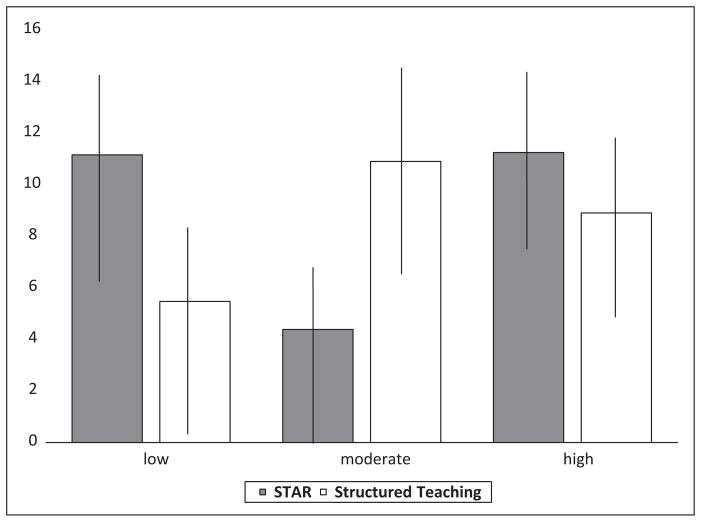
This randomized field trial comparing Strategies for Teaching based on Autism Research and Structured Teaching enrolled educators in 33 kindergarten-through-second-grade autism support classrooms and 119 students, aged 5-8 years in the School District of Philadelphia. Students were assessed at the beginning and end of the academic year using the Differential Ability Scales. Program fidelity was measured through video coding and use of a checklist. Outcomes were assessed using linear regression with random effects for classroom and student. Average fidelity was 57% in Strategies for Teaching based on Autism Research classrooms and 48% in Structured Teaching classrooms. There was a 9.2-point (standard deviation = 9.6) increase in Differential Ability Scales score over the 8-month study period, but no main effect of program. There was a significant interaction between fidelity and group. In classrooms with either low or high program fidelity, students in Strategies for Teaching based on Autism Research experienced a greater gain in Differential Ability Scales score than students in Structured Teaching (11.2 vs. 5.5 points and 11.3 vs. 8.9 points, respectively). In classrooms with moderate fidelity, students in Structured Teaching experienced a greater gain than students in Strategies for Teaching based on Autism Research (10.1 vs. 4.4 points). The results suggest significant variability in implementation of evidence-based practices, even with supports, and also suggest the need to address challenging issues related to implementation measurement in community settings.
Keywords: autism; fidelity; implementation science; randomized trials; school-based intervention.
Figures
References
-
- Alberto P, Troutman A. Applied Behavior Analysis for Teachers. 6. Upper Saddle River, NJ: Merrill; 2002.
-
- Arick J, Loos L, Falco R, et al. The STAR Program: Strategies for Teaching Based on Autism Research. Austin, TX: PRO-ED; 2004.
-
- Arick J, Young H, Falco R, et al. Designing an outcome study to monitor the progress of students with autism spectrum disorders. Focus on Autism and Other Developmental Disabilities. 2003;18:75–87.
-
- Atkins MS, Graczyk PA, Frazier SL, et al. Toward a new model for promoting urban children’s mental health: accessible, effective, and sustainable school-based mental health services. School Psychology Review. 2003;32(4):503–514.
Publication types
MeSH terms
Grants and funding
LinkOut - more resources
Full Text Sources
Other Literature Sources
