STAT3, a Poor Survival Predicator, Is Associated with Lymph Node Metastasis from Breast Cancer
- PMID: 23593080
- PMCID: PMC3625768
- DOI: 10.4048/jbc.2013.16.1.40
STAT3, a Poor Survival Predicator, Is Associated with Lymph Node Metastasis from Breast Cancer
Abstract
Purpose: The aim of this study is to explore signal transducer and activator of transcription 3 (STAT3) expression in breast cancer and to analyze the detailed mechanism that STAT3 contributes to the progression of breast cancer.
Methods: We retrospectively analyzed the clinicopathologic characteristics and overall survival (OS) of 140 breast cancer patients after curative surgery, and detected STAT3 expression, phosphorylated STAT3 (pSTAT3) expression, Ki-67 expression, vascular endothelial growth factor (VEGF)-C and -D expression in breast cancer tissues, and adjacent nontumor tissues. Survival analysis and relationship analysis were adopted for demonstrated the important mechanism of STAT3 contribution to progression of breast cancer.
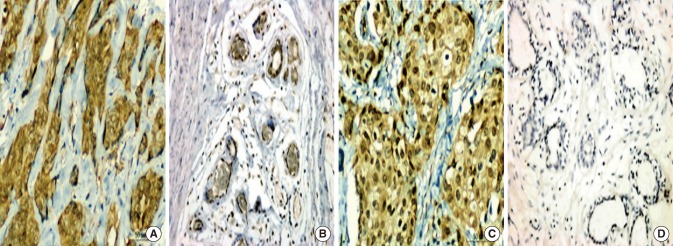
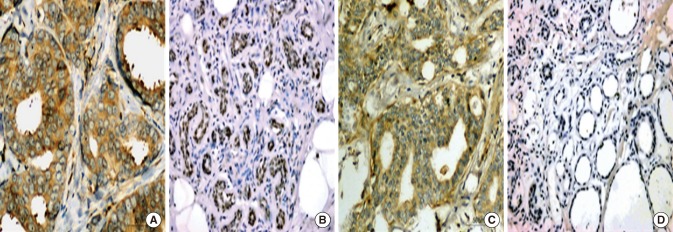
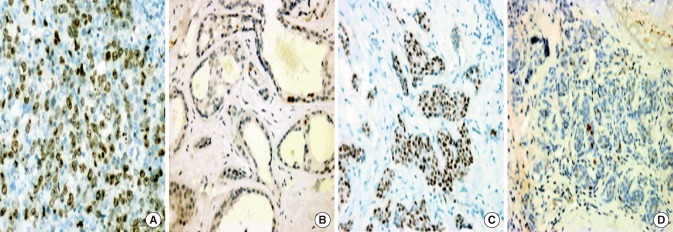
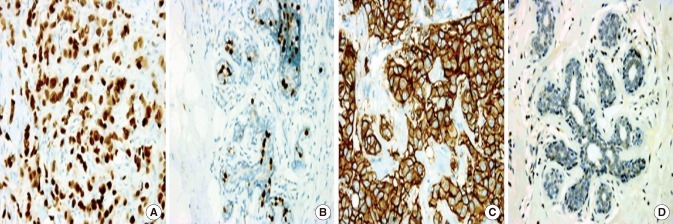
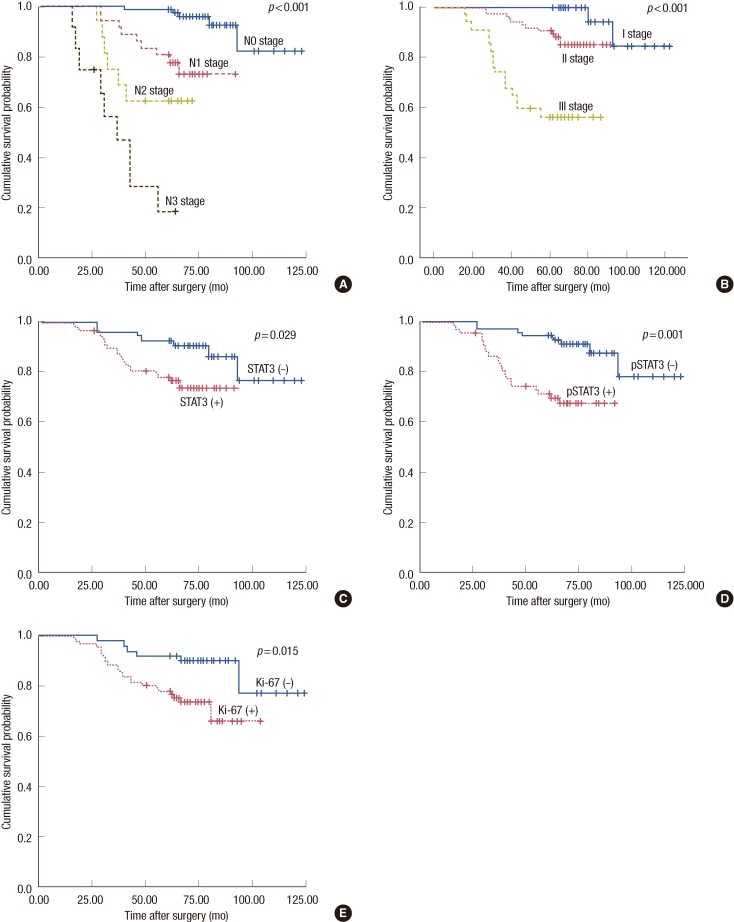
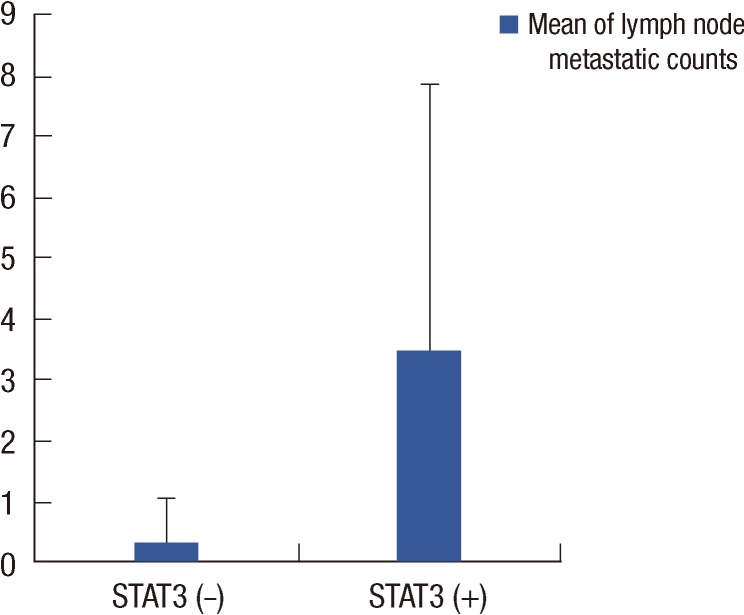
Results: STAT3 expression, pSTAT3 expression, Ki-67 expression, VEGF-C expression, and VEGF-D expression in breast cancer tissues were significantly higher than those in adjacent nontumor tissues, respectively. With survival analysis, only number of lymph node metastasis (N stage) was identified as the independent predictors of the OS of breast cancer patients. Besides, we demonstrated there was the most prominent correlation between STAT3 expression and lymph node metastasis in breast cancer tissues by using the multinominal regression method.
Conclusion: STAT3, a poor survival biomarker potential association with lymph node metastasis, was suitable for predication the OS of breast cancer patients after curative resection.
Keywords: Breast neoplasms; Neoplasm metastasis; Prognosis; STAT3 transcription factor.
Conflict of interest statement
The authors declare that they have no competing interests.
Figures
References
-
- Sola M, Alberro JA, Fraile M, Santesteban P, Ramos M, Fabregas R, et al. Complete axillary lymph node dissection versus clinical follow-up in breast cancer patients with sentinel node micrometastasis: final results from the multicenter clinical trial AATRM 048/13/2000. Ann Surg Oncol. 2013;20:120–127. - PubMed
-
- Sanuki N, Takeda A, Amemiya A, Ofuchi T, Ono M, Ogata H, et al. Outcomes of clinically node-negative breast cancer without axillary dissection: can preserved axilla be safely treated with radiation after a positive sentinel node biopsy? Clin Breast Cancer. 2013;13:69–76. - PubMed
-
- Noguchi M, Morioka E, Ohno Y, Nakano Y, Kosaka T. The changing role of axillary lymph node dissection for breast cancer. Breast Cancer. 2013;20:41–46. - PubMed
LinkOut - more resources
Full Text Sources
Other Literature Sources
Miscellaneous