


Association between BDNF gene polymorphisms and serotonergic activity using loudness dependence of auditory evoked potentials in healthy subjects
- PMID: 23593198
- PMCID: PMC3621878
- DOI: 10.1371/journal.pone.0060340
Association between BDNF gene polymorphisms and serotonergic activity using loudness dependence of auditory evoked potentials in healthy subjects
Abstract
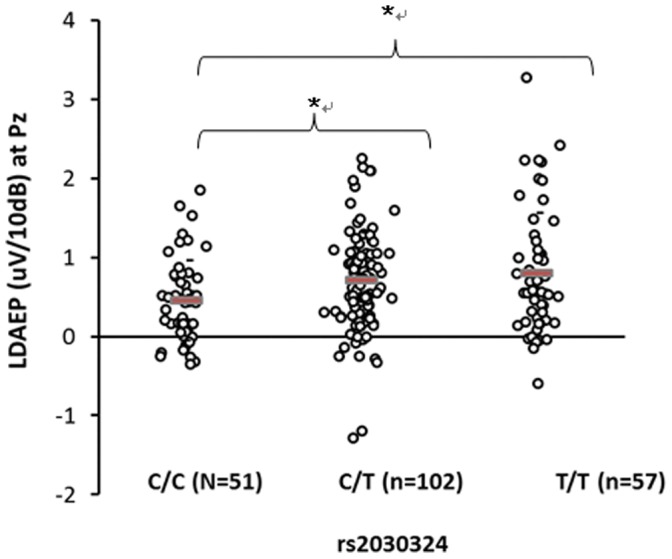
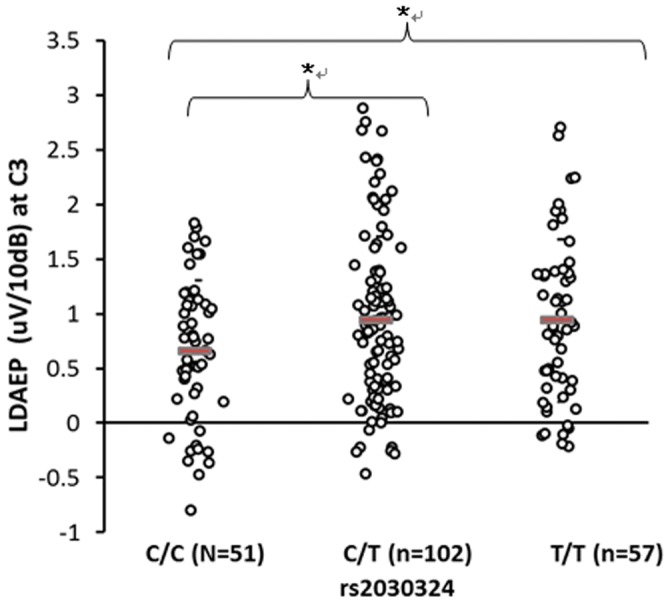
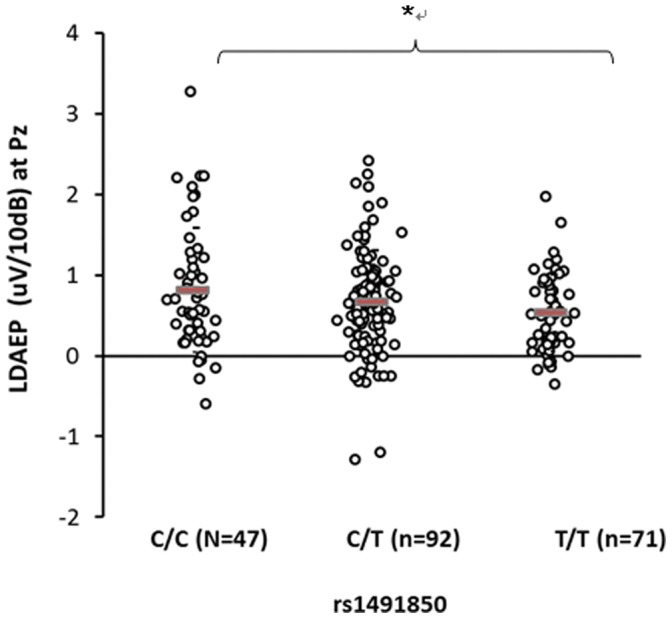
It has been proposed that the loudness dependence of auditory evoked potentials (LDAEP) would be a reliable indicator of central serotonin system activity in humans. Serotonin levels and turnover are also increased by brain-derived neurotrophic factor (BDNF). The aim of the present study was to determine whether there is an association between genetic polymorphisms of BDNF and the LDAEP in healthy Korean young adults. The cohort comprised 211 mentally and physically healthy subjects, all of whom were nonsmokers (111 males, 100 females; age: 20∼32 years). To avoid hormonal effects, the LDAEP was measured during days 2-5 after the beginning of menstruation for female subjects. In addition, BDNF polymorphisms (rs6265, rs2030324, and rs1491850) were genotyped. The strength of the LDAEP differed significantly among the BDNF genotype groups. Furthermore, the distribution of genotypic frequencies differed significantly between subjects with high and low LDAEPs. In particular, subjects with the Val/Met (A/G) genotype for rs6265, the T/T genotype for rs2030324, or the C/C genotype for rs1491850 had a higher LDAEP, indicating lower central serotonergic activity. A low LDAEP was more prevalent than a high LDAEP among those with the C-T haplotype (C genotype for rs2030424 and T genotype for rs1491850). Our results concur with previous findings on BDNF polymorphisms and serotonergic drug responses in psychiatric disorder patients. The present results suggest the possibility that BDNF polymorphisms and LDAEP patterns can predict altered serotonergic activity.
Conflict of interest statement
Figures
References
-
- Hegerl U, Juckel G (1993) Intensity dependence of auditory evoked potentials as an indicator of central serotonergic neurotransmission: a new hypothesis. Biol Psychiatry 33: 173–187. - PubMed
-
- Juckel G, Molnar M, Hegerl U, Csepe V, Karmos G (1997) Auditory-evoked potentials as indicator of brain serotonergic activity–first evidence in behaving cats. Biol Psychiatry 41: 1181–1195. - PubMed
-
- Strobel A, Debener S, Schmidt D, Hunnerkopf R, Lesch KP, et al. (2003) Allelic variation in serotonin transporter function associated with the intensity dependence of the auditory evoked potential. Am J Med Genet B Neuropsychiatr Genet 118B: 41–47. - PubMed
-
- Juckel G, Gallinat J, Riedel M, Sokullu S, Schulz C, et al. (2003) Serotonergic dysfunction in schizophrenia assessed by the loudness dependence measure of primary auditory cortex evoked activity. Schizophr Res 64: 115–124. - PubMed
-
- Gudlowski Y, Ozgurdal S, Witthaus H, Gallinat J, Hauser M, et al. (2009) Serotonergic dysfunction in the prodromal, first-episode and chronic course of schizophrenia as assessed by the loudness dependence of auditory evoked activity. Schizophr Res 109: 141–147. - PubMed
Publication types
MeSH terms
Substances
LinkOut - more resources
Full Text Sources
Other Literature Sources
Miscellaneous
