


CD160Ig fusion protein targets a novel costimulatory pathway and prolongs allograft survival
- PMID: 23593209
- PMCID: PMC3617215
- DOI: 10.1371/journal.pone.0060391
CD160Ig fusion protein targets a novel costimulatory pathway and prolongs allograft survival
Abstract
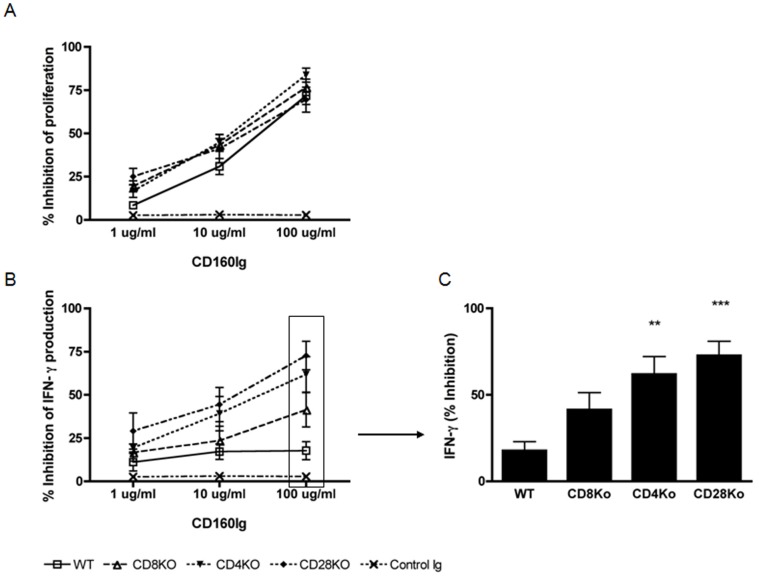
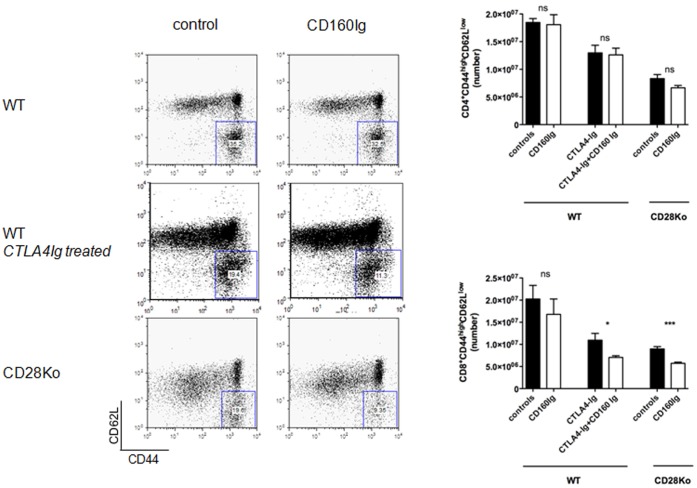
CD160 is a cell surface molecule expressed by most NK cells and approximately 50% of CD8(+) cytotoxic T lymphocytes. Engagement of CD160 by MHC class-I directly triggers a costimulatory signal to TCR-induced proliferation, cytokine production and cytotoxic effector functions. The role of CD160 in alloimmunity is unknown. Using a newly generated CD160 fusion protein (CD160Ig) we examined the role of the novel costimulatory molecule CD160 in mediating CD4(+) or CD8(+) T cell driven allograft rejection. CD160Ig inhibits alloreactive CD8(+) T cell proliferation and IFN-γ production in vitro, in particular in the absence of CD28 costimulation. Consequently CD160Ig prolongs fully mismatched cardiac allograft survival in CD4(-/-), CD28(-/-) knockout and CTLA4Ig treated WT recipients, but not in WT or CD8(-/-) knockout recipients. The prolonged cardiac allograft survival is associated with reduced alloreactive CD8(+) T cell proliferation, effector/memory responses and alloreactive IFN-γ production. Thus, CD160 signaling is particularly important in CD28-independent effector/memory CD8(+) alloreactive T cell activation in vivo and therefore may serve as a novel target for prevention of allograft rejection.
Conflict of interest statement
Figures




References
-
- Rothstein DM, Sayegh MH (2003) T-cell costimulatory pathways in allograft rejection and tolerance. Immunol Rev Dec 196: 85–108. - PubMed
-
- Pearson TC, Alexander DZ, Winn KJ, Linsley PS, Lowry RP, et al. (1994) Transplantation tolerance induced by CTLA4-Ig. Transplantation Jun 27 57(12): 1701–6. - PubMed
-
- Lenschow DJ, Zeng Y, Hathcock KS, Zuckerman LA, Freeman G, et al. (1995) Inhibition of transplant rejection following treatment with anti-B7–2 and anti-B7–1 antibodies. Transplantation 60(10): 1171–8. - PubMed
Publication types
MeSH terms
Substances
Grants and funding
LinkOut - more resources
Full Text Sources
Other Literature Sources
Research Materials
