


Myelosuppressive conditioning using busulfan enables bone marrow cell accumulation in the spinal cord of a mouse model of amyotrophic lateral sclerosis
- PMID: 23593276
- PMCID: PMC3620474
- DOI: 10.1371/journal.pone.0060661
Myelosuppressive conditioning using busulfan enables bone marrow cell accumulation in the spinal cord of a mouse model of amyotrophic lateral sclerosis
Abstract
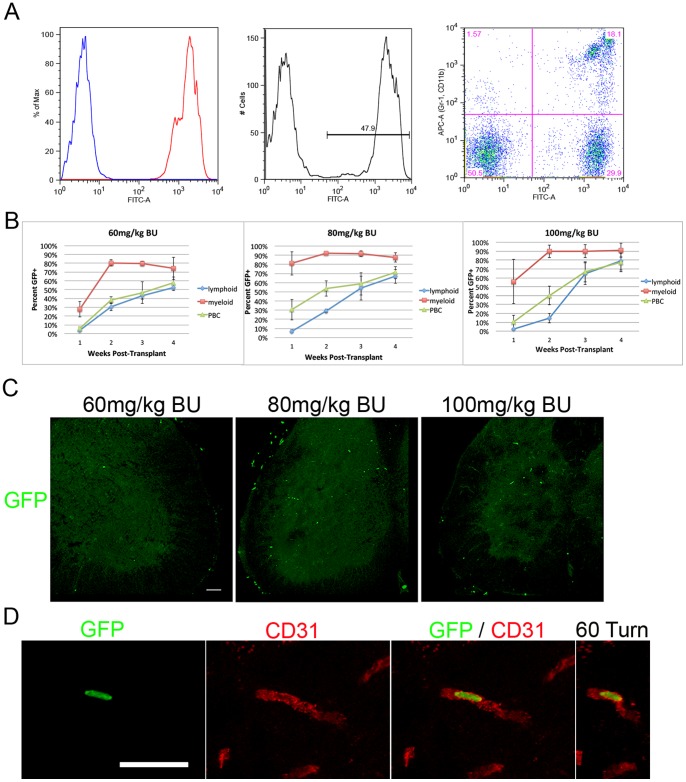
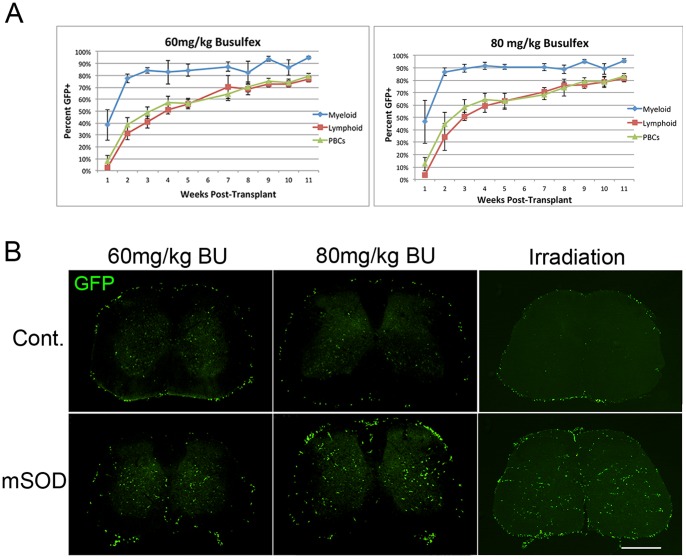
Myeloablative preconditioning using irradiation is the most commonly used technique to generate rodents having chimeric bone marrow, employed for the study of bone marrow-derived cell accumulation in the healthy and diseased central nervous system. However, irradiation has been shown to alter the blood-brain barrier, potentially creating confounding artefacts. To better study the potential of bone marrow-derived cells to function as treatment vehicles for neurodegenerative diseases alternative preconditioning regimens must be developed. We treated transgenic mice that over-express human mutant superoxide dismutase 1, a model of amyotrophic lateral sclerosis, with busulfan to determine whether this commonly used chemotherapeutic leads to stable chimerism and promotes the entry of bone marrow-derived cells into spinal cord. Intraperitoneal treatment with busulfan at 60 mg/kg or 80 mg/kg followed by intravenous injection of green fluorescent protein-expressing bone marrow resulted in sustained levels of chimerism (~80%). Bone marrow-derived cells accumulated in the lumbar spinal cord of diseased mice at advanced stages of pathology at both doses, with limited numbers of bone marrow derived cells observed in the spinal cords of similarly treated, age-matched controls; the majority of bone marrow-derived cells in spinal cord immunolabelled for macrophage antigens. Comparatively, significantly greater numbers of bone marrow-derived cells were observed in lumbar spinal cord following irradiative myeloablation. These results demonstrate bone marrow-derived cell accumulation in diseased spinal cord is possible without irradiative preconditioning.
Conflict of interest statement
Figures

References
-
- Corti S, Locatelli F, Donadoni C, Guglieri M, Papadimitriou D, et al. (2004) Wild-type bone marrow cells ameliorate the phenotype of SOD1-G93A ALS mice and contribute to CNS, heart and skeletal muscle tissues. Brain, 127 (Pt 11): 2518–2532. - PubMed
-
- Solomon JN, Lewis CA, Ajami B, Corbel SY, Rossi FM, et al. (2006) Origin and distribution of bone marrow-derived cells in the central nervous system in a mouse model of amyotrophic lateral sclerosis. Glia 53(7): 744–753. - PubMed
-
- Lewis CA, Solomon JN, Rossi FM, Krieger C (2009) Bone marrow-derived cells in the central nervous system of a mouse model of amyotrophic lateral sclerosis are associated with blood vessels and express CX(3)CR1. Glia 57(13): 1410–1419. - PubMed
Publication types
MeSH terms
Substances
Grants and funding
LinkOut - more resources
Full Text Sources
Other Literature Sources
Medical
Miscellaneous
