Clinical features and outcomes of gastric variceal bleeding: retrospective Korean multicenter data
- PMID: 23593608
- PMCID: PMC3622854
- DOI: 10.3350/cmh.2013.19.1.36
Clinical features and outcomes of gastric variceal bleeding: retrospective Korean multicenter data
Abstract
Background/aims: While gastric variceal bleeding (GVB) is not as prevalent as esophageal variceal bleeding, it is reportedly more serious, with high failure rates of the initial hemostasis (>30%), and has a worse prognosis than esophageal variceal bleeding. However, there is limited information regarding hemostasis and the prognosis for GVB. The aim of this study was to determine retrospectively the clinical outcomes of GVB in a multicenter study in Korea.
Methods: The data of 1,308 episodes of GVB (males:females=1062:246, age=55.0±11.0 years, mean±SD) were collected from 24 referral hospital centers in South Korea between March 2003 and December 2008. The rates of initial hemostasis failure, rebleeding, and mortality within 5 days and 6 weeks of the index bleed were evaluated.
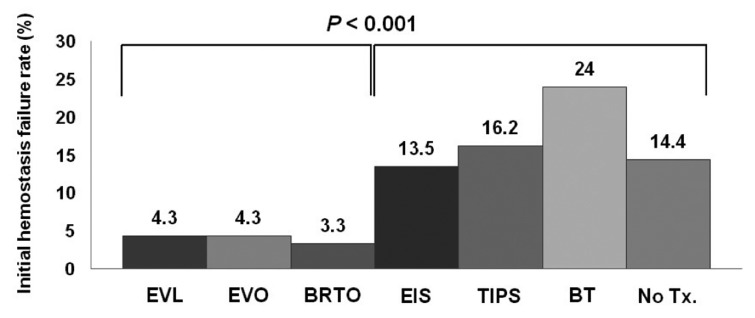
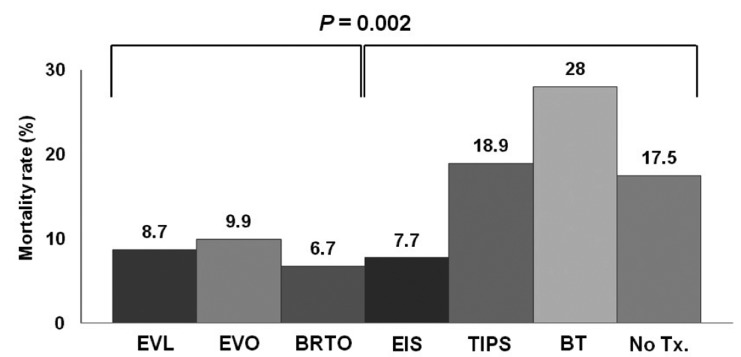
Results: The initial hemostasis failed in 6.1% of the patients, and this was associated with the Child-Pugh score [odds ratio (OR)=1.619; P<0.001] and the treatment modality: endoscopic variceal ligation, endoscopic variceal obturation, and balloon-occluded retrograde transvenous obliteration vs. endoscopic sclerotherapy, transjugular intrahepatic portosystemic shunt, and balloon tamponade (OR=0.221, P<0.001). Rebleeding developed in 11.5% of the patients, and was significantly associated with Child-Pugh score (OR=1.159, P<0.001) and treatment modality (OR=0.619, P=0.026). The GVB-associated mortality was 10.3%; mortality in these cases was associated with Child-Pugh score (OR=1.795, P<0.001) and the treatment modality for the initial hemostasis (OR=0.467, P=0.001).
Conclusions: The clinical outcome for GVB was better for the present cohort than in previous reports. Initial hemostasis failure, rebleeding, and mortality due to GVB were universally associated with the severity of liver cirrhosis.
Keywords: Cirrhosis; Gastric variceal bleeding; Mortality; Rebleeding.
Conflict of interest statement
The authors have no conflicts to disclose.
Figures
References
-
- Sarin SK, Lahoti D, Saxena SP, Murthy NS, Makwana UK. Prevalence, classification and natural history of gastric varices: a long-term follow-up study in 568 portal hypertension patients. Hepatology. 1992;16:1343–1349. - PubMed
-
- Thakeb F, Salem SA, Abdallah M, el Batanouny M. Endoscopic diagnosis of gastric varices. Endoscopy. 1994;26:287–291. - PubMed
-
- Trudeau W, Prindiville T. Endoscopic injection sclerosis in bleeding gastric varices. Gastrointest Endosc. 1986;32:264–268. - PubMed
-
- Sarin SK. Long-term follow-up of gastric variceal sclerotherapy: an eleven-year experience. Gastrointest Endosc. 1997;46:8–14. - PubMed
-
- Ryan BM, Stockbrugger RW, Ryan JM. A pathophysiologic, gastroenterologic, and radiologic approach to the management of gastric varices. Gastroenterology. 2004;126:1175–1189. - PubMed
Publication types
MeSH terms
LinkOut - more resources
Full Text Sources
Other Literature Sources
Medical