


Differential expression of colon cancer associated transcript1 (CCAT1) along the colonic adenoma-carcinoma sequence
- PMID: 23594791
- PMCID: PMC3639026
- DOI: 10.1186/1471-2407-13-196
Differential expression of colon cancer associated transcript1 (CCAT1) along the colonic adenoma-carcinoma sequence
Abstract
Background: The transition from normal epithelium to adenoma and, to invasive carcinoma in the human colon is associated with acquired molecular events taking 5-10 years for malignant transformation. We discovered CCAT1, a non-coding RNA over-expressed in colon cancer (CC), but not in normal tissues, thereby making it a potential disease-specific biomarker. We aimed to define and validate CCAT1 as a CC-specific biomarker, and to study CCAT1 expression across the adenoma-carcinoma sequence of CC tumorigenesis.
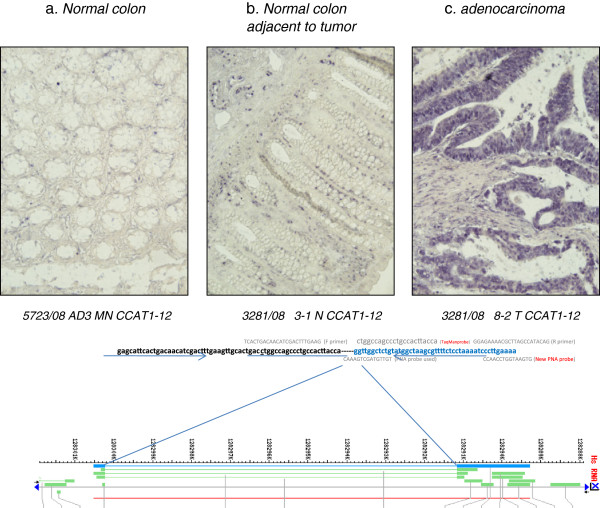
Methods: Tissue samples were obtained from patients undergoing resection for colonic adenoma(s) or carcinoma. Normal colonic tissue (n = 10), adenomatous polyps (n = 18), primary tumor tissue (n = 22), normal mucosa adjacent to primary tumor (n = 16), and lymph node(s) (n = 20), liver (n = 8), and peritoneal metastases (n = 19) were studied. RNA was extracted from all tissue samples, and CCAT1 expression was analyzed using quantitative real time-PCR (qRT-PCR) with confirmatory in-situ hybridization (ISH).
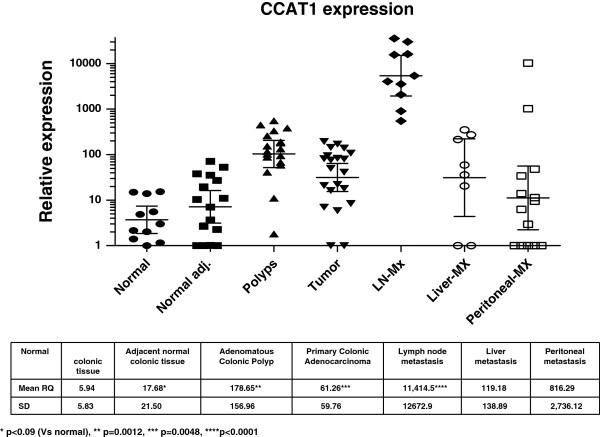
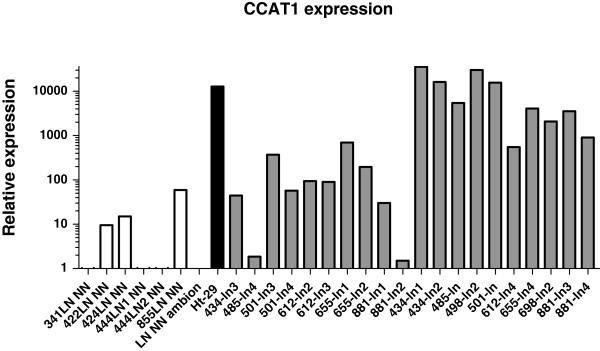
Results: Borderline expression of CCAT1 was identified in normal tissue obtained from patients with benign conditions [mean Relative Quantity (RQ) = 5.9]. Significant relative CCAT1 up-regulation was observed in adenomatous polyps (RQ = 178.6 ± 157.0; p = 0.0012); primary tumor tissue (RQ = 64.9 ± 56.9; p = 0.0048); normal mucosa adjacent to primary tumor (RQ = 17.7 ± 21.5; p = 0.09); lymph node, liver and peritoneal metastases (RQ = 11,414.5 ± 12,672.9; 119.2 ± 138.9; 816.3 ± 2,736.1; p = 0.0001, respectively). qRT-PCR results were confirmed by ISH, demonstrating significant correlation between CCAT1 up-regulation measured using these two methods.
Conclusion: CCAT1 is up-regulated across the colon adenoma-carcinoma sequence. This up-regulation is evident in pre-malignant conditions and through all disease stages, including advanced metastatic disease suggesting a role in both tumorigenesis and the metastatic process.
Figures
References
-
- Edwards BK, Ward E, Kohler BA, Eheman C, Zauber AG, Anderson RN, Jemal A, Schymura MJ, Lansdorp-Vogelaar I, Seeff LC, van Ballegooijen M, Goede SL, Ries LA. Annual report to the nation on the status of cancer, 1975-2006, featuring colorectal cancer trends and impact of interventions (risk factors, screening, and treatment) to reduce future rates. Cancer. 2010;116:544–573. doi: 10.1002/cncr.24760. - DOI - PMC - PubMed
-
- Edge SB. American Joint Committee on Cancer: AJCC Cancer Staging Manual. 7. New York: Springer; 2010. - PubMed
Publication types
MeSH terms
Substances
LinkOut - more resources
Full Text Sources
Other Literature Sources
Medical
