. 2013 Jun;10(6):909-14.
doi: 10.4161/rna.24513. Epub 2013 Apr 1.

RNase P enzymes: divergent scaffolds for a conserved biological reaction

Affiliations

RNase P enzymes: divergent scaffolds for a conserved biological reaction

Michael J Howard et al. RNA Biol. 2013 Jun.

Abstract

Ribonuclease P (RNase P) catalyzes the maturation of the 5' end of precursor-tRNAs (pre-tRNA) and is conserved in all domains of life. However, the composition of RNase P varies from bacteria to archaea and eukarya, making RNase P one of the most diverse enzymes characterized. Most known RNase P enzymes contain a large catalytic RNA subunit that associates with one to 10 proteins. Recently, a protein-only form of RNase P was discovered in mitochondria and chloroplasts of many higher eukaryotes. This proteinaceous RNase P (PRORP) represents a new class of metallonucleases. Here we discuss our recent crystal structure of PRORP1 from Arabidopsis thaliana and speculate on the reasons for the replacement of catalytic RNA by a protein catalyst. We conclude, based on an analysis of the catalytic efficiencies of ribonucleoprotein (RNP) and PRORP enzymes, that the need for greater catalytic efficiency is most likely not the driving force behind the replacement of the RNA with a protein catalyst. The emergence of a protein-based RNase P more likely reflects the increasing complexity of the biological system, including difficulties in importation into organelles and vulnerability of organellar RNAs to cleavage.

Keywords: MRPP; PRORP; RNA world; RNase P; mitochondrial tRNA; ribozyme; tRNA processing.


Figures
None
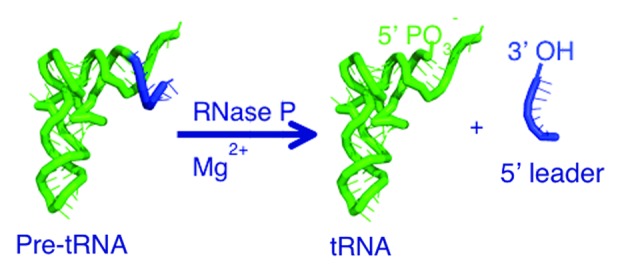
Figure 1. RNase P catalyzes the cleavage of 5′ leader sequences from precursor tRNAs. RNase P enzymes use divalent metal ions to catalyze hydrolysis of a specific phosphodiester bond in pre-tRNA, resulting in the formation of a mature 5′-end containing a phosphate and a leader with 3′ hydroxyl.
None
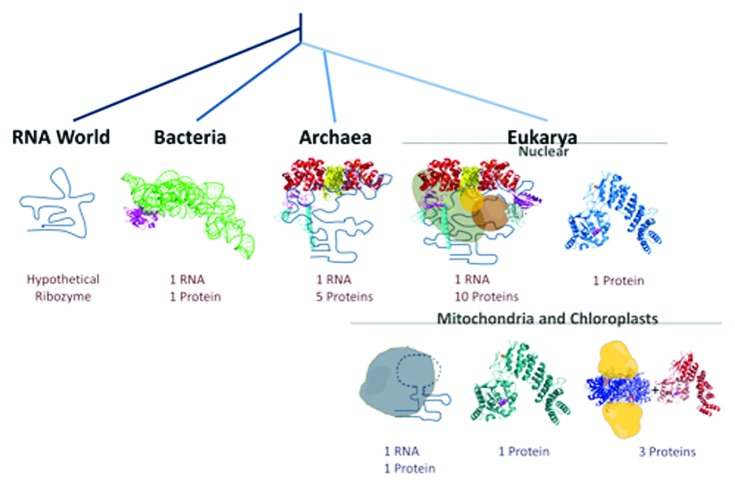
Figure 2. Evolutionary spread of RNase P. RNase P is conserved in all three domains of life. Bacterial RNase Ps consist of one RNA (green) and one protein (magenta) (pdb 3Q1R). Model of archaeal RNase P, which contains one RNA (secondary structure in blue) and at least four proteins [red: PH1877 (PDB 2CZV), yellow: PH1481 (PDB 2CZV), magenta: PH1771 (PDB: 2ZAE), cyan: PH1601 (PDB 2CZV)]. Proteins are arbitrary positioned. Most eukaryal nuclear RNase Ps are RNP based (left), which contain one RNA (blue) and at least nine proteins (four archaeal homologs, green: POP1, brown: POP3, purple: POP6 (PDB 3IAB), silver: POP7 (PDB 3IAB), orange: POP8). The proteins are arbitrary positioned. Some nuclear RNase Ps are proposed to be protein-only with homology to PRORP1 (i.e., T. brucei and A. thaliana; structure of PRORP1 shown). Mitochondrial and chloroplast RNase Ps from left to right: yeast; plants, some algae and some protists (A. thaliana and T. brucei); mammals (human). The mitochondrial yeast RNase P contain one RNA (blue) and one large protein, RPM2, (gray). Plant, some algae and protists mitochondrial/chloroplast RNase Ps are single proteins (teal) that have homology to A. thaliana PRORP1. Mammalian mitochondrial RNase Ps consist of three nuclear encoded proteins TRMT10C, (MRPP1), SDR5C1 (MRPP2) and PRORP (MRPP3) shown in yellow cartoon, blue tetramer (PDB 1U7T) and red (homology model based of A. thaliana PRORP1), respectively. The positioning of the TRMT10C/SDR5C1 subunits has not yet been demonstrated.
None
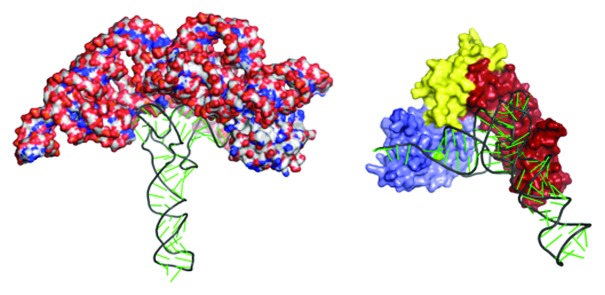
Figure 3. Comparison of a proposed model of PRORP-tRNA interaction and RNP-based RNase P. Left panel shows the crystal structure of bacterial RNase P (shown in spheres) in complex with tRNA (surface representation) (pdb 3Q1R). The right panel shows a hypothetical model of PRORP1 bound to tRNA. PRORP1 is shown in a surface representation with the PPR domain in red, central domain in yellow and the metallonuclease domain in blue. An active site metal is colored green and is in close proximity to the 5′ end of the tRNA. The tRNA was manually docked onto PRORP1. Pre-tRNAs substrates lacking an anticodon arm are cleaved by both enzymes, suggesting some similarity in recognition mechanisms., The D-TΨC loops in tRNA, a region that contacts bacterial RNase P RNA, are also recognized by PRORP1.

References

    1. Randau L, Schröder I, Söll D. Life without RNase P. Nature. 2008;453:120–3. doi: 10.1038/nature06833. - DOI - PubMed
    1. Ellis JC, Brown JW. The RNase P family. RNA Biol. 2009;6:362–9. doi: 10.4161/rna.6.4.9241. - DOI - PubMed
    1. Seif ER, Forget L, Martin NC, Lang BF. Mitochondrial RNase P RNAs in ascomycete fungi: lineage-specific variations in RNA secondary structure. RNA. 2003;9:1073–83. doi: 10.1261/rna.5880403. - DOI - PMC - PubMed
    1. Hollingsworth MJ, Martin NC. RNase P activity in the mitochondria of Saccharomyces cerevisiae depends on both mitochondrion and nucleus-encoded components. Mol Cell Biol. 1986;6:1058–64. - PMC - PubMed
    1. Holzmann J, Frank P, Löffler E, Bennett KL, Gerner C, Rossmanith W. RNase P without RNA: identification and functional reconstitution of the human mitochondrial tRNA processing enzyme. Cell. 2008;135:462–74. doi: 10.1016/j.cell.2008.09.013. - DOI - PubMed

MeSH terms

LinkOut - more resources