. 2013 Aug;28(8):1035-41.
doi: 10.1007/s11606-013-2398-0.

Association of volume of patient encounters with residents' in-training examination performance

Affiliations

Association of volume of patient encounters with residents' in-training examination performance

Christopher P McCoy et al. J Gen Intern Med. 2013 Aug.

Abstract

Background: Patient care and medical knowledge are Accreditation Council for Graduate Medical Education (ACGME) core competencies. The correlation between amount of patient contact and knowledge acquisition is not known.

Objective: To determine if a correlation exists between the number of patient encounters and in-training exam (ITE) scores in internal medicine (IM) and pediatric residents at a large academic medical center.

Design: Retrospective cohort study

Participants: Resident physicians at Mayo Clinic from July 2006 to June 2010 in IM (318 resident-years) and pediatrics (66 resident-years).

Methods: We tabulated patient encounters through review of clinical notes in an electronic medical record during post graduate year (PGY)-1 and PGY-2. Using linear regression models, we investigated associations between ITE score and number of notes during the previous PGY, adjusted for previous ITE score, gender, medical school origin, and conference attendance.

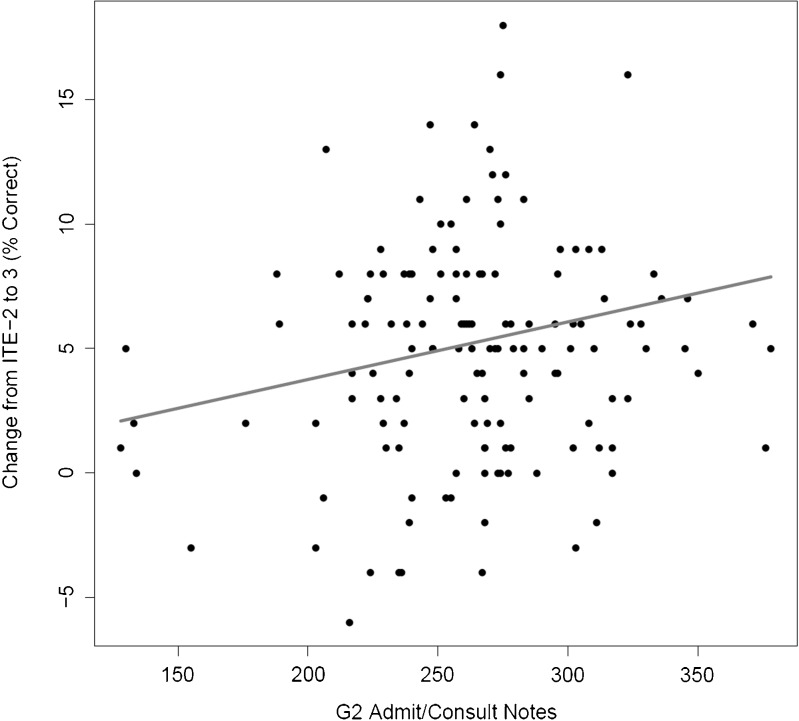
Key results: For IM, PGY-2 admission and consult encounters in the hospital and specialty clinics had a positive linear association with ITE-3 % score (β = 0.02; p = 0.004). For IM, PGY-1 conference attendance is positively associated with PGY-2 ITE performance. We did not detect a correlation between PGY-1 patient encounters and subsequent ITE scores for IM or pediatric residents. No association was found between IM PGY-2 ITE score and inpatient, outpatient, or total encounters in the first year of training. Resident continuity clinic and total encounters were not associated with change in PGY-3 ITE score.

Conclusions: We identified a positive association between hospital and subspecialty encounters during the second year of IM training and subsequent ITE score, such that each additional 50 encounters were associated with an increase of 1 % correct in PGY-3 ITE score after controlling for previous ITE performance and continuity clinic encounters. We did not find a correlation for volume of encounters and medical knowledge for IM PGY-1 residents or the pediatric cohort.


Figures
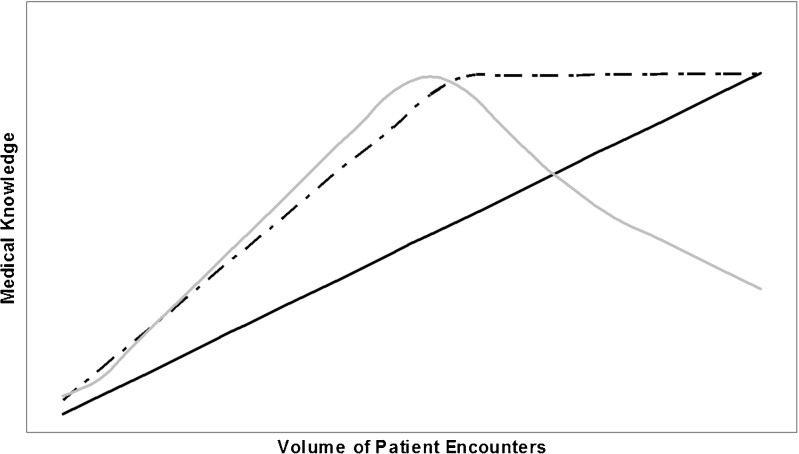
Figure 1.
Figure 1.
Models for knowledge acquisition versus volume of patient encounters. Positive linear association (solid): each additional encounter provides educational value to the learner. Threshold (dashed): a linear relationship until a threshold is reached, above which point no additional knowledge is gained from each subsequent encounter. Yerkes Dodson curve (gray): increased knowledge acquisition up to a critical point; residents beyond the peak do not have time to synthesis the educational opportunity or are otherwise stressed by the workload such that their educational performance is poorer when compared to their colleagues with fewer encounters. Null (not shown): no association between patient encounters and exam scores.
Figure 2.
Figure 2.
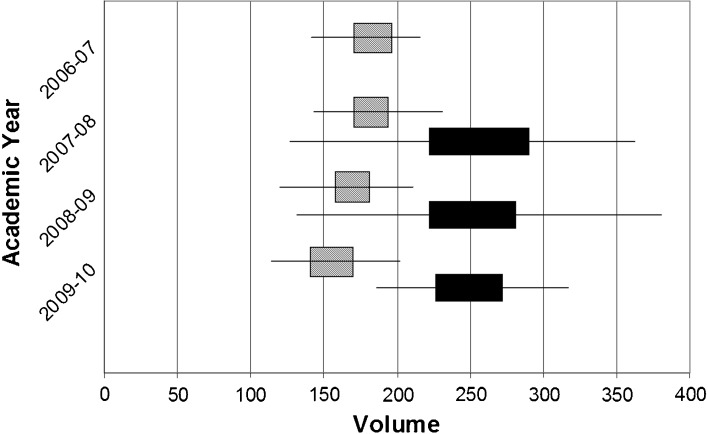
Internal medicine volume of encounters by academic year. The number of admission/consult encounters by post-graduate year (PGY)-1 (gray) and PGY-2 (solid) internal medicine residents over academic years. Range in volume of patient encounters indicated by bars, with interquartile range (25th percentile to 75th percentiile) indicated by the boxes.
Figure 3.
Figure 3.
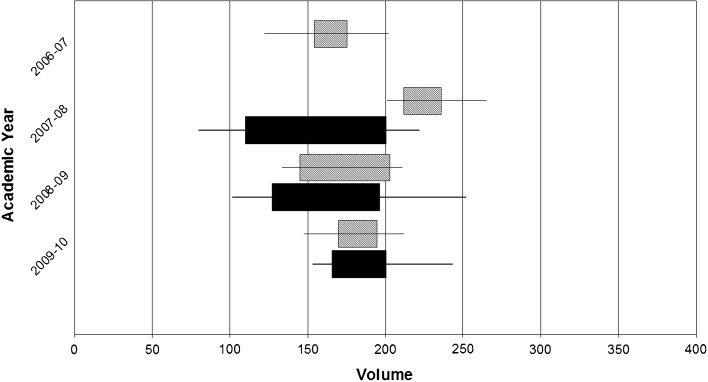
Pediatric volume of encounters by academic year. The number of admission/consult encounters by post-graduate year (PGY)-1 (gray) and PGY-2 (solid) pediatric residents over academic years. Range in volume of patient encounters indicated by bars, with interquartile range (25%ile to 75%ile) indicated by the boxes.
Figure 4.
Figure 4.
Graph of change in in-training examination (ITE) scores versus volume of admissions and consults for internal medicine (IM) post-graduate year (PGY)-2 residents. The plotted line is the correlation after adjustment for gender, medical school location, volume of encounters in the continuity clinic setting and conference attendance, thus it represents an “average” male graduate of a Liaison Committee on Medical Education (LCME)-accredited medical school with 68 % correct on ITE-2, 73 core conferences attended as PGY-2, and 145 encounters in continuity clinic.

References

    1. Nasca TJ, Day SH, Amis ES. The new recommendations on duty hours from the ACGME task force. N Engl J Med. 2010;363:e3. - PubMed
    1. Garibaldi RA, Subhiyah R, Moore ME, Waxman H. The in-training examination in internal medicine: an analysis of resident performance over time. Ann Intern Med. 2002;137:505–10. doi: 10.7326/0003-4819-137-6-200209170-00011. - DOI - PubMed
    1. Grossman RS, Fincher RM, Layne RD, Seelig CB, Berkowitz LR, Levine MA. Validity of the in-training examination for predicting American Board of Internal Medicine certifying examination scores. J Gen Intern Med. 1992;7:63–7. doi: 10.1007/BF02599105. - DOI - PubMed
    1. Althouse LA, McGuinness GA. The in-training examination: an analysis of its predictive value on performance on the general pediatrics certification examination. J Pediatr. 2008;153:425–8. doi: 10.1016/j.jpeds.2008.03.012. - DOI - PubMed
    1. McDonald FS, Zeger SL, Kolars JC. Factors associated with medical knowledge acquisition during internal medicine residency. J Gen Intern Med. 2007;22:962–8. doi: 10.1007/s11606-007-0206-4. - DOI - PMC - PubMed

Publication types

LinkOut - more resources