. 2013 May 30;121(22):4541-50.
doi: 10.1182/blood-2012-12-474577. Epub 2013 Apr 17.

Discovery of somatic STAT5b mutations in large granular lymphocytic leukemia

Affiliations

Discovery of somatic STAT5b mutations in large granular lymphocytic leukemia

Hanna L M Rajala et al. Blood. .

Abstract

Large granular lymphocytic (LGL) leukemia is characterized by clonal expansion of cytotoxic T cells or natural killer cells. Recently, somatic mutations in the signal transducer and activator of transcription 3 (STAT3) gene were discovered in 28% to 40% of LGL leukemia patients. By exome and transcriptome sequencing of 2 STAT3 mutation-negative LGL leukemia patients, we identified a recurrent, somatic missense mutation (Y665F) in the Src-like homology 2 domain of the STAT5b gene. Targeted amplicon sequencing of 211 LGL leukemia patients revealed 2 additional patients with STAT5b mutations (N642H), resulting in a total frequency of 2% (4 of 211) of STAT5b mutations across all patients. The Y665F and N642H mutant constructs increased the transcriptional activity of STAT5 and tyrosine (Y694) phosphorylation, which was also observed in patient samples. The clinical course of the disease in patients with the N642H mutation was aggressive and fatal, clearly different from typical LGL leukemia with a relatively favorable outcome. This is the first time somatic STAT5 mutations are discovered in human cancer and further emphasizes the role of STAT family genes in the pathogenesis of LGL leukemia.


Figures
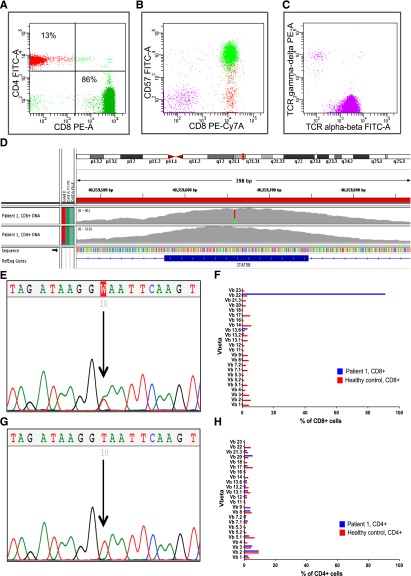
Figure 1
Figure 1
Sequencing and flow cytometry results of the patient 1 with STAT5b Y665F mutation. (A) The majority of the cells in the CD45-positive lymphocyte population were CD3 and CD8 positive. (B) Gated from CD3+ cells, CD8+ cells also expressed CD57 antigen and (C) TCR α-β on the cell surface. (D) IGV visualization of exon 16 of the STAT5b gene sequence. The tracks of both CD8+ tumor DNA and CD4+ control DNA are shown. In the CD8+ DNA, 30 of 73 (41%) of the reads supported the variant allele (green), and 43 of 73 (59%) the normal allele (red). In the CD4+ DNA, only the normal allele is seen (gray). (E) The mutation T>A (Y665F) in capillary sequencing of CD8+ DNA. (F) Ninety-one percent of the CD8-positive cells consisted of a single Vβ21 clone when analyzed by flow cytometry. (G) Only the normal allele T is visible in the capillary sequencing of CD4+ DNA. (H) The Vβ analysis of CD4+ cells presents normal polyclonal lymphocyte population. Y, tyrosine; F, phenylalanine; PE, phycoerythrin; FITC, fluorescein isothiocyanate; PE-Cy7, phycoerythrin-cyanine 7; T, thymidine; A, adenosine; IGV, Integrative Genomics viewer.
Figure 2
Figure 2
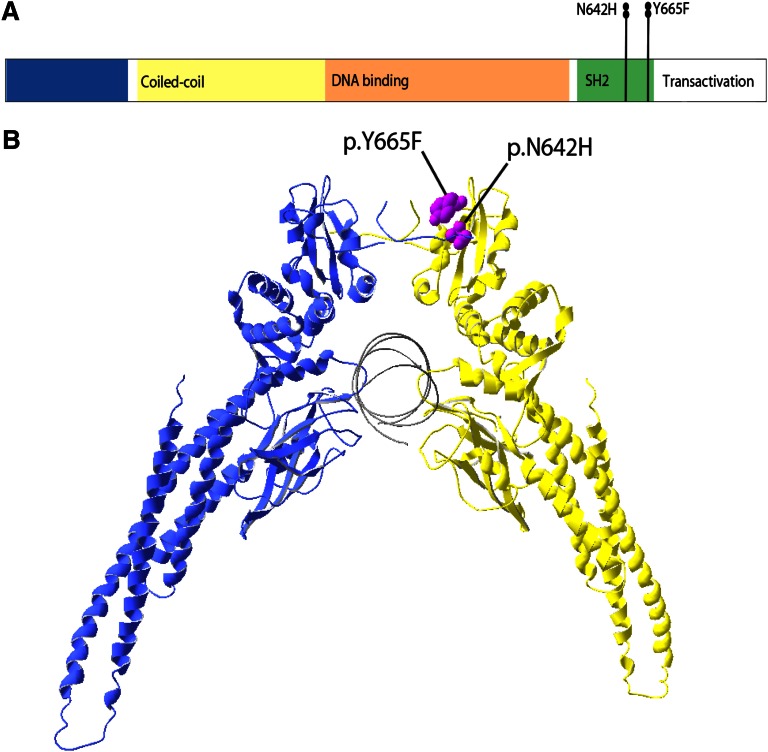
Linear representation of STAT5b mutation locations and structure model of STAT5b homodimer. (A) The STAT5b protein domains and localizations of the mutations. Both STAT5b mutations Y665F and N642H are located in the SH2 domain of STAT5b protein. (B) A 3-dimensional model of STAT5b protein structure. The mutations Y665F and N642H are located on the surface of SH2 domain and are colored in purple. F, phenylalanine; H, histidine; N, aspartic acid; and Y, tyrosine.
Figure 3
Figure 3
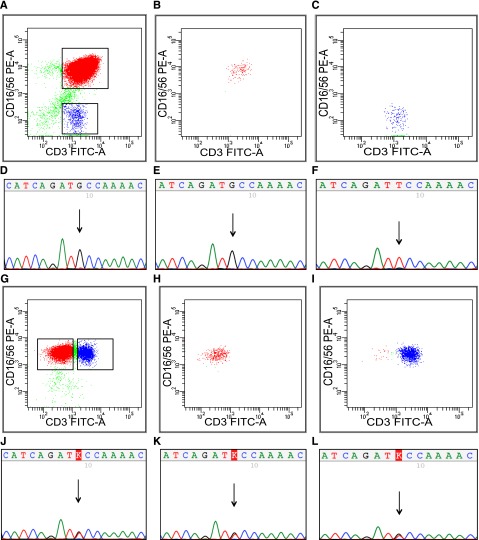
STAT5b sequencing from sorted fractions of patients 3 and 4. (A) In patient 3 (Table 1) with STAT5b N642H mutation, leukemic LGLs expressed CD3 and CD56. (B) Leukemic CD3+CD56+ cells and (C) CD3+CD16/56neg control cells were sorted with flow cytometry. (B-C) The purity of sorted fractions. By capillary sequencing, the mutation N642H is visible in (D) the MNC fraction and in (E) the CD3+CD16/56+ fraction, but not in (F) CD3+CD16/56neg cells. (G) The phenotype of leukemic cells in patient number 4 (Table 1) was CD3negCD16/56+ NK cell, but also CD3+ T cells aberrantly expressed CD56 antigen. Both (H) CD3negCD16/56+ and (I) CD3+CD16/56+ cells were sorted by flow cytometry, and the panels show purity of sorted fractions. By capillary sequencing, the mutation N642H was present in (J) MNCs, but also in (K-L) both of the sorted fractions, suggesting that the aberrant CD3+CD56+ cells also belong to the leukemic clone.
Figure 4
Figure 4
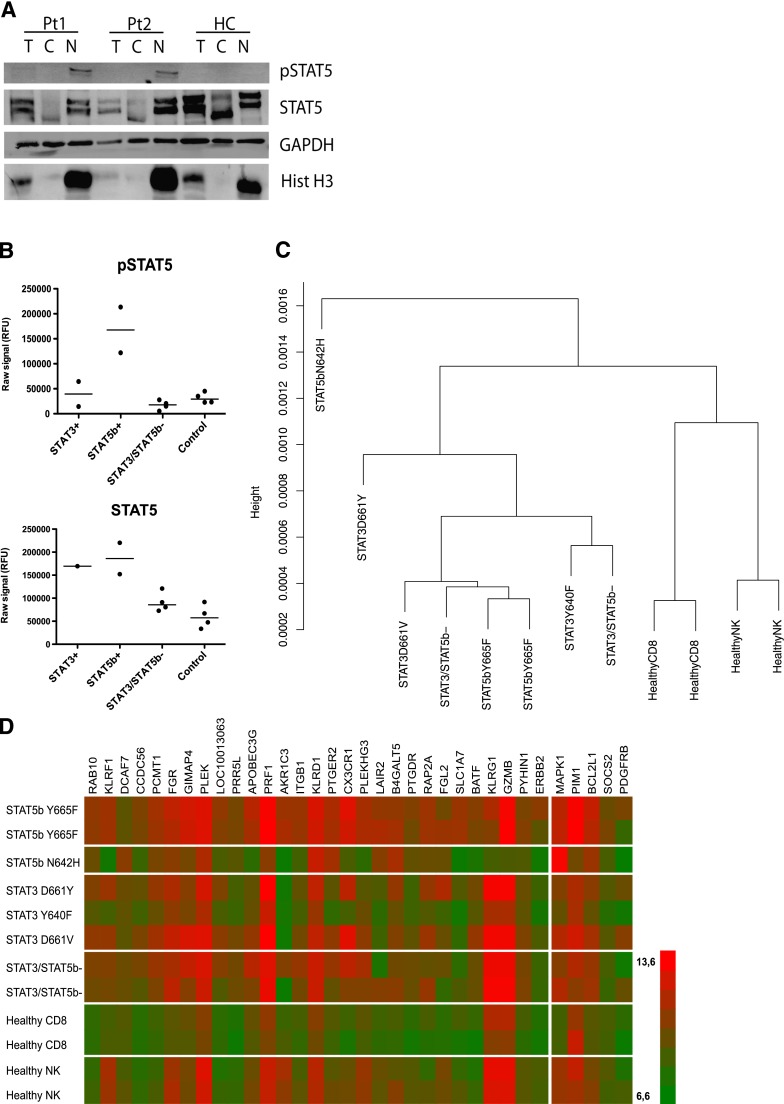
STAT5b is phosphorylated and localized in the nucleus leading to increased expression of STAT5 target genes in patients with Y665F mutation. (A) MNC samples from LGL patients 1 and 2 (Table 1) carrying the Y665F STAT5b mutation, and a healthy donor were fractionated. Normalized aliquots of total cell (T), cytosolic (C), and nuclear (N) fractions were separated on an SDS-PAGE gel, transferred to PVDF membrane, and western blot analysis was performed using anti-pSTAT5, anti-STAT5 anti-GAPDH (protein loading control), and anti-Histone H3 antibodies (nuclear localization control). (B) Phospho-STAT5 and STAT5 expression were analyzed by ELISA using PB MNC samples from 2 LGL leukemia patients with STAT3 mutation (Y640F and D661V), 2 patients with STAT5b Y665F mutation, 4 patients without STAT3/STAT5b mutation, and 4 healthy controls. (C) A dendrogram showing the clustering analysis of LGL leukemia patients and healthy controls based on the gene expression profile. (D) A heatmap reflecting gene expression profile of 2 LGL leukemia patients with STAT5b mutation Y665F, 1 patient with STAT5b mutation N642H, 3 patients with STAT3 mutation, 2 patients with STAT3/STAT5b WT, and 4 healthy controls. Shown are 29 upregulated genes (log2 scale) based on the comparison between STAT5b Y665F mutated patients and healthy controls (CD8+ cells). On the right, data from 5 known STAT5b target genes are displayed.
Figure 5
Figure 5
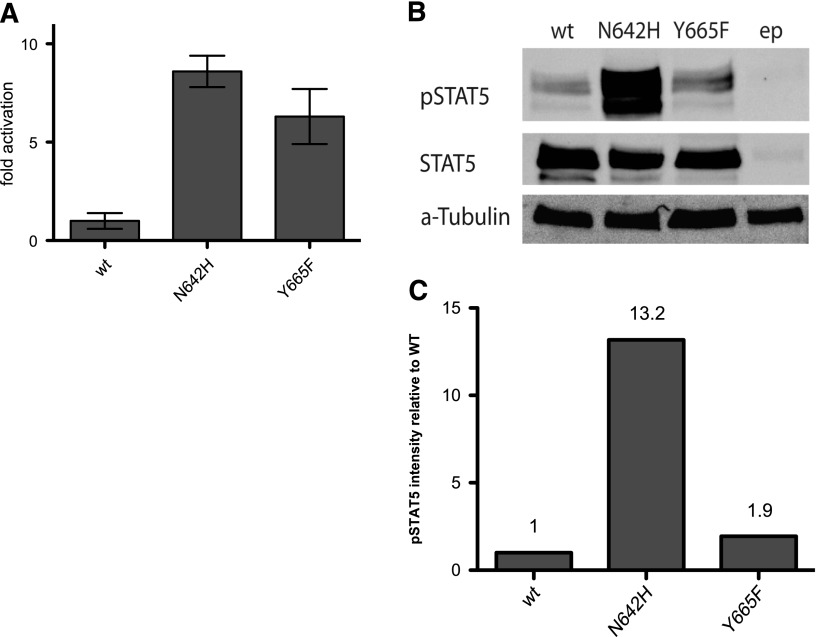
STAT5b mutations Y665F and N642H increase the transcriptional activity of STAT5. (A) HeLa cells were transfected simultaneously with a wild-type STAT5b vector or STAT5b mutants Y665F or N642H, and a luciferase reporter construct with a STAT5-responsive element. Each condition was tested in triplicate and the fold increase compared with wild-type vector is presented. (B) HeLa cells transfected with empty vector, wild-type STAT5b or mutant construct Y665F or N642H were lysed, and STAT5 and phospho-STAT5 levels were analyzed by western blot. (C) The western blot results shown as a fold change of the intensity of phospho-STAT5 expression compared with total STAT5 protein, normalized to the phospho-STAT5/STAT5 expression levels of HeLa cells with the wild-type STAT5 construct (Odyssey Imaging System; LI-COR Biosciences). wt, wild type; ep, empty plasmid.

References

    1. Loughran TP, Jr, Kadin ME, Starkebaum G, et al. Leukemia of large granular lymphocytes: association with clonal chromosomal abnormalities and autoimmune neutropenia, thrombocytopenia, and hemolytic anemia. Ann Intern Med. 1985;102(2):169–175. - PubMed
    1. Loughran TP., Jr Clonal diseases of large granular lymphocytes. Blood. 1993;82(1):1–14. - PubMed
    1. Sokol L, Loughran TP., Jr Large granular lymphocyte leukemia. Oncologist. 2006;11(3):263–273. - PubMed
    1. Burks EJ, Loughran TP., Jr Pathogenesis of neutropenia in large granular lymphocyte leukemia and Felty syndrome. Blood Rev. 2006;20(5):245–266. - PubMed
    1. Leblanc F, Zhang D, Liu X, Loughran TP. Large granular lymphocyte leukemia: from dysregulated pathways to therapeutic targets. Future Oncol. 2012;8(7):787–801. - PMC - PubMed

Publication types

MeSH terms