


Modulation by dietary fat and carbohydrate of IRS1 association with type 2 diabetes traits in two populations of different ancestries
- PMID: 23596181
- PMCID: PMC3747864
- DOI: 10.2337/dc12-2607
Modulation by dietary fat and carbohydrate of IRS1 association with type 2 diabetes traits in two populations of different ancestries
Abstract
Objective: Insulin receptor substrate 1 (IRS1) is central to insulin signaling pathways. This study aimed to examine the association of IRS1 variants with insulin resistance (IR) and related phenotypes, as well as potential modification by diet.
Research design and methods: Two IRS1 variants (rs7578326 and rs2943641) identified by genome-wide association studies as related to type 2 diabetes were tested for their associations with IR and related traits and interaction with diet in the Genetics of Lipid Lowering Drugs and Diet Network (GOLDN) study (n = 820) and the Boston Puerto Rican Health Study (BPRHS) (n = 844).
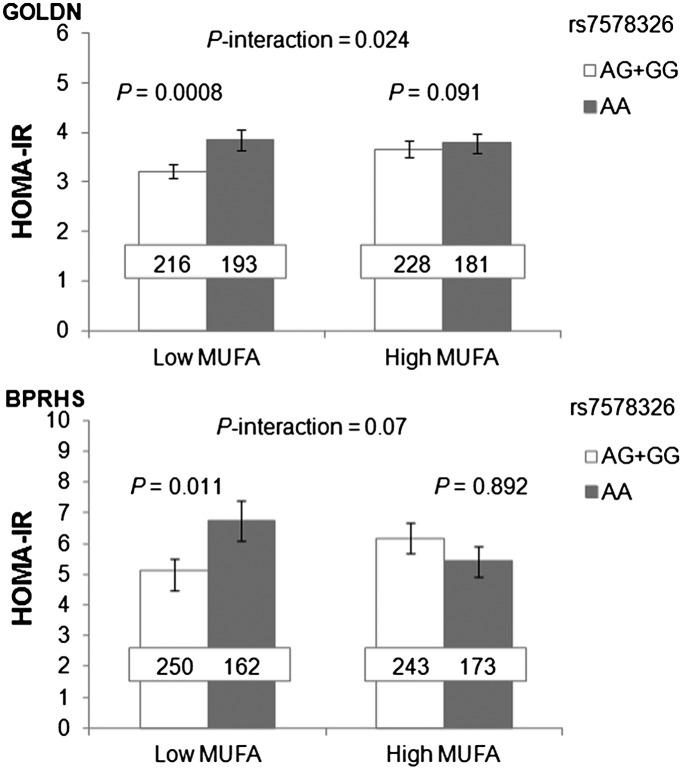
Results: Meta-analysis indicated that rs7578326 G-allele carriers and rs2943641 T-allele carriers had a lower risk of IR, type 2 diabetes, and metabolic syndrome (MetS). Significant interactions on IR and MetS were found for these two variants and their haplotypes with diet. In GOLDN, rs7578326 G-allele carriers and rs2943641 T-allele carriers and their haplotype G-T carriers had a significantly lower risk of IR and MetS than noncarriers only when the dietary saturated fatty acid-to-carbohydrate ratio was low (≤ 0.24). In both GOLDN (P = 0.0008) and BPRHS (P = 0.011), rs7578326 G-allele carriers had a lower risk of MetS than noncarriers only when dietary monounsaturated fatty acids were lower than the median intake of each population.
Conclusions: IRS1 variants are associated with IR and related traits and are modulated by diet in two populations of different ancestries. These findings suggest that IRS1 variants have important functions in various metabolic disorders and that dietary factors could modify these associations.
Figures
References
-
- Centers for Disease Control and Prevention. National Diabetes Fact Sheet: United States 2011 Atlanta, Centers for Disease Control and Prevention, U.S. Department of Health and Human Services, 2011
-
- Shaw JE, Sicree RA, Zimmet PZ. Global estimates of the prevalence of diabetes for 2010 and 2030. Diabetes Res Clin Pract 2010;87:4–14 - PubMed
-
- Grundy SM, Cleeman JI, Daniels SR, et al. American Heart Association. National Heart, Lung, and Blood Institute Diagnosis and management of the metabolic syndrome: an American Heart Association/National Heart, Lung, and Blood Institute Scientific Statement. Circulation 2005;112:2735–2752 - PubMed
Publication types
MeSH terms
Substances
Grants and funding
- R01 HL091357/HL/NHLBI NIH HHS/United States
- P01AG023394/AG/NIA NIH HHS/United States
- P50HL105185/HL/NHLBI NIH HHS/United States
- R01 HL078885/HL/NHLBI NIH HHS/United States
- HL54776/HL/NHLBI NIH HHS/United States
- U01 HL072524/HL/NHLBI NIH HHS/United States
- HL078885/HL/NHLBI NIH HHS/United States
- L60 MD003562/MD/NIMHD NIH HHS/United States
- R01 HL054776/HL/NHLBI NIH HHS/United States
- K08 HL112845/HL/NHLBI NIH HHS/United States
- P50 HL105185/HL/NHLBI NIH HHS/United States
- P01 AG023394/AG/NIA NIH HHS/United States
LinkOut - more resources
Full Text Sources
Other Literature Sources
Medical
Molecular Biology Databases
Miscellaneous
