Review
doi: 10.7812/TPP/12-060.
The treatment of angiocentric glioma: case report and literature review
Affiliations
- PMID: 23596378
- PMCID: PMC3627792
- DOI: 10.7812/TPP/12-060
Item in Clipboard
Review
The treatment of angiocentric glioma: case report and literature review
Perm J.
2013 Winter.
Abstract
Angiocentric glioma is a recently described tumor recognized since 2007 by the World Health Organization Classification of Tumours of the Central Nervous System. We present the only case of angiocentric glioma at our institution in the last 15 years and review the literature in an attempt to establish prognostic parameters. Our search revealed only 27 cases of angiocentric glioma in the literature. The most common presenting symptom of angiocentric glioma was seizures. Gross total resection of the lesion was curative, without need for radiation or chemotherapy.
Figures
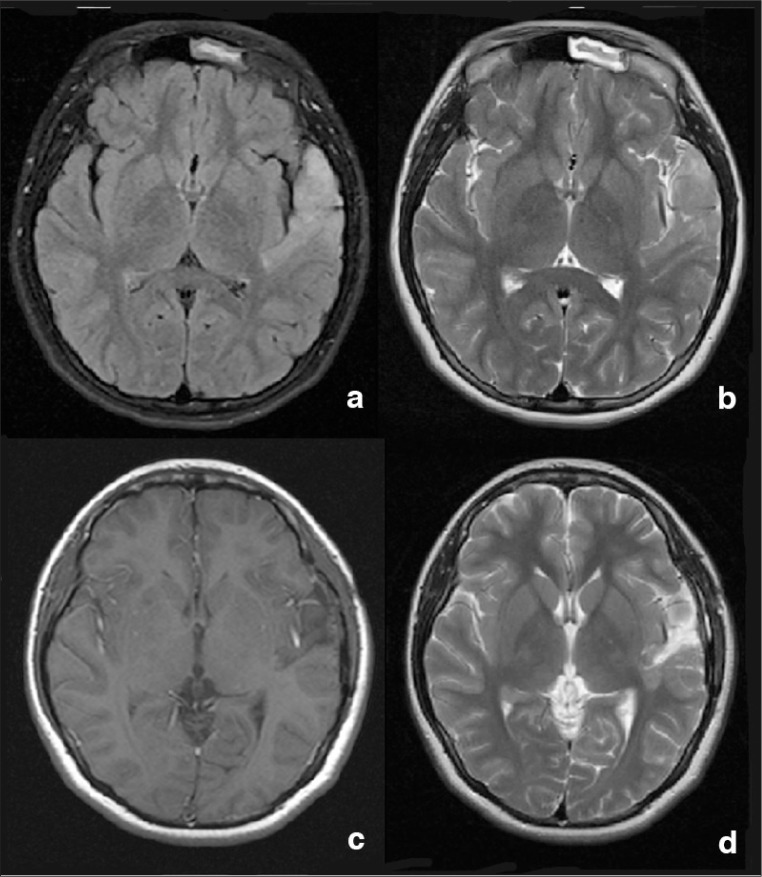
Magnetic resonance imaging of the brain. a) axial fluid-attenuated inversion recovery (FLAIR) MR image showing tumor signal; b) axial T2-weighted MR image obtained at the same level, demonstrating the hyperintense tumor signal; c) postoperative T1-weighted MR image with contrast; and d) postoperative T2 MR image showing complete resection of the tumor.
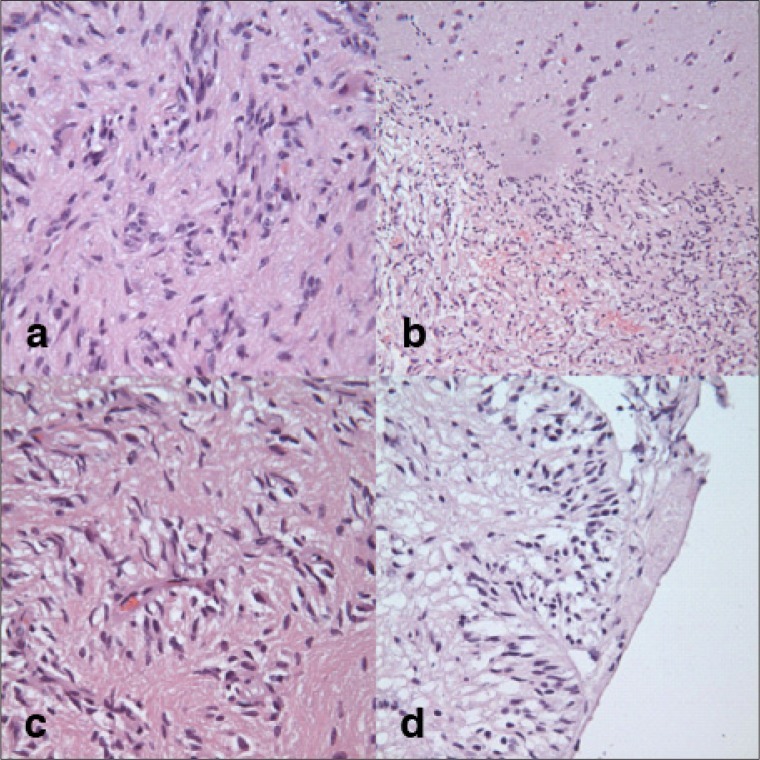
Pathology evaluation of tumor. a) Hematoxylin and eosin stain showing tumor cells; b) interface between the brain and the tumor; c) tumor cells that form pseudorosette type structures around the blood vessels; and d) tumor cells in subpial locations arranged in radial arrays perpendicular to the pial surface.
References
-
- Brat DJ, Scheithauer BW, Fuller GN, Tihan T. Newly codified glial neoplasms of the 2007 WHO Classification of Tumours of the Central Nervous System: angiocentric glioma, pilomyxoid astrocytoma and pituicytoma. Brain Pathol. 2007 Jul;17(3):319–24. DOI: http://dx.doi.org/10.1111/j.1750-3639.2007.00082.x. - DOI - PMC - PubMed
-
- Lellouch-Tubiana A, Boddaert N, Bourgeois M, et al. Angiocentric neuroepithelial tumor (ANET): a new epilepsy-related clinicopathological entity with distinctive MRI. Brain Pathol. 2005 Oct;15(4):281–6. DOI: http://dx.doi.org/10.1111/j.1750-3639.2005.tb00112.x. - DOI - PMC - PubMed
-
- Wang M, Tihan T, Rojiani AM, et al. Monomorphous angiocentric glioma: a distinctive epileptogenic neoplasm with features of infiltrating astrocytoma and ependymoma. J Neuropathol Exp Neurol. 2005 Oct;64(10):875–81. DOI: http://dx.doi.org/10.1097/01.jnen.0000182981.02355.10. - DOI - PubMed
-
- Rho GJ, Kim H, Kim HI, Ju MJ. A case of angiocentric glioma with unusual clinical and radiological features. J Korean Neurosurg Soc. 2011 Jun;49(6):367–9. DOI: http://dx.doi.org/10.3340/jkns.2011.49.6.367. - DOI - PMC - PubMed
-
- Fulton SP, Clarke DF, Wheless JW, Ellison DW, Ogg R, Boop FA. Angiocentric glioma-induced seizures in a 2-year-old child. J Child Neurol. 2009 Jul;24(7):852–6. DOI: http://dx.doi.org/10.1177/0883073808331078. - DOI - PubMed
Publication types
MeSH terms
LinkOut - more resources
Full Text Sources
Other Literature Sources
Medical