Recombinant influenza viruses as delivery vectors for hepatis B virus epitopes
- PMID: 23596580
- PMCID: PMC3623514
- DOI: 10.7774/cevr.2012.1.1.77
Recombinant influenza viruses as delivery vectors for hepatis B virus epitopes
Abstract
Purpose: Neuraminidase (NA) of influenza virus contains stalk region that shows a great deal of variability in both amino acid sequence and length. In this paper, we investigated generation of recombinant influenza viruses that had hepatitis B virus (HBV) B cell epitopes in the NA stalk region as a dual vaccine candidate.
Materials and methods: We used the WSH-HK reassortant helper virus for rescue of recombinant influenza virus containing HBV epitopes and reverse genetic protocol based on the use of micrococcal nuclease-treated virus cores for reconstitution of ribonucleoproteins.
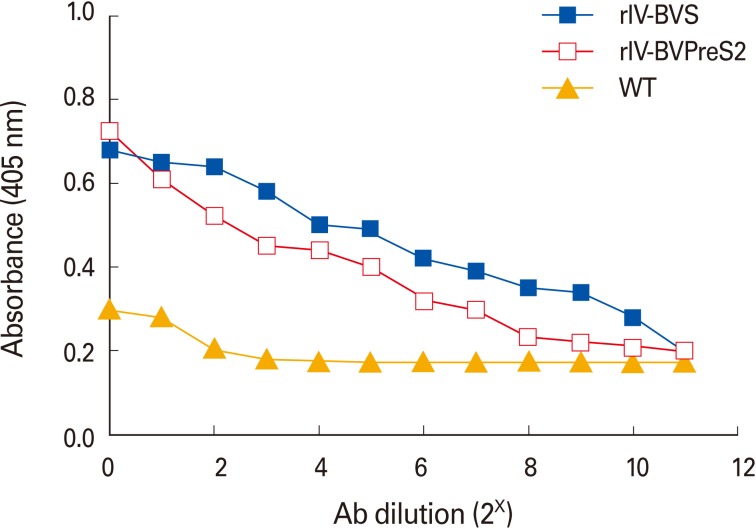
Results: We successfully generated a chimeric influenza viruses which contained 22 amino acid peptides in the stalk region derived from the surface and pre-surface protein HBV. The growth kinetics of the recombinant viruses was investigated after infection of Madin-Darby canine kidney (MDCK) and Madin-Darby bovine kidney (MDBK) cells and the rIV-BVPreS virus showed higher titer than other viruses in MDCK cells. We also confirmed the presence of HBV epitopes in the chimeric viruses by enzyme-linked immunosorbent assay (ELISA) using anti-HBV polyclonal antibody. When the ratio of recombinant virus verse wild type virus was calculated by ELISA, recombinant viruses exhibited 2 fold higher values than the wild type virus.
Conclusion: These results suggest that chimeric influenza virus which contained foreign antigens can be used as dual vaccine against both HBV and influenza viruses.
Keywords: Chimeric virus; Dual vaccine; NA stalk.
Conflict of interest statement
No potential conflict of interest relevant to this article was reported.
Figures



References
-
- Baum C, Schambach A, Bohne J, Galla M. Retrovirus vectors: toward the plentivirus? Mol Ther. 2006;13:1050–1063. - PubMed
-
- Young LS, Searle PF, Onion D, Mautner V. Viral gene therapy strategies: from basic science to clinical application. J Pathol. 2006;208:299–318. - PubMed
-
- Arribillaga L, de Cerio AL, Sarobe P, et al. Vaccination with an adenoviral vector encoding hepatitis C virus (HCV) NS3 protein protects against infection with HCV-recombinant vaccinia virus. Vaccine. 2002;21:202–210. - PubMed
-
- Fournillier A, Gerossier E, Evlashev A, et al. An accelerated vaccine schedule with a poly-antigenic hepatitis C virus MVA-based candidate vaccine induces potent, long lasting and in vivo cross-reactive T cell responses. Vaccine. 2007;25:7339–7353. - PubMed
LinkOut - more resources
Full Text Sources