


Prostate cancer and sexual function
- PMID: 23596596
- PMCID: PMC3623527
- DOI: 10.5534/wjmh.2012.30.2.99
Prostate cancer and sexual function
Abstract
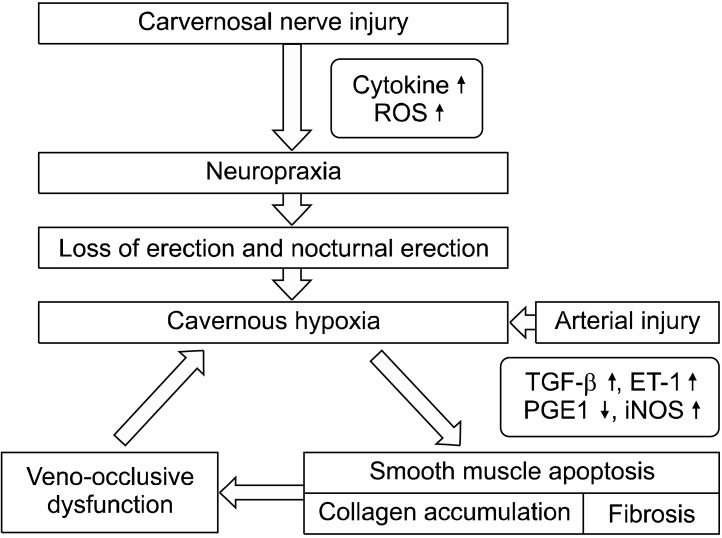
Prostate cancer is now ranked fifth in incidence among cancers in Korean adult males. This is attributable to the more Westernized dietary style which increases the morbidity of prostate cancer and the development of cancer diagnostic technologies, such as prostate-specific antigen and advanced medical systems, increasing the rate of prostate cancer diagnosis. Prostate cancer effects include not only erectile dysfunction caused by the disease itself, but also by psychiatric disorders caused by prostate cancer or its treatments. Prostate cancer by itself reduces sexual desire and the frequency of sexual intercourse. Additionally, surgery or hormonal therapy to block testosterone further increases the frequency of erectile dysfunction. Erectile dysfunction following radical prostatectomy is primarily attributable to nerve injury caused by intraoperative nerve traction, thermal injury, ischemic injury, and local inflammatory reactions. Additionally, the absence of nocturnal penile tumescence causes persistent hypoxia of the corpus cavernosum, which, secondarily, causes anatomical and functional changes in the corpus cavernosum. Preservation of erectile function is one of the most significant issues for patients with local prostate cancer. Erectile dysfunction following radical prostatectomy is known to have various prognoses, depending on preservation of the neurovascular bundle, patient age, and preoperative erectile status. Intracavernosal injections, PDE5 inhibitors, and penile rehabilitation therapy using a vacuum constriction device after radical prostatectomy are known to improve the recovery of erectile function. Recently, testosterone replacement therapy has also drawn attention as a treatment method.
Keywords: Erectile dysfunction; Neoplasms; Prostate; Therapy.
Figures
References
-
- Giovannucci E, Platz EA. Epidemiology of prostate cancer. In: Vogelzang NJ, Scardino PT, Shipley WU, Debruyne FMJ, Linehan WM, editors. Comprehensive textbook of genitourinary oncology. 3rd ed. Philadelphia: Lippincott Williams & Wilkins; 2006. pp. 9–22.
-
- Jemal A, Siegel R, Xu J, Ward E. Cancer statistics, 2010. CA Cancer J Clin. 2010;60:277–300. - PubMed
-
- Kim KI, Chang HJ, Cho YS, Youn TJ, Chung WY, Chae IH, et al. Current status and characteristics of hypertension control in community resident elderly Korean people: data from a Korean longitudinal study on health and aging (KLoSHa study) Hypertens Res. 2008;31:97–105. - PubMed
-
- Seo HK, Chung MK, Ryu SB, Lee KH Korean Urological Oncologic Society Prostate Cancer Study Group. Detection rate of prostate cancer according to prostate-specific antigen and digital rectal examination in Korean men: a nationwide multicenter study. Urology. 2007;70:1109–1112. - PubMed
-
- Song C, Ro JY, Lee MS, Hong SJ, Chung BH, Choi HY, et al. Prostate cancer in Korean men exhibits poor differentiation and is adversely related to prognosis after radical prostatectomy. Urology. 2006;68:820–824. - PubMed
LinkOut - more resources
Full Text Sources