


Intensive cataract training: a novel approach
- PMID: 23598673
- PMCID: PMC3682359
- DOI: 10.1038/eye.2013.54
Intensive cataract training: a novel approach
Abstract
Purpose: To evaluate the safety of an intensive cataract surgery training programme.
Methods: An intensive cataract surgery training programme was implemented in August 2010 for year 3 ophthalmology trainees in the East Midlands Deanery North Rotation (United Kingdom). Trainees participated in extra-ocular surgery and 50 h of virtual reality cataract surgery simulator training over a 2-year period. Their third year comprised 6 months of intensive phacoemulsification training in a tertiary centre followed by a 6-month period of consolidation in a district general hospital. The complication rates and case numbers were evaluated after the first 2 years of implementation.
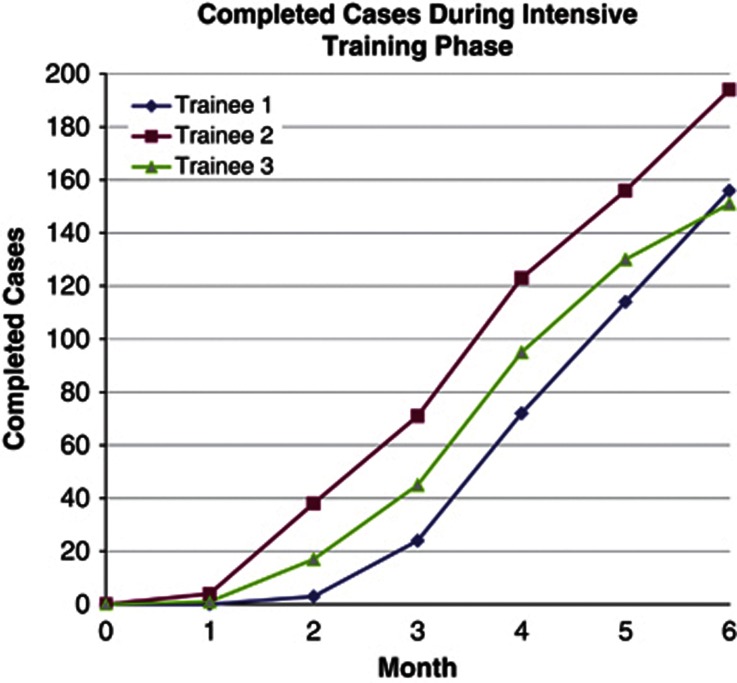
Results: At 2 years, three trainees had completed a full year of intensive training. In the first 6 months of training, Trainee 1 completed 156 cases, Trainee 2 completed 194 cases, and Trainee 3 completed 151 full cases as primary surgeons with an average rate of posterior capsule rupture (PCR) of 1%. At 12 months, Trainee 1 completed 291, Trainee 2 completed 318, and Trainee 3 completed 294 cases, with an average PCR rate of 0.66%. The trainees required 84 lists on average to complete 150 full cataract procedures.
Conclusion: The combination of simulation and the new intensive training programme is safer than the traditional programme for cataract surgery training.
Figures

Comment in
-
Response to Dr Yeo.Eye (Lond). 2014 Feb;28(2):236. doi: 10.1038/eye.2013.269. Epub 2013 Dec 13. Eye (Lond). 2014. PMID: 24336299 Free PMC article. No abstract available.
-
Reply: Intensive cataract training: a novel approach.Eye (Lond). 2014 Feb;28(2):236. doi: 10.1038/eye.2013.268. Epub 2013 Dec 13. Eye (Lond). 2014. PMID: 24336300 Free PMC article. No abstract available.
References
-
- RANZCO. [cited2011. Available from http://www.ranzco.edu/index.php/media-releases/88-the-continuing-evoluti... .
-
- Johnston RL, Taylor H, Smith R, Sparrow JM. The Cataract National Dataset electronic multi-centre audit of 55,567 operations: variation in posterior capsule rupture rates between surgeons. Eye. 2010;24 (5:888–893. - PubMed
-
- Narendran N, Jaycock P, Johnston RL, Taylor H, Adams M, Tole DM, et al. The Cataract National Data set electronic multicentre audit of 55,567 operations: risk stratification for posterior capsule rupture and vitreous loss. Eye. 2009;23 (1:31–37. - PubMed
-
- Henderson BA, Ali R. Teaching and assessing competence in cataract surgery. Curr Opin Ophthalmol. 2007;18 (1:27–31. - PubMed
Publication types
MeSH terms
LinkOut - more resources
Full Text Sources
Other Literature Sources
