. 2013 Jun;172(3):500-6.
doi: 10.1111/cei.12069.

Simultaneous blockade of programmed death 1 and vascular endothelial growth factor receptor 2 (VEGFR2) induces synergistic anti-tumour effect in vivo

Affiliations

Simultaneous blockade of programmed death 1 and vascular endothelial growth factor receptor 2 (VEGFR2) induces synergistic anti-tumour effect in vivo

S Yasuda et al. Clin Exp Immunol. 2013 Jun.

Abstract

Recent basic and clinical studies have shown that the programmed death ligand (PD-L)/PD-1 pathway has a significant role in tumour immunity, and its blockade has a therapeutic potential against several human cancers. We hypothesized that anti-angiogeneic treatment might augment the efficacy of PD-1 blockade. To this end, we evaluated combining the blockade of PD-1 and vascular endothelial growth factor receptor 2 (VEGFR2) in a murine cancer model using Colon-26 adenocarcinoma. Interestingly, simultaneous treatment with anti-PD-1 and anti-VEGFR2 monoclonal antibodies (mAbs) inhibited tumour growth synergistically in vivo without overt toxicity. Blocking VEGFR2 inhibited tumour neovascularization significantly, as demonstrated by the reduced number of microvessels, while PD-1 blockade had no impact on tumour angiogenesis. PD-1 blockade might promote T cell infiltration into tumours and significantly enhanced local immune activation, as shown by the up-regulation of several proinflammatory cytokine expressions. Importantly, VEGFR2 blockade did not interfere with T cell infiltration and immunological activation induced by PD-1 blockade. In conclusion, simultaneous blockade of PD-1 and VEGFR2 induced a synergistic in-vivo anti-tumour effect, possibly through different mechanisms that might not be mutually exclusive. This unique therapeutic strategy may hold significant promise for future clinical application.


Figures

Fig. 1
Fig. 1
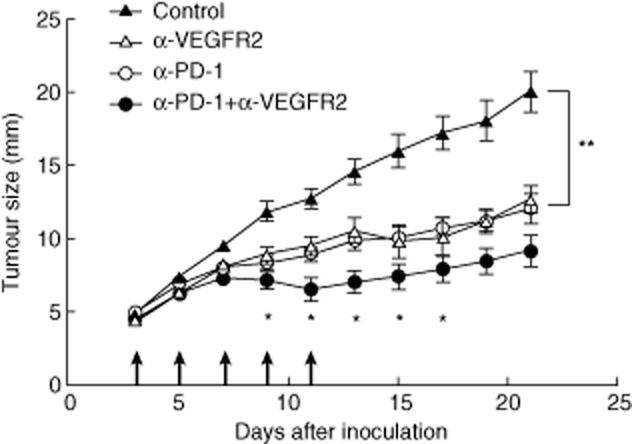
Simultaneous blockade of programmed death (PD)-1 and vascular endothelial growth factor receptor 2 (VEGFR2) induced synergistic anti-tumour effect in vivo. BALB/c mice were inoculated subcutaneously with Colon-26 cells and were given with control rat immunoglobulin (Ig)G, anti-PD-1 monoclonal antibody (mAb), anti-VEGFR2 mAb or both mAbs five times (arrow). Data are presented as mean ±standard error of seven to 10 mice of each group. *P < 0·05; **P < 0·01.
Fig. 2
Fig. 2
Programmed death (PD)-1and vascular endothelial growth factor receptor 2 (VEGFR2) blockade did not have any direct effect on cancer cell growth in vitro. A total of 3000 Colon-26 cells were co-cultured with anti-PD-1 monoclonal antibody (mAb), anti-VEGFR2 mAb or control rat immunoglobulin (Ig)G for 72 h, and cell proliferation was determined by MTS assay.
Fig. 3
Fig. 3
Treatment with anti-vascular endothelial growth factor receptor 2 (VEGFR2) monoclonal antibody (mAb) inhibited tumour neovascularization. (a) Immunohistochemistry analysis by staining with CD34. Representative tumours from mice treated with control rat IgG, anti-programmed death (PD)-1 mAb, anti-VEGFR2 mAb or both mAbs. (b) Tumour microvessels were counted at ×200 magnification. Data are collected from four to seven mice of each group. *P < 0·01; **P < 0·001.
Fig. 4
Fig. 4
(a) Immunohistochemical staining of CD4+ and (b) CD8+ T cells in tumour tissue at day 11. Representative pictures of mice for each treatment are shown. Programmed death (PD)-1 blockade and combination treatment seemed to induce more CD4+ and CD8+ T cell infiltration compared to control and vascular endothelial growth factor receptor 2 (VEGFR2) blockade. (c) Quantification of tumour-infiltrating CD4+ and (d) CD8+ T cells by real-time polymerase chain reaction (PCR). There was a tendency towards increased T cell infiltration by the treatment of anti-PD-1 monoclonal antibody (mAb) and combination treatment. Anti-VEGFR2 mAb treatment did not interfere with T cell infiltration. Data are collected from four to seven mice of each group.
Fig. 5
Fig. 5
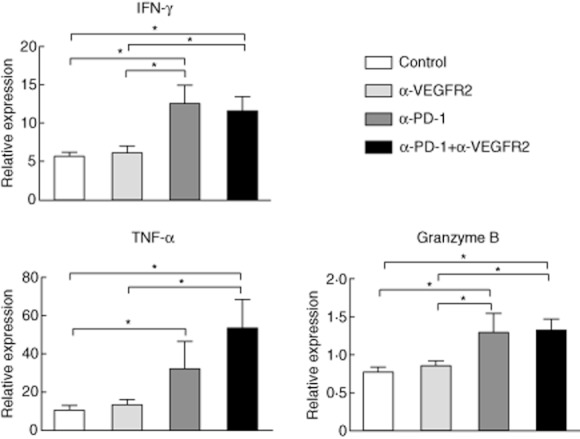
Expression of interferon (IFN)-γ, tumour necrosis factor (TNF)-α and granzyme B was up-regulated significantly by anti-programmed death (PD)-1 monoclonal antibody (mAb) or combination mAb treatment compared with control. Treatment of anti-VEGFR2 mAb alone did not increase each cytokine expression. Data are collected from four to seven mice of each group. *P < 0·05.

References

    1. Vesely MD, Kershaw MH, Schreiber RD, Smyth MJ. Natural innate and adaptive immunity to cancer. Annu Rev Immunol. 2011;29:235–271. - PubMed
    1. Schwartz RH. Costimulation of T lymphocytes: the role of CD28, CTLA-4, and B7/BB1 in interleukin-2 production and immunotherapy. Cell. 1992;71:1065–1068. - PubMed
    1. Lenschow DJ, Walunas TL, Bluestone JA. CD28/B7 system of T cell costimulation. Annu Rev Immunol. 1996;14:233–258. - PubMed
    1. Hodi FS, O'Day SJ, McDermott DF, et al. Improved survival with ipilimumab in patients with metastatic melanoma. N Engl J Med. 2010;363:711–723. - PMC - PubMed
    1. Greenwald RJ, Freeman GJ, Sharpe AH. The B7 family revisited. Annu Rev Immunol. 2005;23:515–548. - PubMed

Publication types

MeSH terms

Substances