


Pseudomonas aeruginosa disrupts Caenorhabditis elegans iron homeostasis, causing a hypoxic response and death
- PMID: 23601103
- PMCID: PMC3641844
- DOI: 10.1016/j.chom.2013.03.003
Pseudomonas aeruginosa disrupts Caenorhabditis elegans iron homeostasis, causing a hypoxic response and death
Abstract
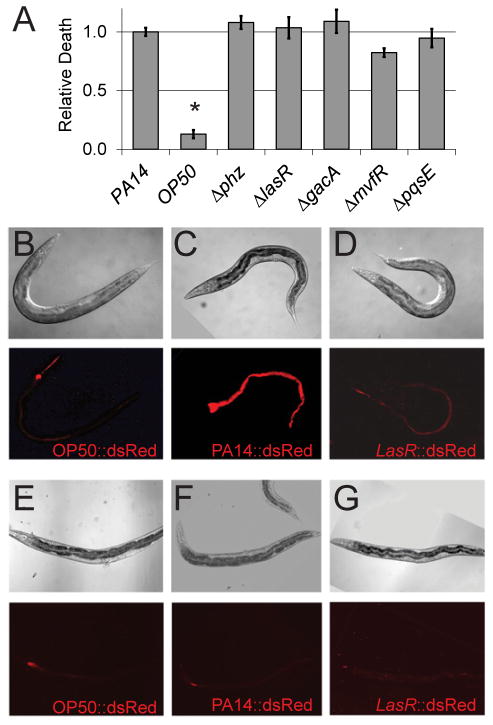
The opportunistic pathogen Pseudomonas aeruginosa causes serious human infections, but effective treatments and the mechanisms mediating pathogenesis remain elusive. Caenorhabditis elegans shares innate immune pathways with humans, making it invaluable to investigate infection. To determine how P. aeruginosa disrupts host biology, we studied how P. aeruginosa kills C. elegans in a liquid-based pathogenesis model. We found that P. aeruginosa-mediated killing does not require quorum-sensing pathways or host colonization. A chemical genetic screen revealed that iron chelators alleviate P. aeruginosa-mediated killing. Consistent with a role for iron in P. aeruginosa pathogenesis, the bacterial siderophore pyoverdin was required for virulence and was sufficient to induce a hypoxic response and death in the absence of bacteria. Loss of the C. elegans hypoxia-inducing factor HIF-1, which regulates iron homeostasis, exacerbated P. aeruginosa pathogenesis, further linking hypoxia and killing. As pyoverdin is indispensable for virulence in mice, pyoverdin-mediated hypoxia is likely to be relevant in human pathogenesis.
Copyright © 2013 Elsevier Inc. All rights reserved.
Figures



References
-
- Baldwin DA, Jenny ER, Aisen P. The effect of human serum transferrin and milk lactoferrin on hydroxyl radical formation from superoxide and hydrogen peroxide. The Journal of biological chemistry. 1984;259:13391–13394. - PubMed
-
- Bumann D. Has nature already identified all useful antibacterial targets? Current opinion in microbiology. 2008;11:387–392. - PubMed
Publication types
MeSH terms
Substances
Grants and funding
LinkOut - more resources
Full Text Sources
Other Literature Sources
Medical
Research Materials
