


Pro-tobacco influences and susceptibility to smoking cigarettes among middle and high school students--United States, 2011
- PMID: 23601611
- PMCID: PMC4610118
- DOI: 10.1016/j.jadohealth.2012.07.007
Pro-tobacco influences and susceptibility to smoking cigarettes among middle and high school students--United States, 2011
Abstract
Purpose: Smoking is a leading cause of cancer, and most smokers begin during adolescence. We examined the proportion of adolescents exposed to pro-tobacco advertising and assessed the association between this exposure and susceptibility to smoking.
Methods: Data from the 2011 National Youth Tobacco Survey were used to calculate the proportion of susceptible middle school (MS) and high school (HS) students exposed to pro-tobacco advertisements through stores, magazines, and the Internet. Following previous work, susceptibility to smoking cigarettes was defined as "never smoked but open to trying cigarettes."
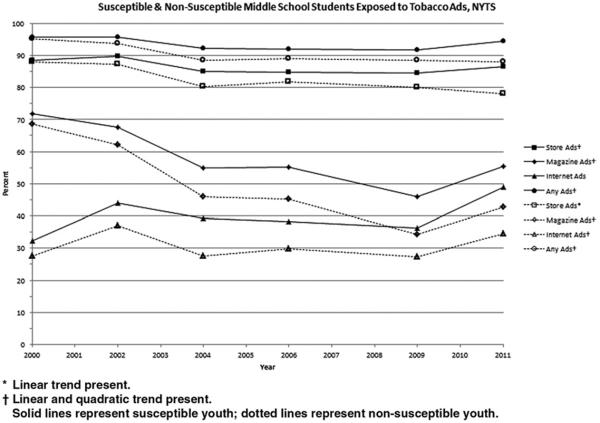
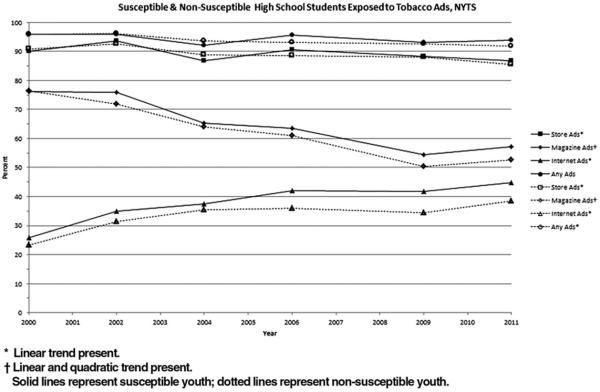
Results: In 2011, 81.5% of MS students and 86.9% of HS students were exposed to tobacco advertisements in stores; 48.2% of MS students and 54.0% of HS students were exposed to such advertising in magazines. Exposure to tobacco advertisements on the Internet was similar for MS (40.8%) and HS students (40.2%). Of those surveyed, 22.5% of MS students and 24.2% of HS students were susceptible to trying cigarettes. Exposure to magazine advertising declined from 71.8% in 2000 to 46.1% in 2009 among susceptible MS students; however, exposure increased to 55.4% in 2011. Tobacco advertising seen through the Internet among susceptible HS students increased from 25.9% in 2000 to 44.7% in 2011.
Conclusions: Adolescents continue to be exposed to pro-tobacco advertisements. Adolescents susceptible to smoking are more likely to report exposure to pro-tobacco advertisements. In addition to continued monitoring, more effective interventions to eliminate youth exposure to pro-tobacco marketing are needed.
Published by Elsevier Inc.
Figures
References
-
- U.S. Department of Health and Human Services . The health consequences of smoking: A report of the surgeon general. Centers for Disease Control and Prevention; Atlanta, GA: [Accessed January 11, 2012]. 2004. Available at: http://www.cdc.gov/tobacco/data_statistics/sgr/2004/index.htm. - PubMed
-
- U.S. Department of Health and Human Services . How tobacco smoke causes disease: The biology and behavioral basis for smoking-attributable disease. Centers for Disease Control and Prevention; Atlanta, GA: [Accessed January 11, 2012]. 2010. Available at: http://www.cdc.gov/tobacco/data_statistics/sgr/2010/index.htm. - PubMed
-
- Centers for Disease Control and Prevention Smoking-attributable mortality, years of potential life lost, and productivity losses—United States, 2000–2004. MMWR Morb Mortal Wkly Rep. 2008;57:1226–8. - PubMed
-
- U.S. Department of Health and Human Services . Preventing tobacco use among youth and young adults: A report of the surgeon general. U.S. Department of Health and Human Services, Centers for Disease Control and Prevention, National Center for Chronic Disease Prevention and Health Promotion, Office on Smoking and Health; Atlanta, GA: 2012.
-
- Centers for Disease Control and Prevention Cigarette use among high school students—United States, 1991–2009. MMWR Morb Mortal Wkly Rep. 2010;59:797–801. - PubMed
Publication types
MeSH terms
Grants and funding
LinkOut - more resources
Full Text Sources
Other Literature Sources
Medical
