


Comparison of clot-based, chromogenic and fluorescence assays for measurement of factor VIII inhibitors in the US Hemophilia Inhibitor Research Study
- PMID: 23601690
- PMCID: PMC4477744
- DOI: 10.1111/jth.12259
Comparison of clot-based, chromogenic and fluorescence assays for measurement of factor VIII inhibitors in the US Hemophilia Inhibitor Research Study
Abstract
Background: Detection and validation of inhibitors (antibodies) to hemophilia treatment products are important for clinical care, evaluation of product safety and assessment of population trends.
Methods: Centralized monitoring for factor VIII (FVIII) inhibitors was conducted for patients in the Hemophilia Inhibitor Research Study using a previously reported modified Nijmegen-Bethesda clotting assay (NBA), a chromogenic Bethesda assay (CBA) and a novel fluorescence immunoassay (FLI).
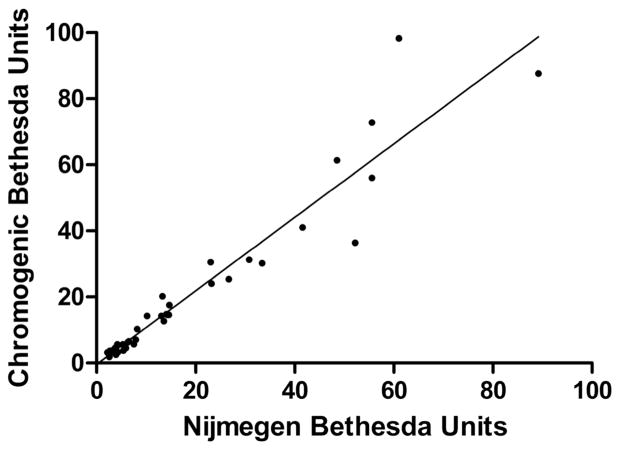
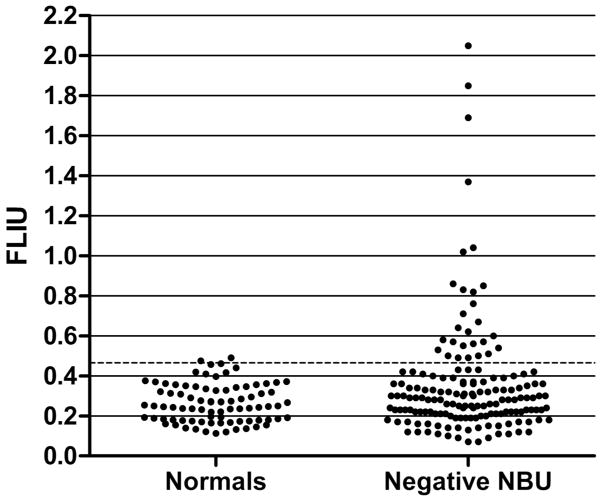
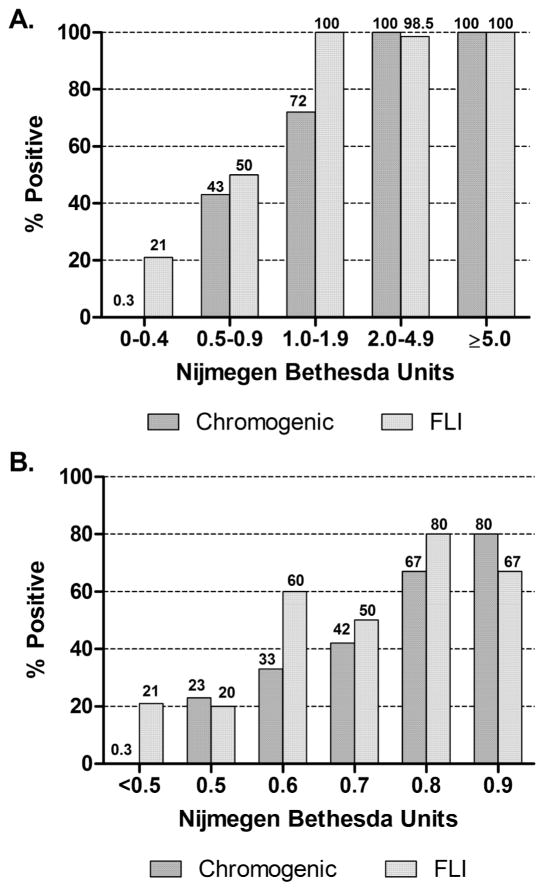
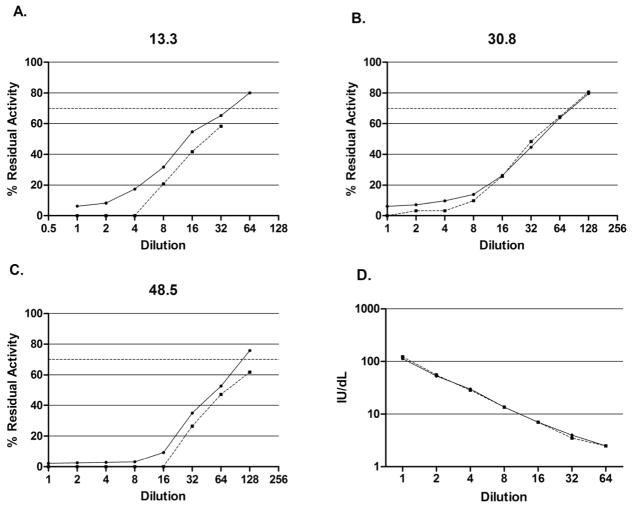
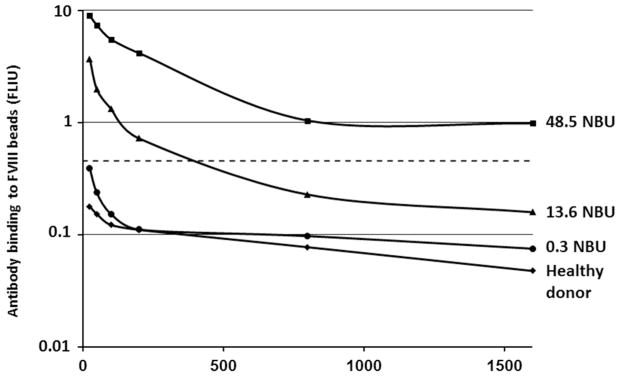
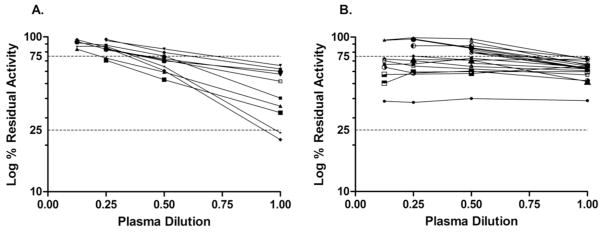
Results: NBA and CBA were performed on 1005 specimens and FLI on 272 specimens. CBA was negative on 880/883 specimens (99.7%) with Nijmegen-Bethesda units (NBU) < 0.5 and positive on 42/42 specimens (100%) with NBU ≥ 2.0 and 43/80 specimens (53.8%) with NBU 0.5-1.9. Among specimens with positive NBA and negative CBA, 58.1% were FLI negative, 12.9% had evidence of lupus anticoagulant, and 35.5% had non-time-dependent inhibition. CBA and FLI were positive on 72.4% and 100% of 1.0-1.9 NBU specimens and 43.1% and 50.0% of 0.5-0.9 NBU specimens. FLI detected antibodies in 98.0% of CBA-positive and 81.6% of NBA-positive specimens (P = 0.004). Among 21 new inhibitors detected by NBA, five (23.8%) with 0.7-1.3 NBU did not react in CBA or FLI. Among previously positive patients with 0.5-1.9 NBU, 7/25 (28%) were not CBA or FLI positive. FLI was positive on 36/169 NBU-negative specimens (21.3%).
Conclusions: FVIII specificity could not be demonstrated by CBA or FLI for 26% of inhibitors of 0.5-1.9 NBU; such results must be interpreted with caution. Low titer inhibitors detected in clot-based assays should always be repeated, with consideration given to evaluating their reactivity with FVIII using more specific assays.
Keywords: factor VIII; factor VIII inhibitor; hemophilia A; immunology and fluorescence immunoassay.
© 2013 International Society on Thrombosis and Haemostasis.
Figures
References
-
- Biggs R, Bidwell E. A method for the study of antihaemophilic globulin inhibitors with reference to six cases. Br J Haematol. 1959;5:379–95. - PubMed
-
- Nuss R, Jacobson L, Hathaway WE, Manco-Johnson M Recombinate PUP Study Group. Evidence for antiphospholipid antibodies in children with factor VIII inhibitors. Thromb Haemost. 1999;82:1559–60. - PubMed
-
- Blanco AN, Peirano AA, Grosso SH, Gennari LC, Perez Blanco R, Lazzari MA. A chromogenic substrate method for detecting and titrating anti-factor VIII antibodies in the presence of lupus anticoagulants. Haematologica. 2002;87:271–8. - PubMed
-
- Shaw PH, Reynolds S, Gunawardena S, Krishnamurti L, Ritchey AK. The prevalence of bleeding disorders among healthy pediatric patients with abnormal preprocedural coagulation studies. J Pediatr Hematol Oncol. 2008;30:135–41. - PubMed
-
- Manco-Johnson MJ, Nuss R, Jacobson LJ. Heparin neutralization is essential for accurate measurement of factor VIII activity and inhibitor assays in blood samples drawn from implanted venous access devices. J Lab Clin Med. 2000;136:74–9. - PubMed
Publication types
MeSH terms
Substances
Grants and funding
LinkOut - more resources
Full Text Sources
Other Literature Sources
Medical
Miscellaneous
